
Foil-Effect Labels · Metallic
The metal shows through the design, not around it
The short answer: print in full colour on a metallised paper and the ink behaves like a filter — dark areas hide the metal, pale areas let it shine through. You get gradients that glow and highlights that move with the light, from a single printing pass and without a stamping die. From £182 per 100.
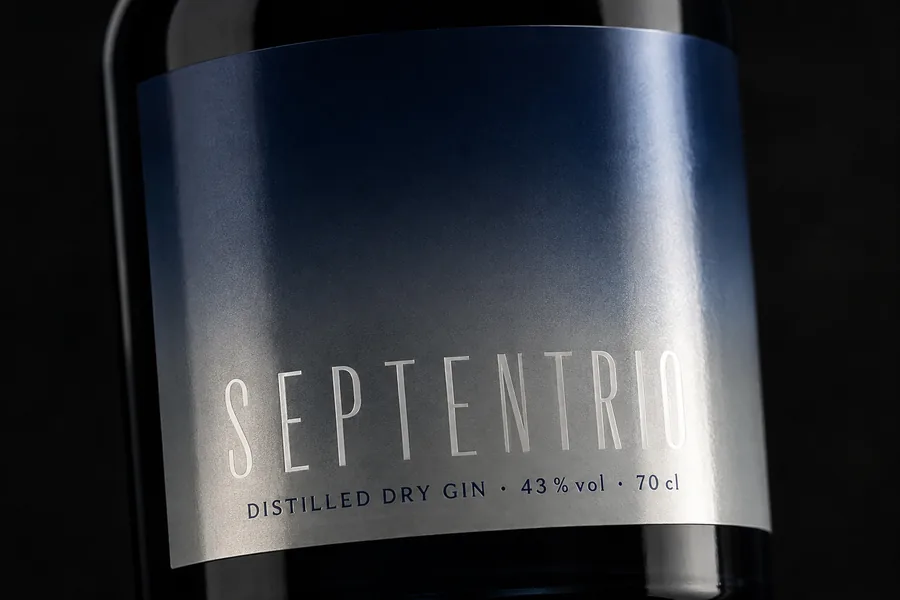
Any shape within this size — rectangle, round, oval or custom die-cut.
VAT invoice · card or bank transfer · proof before production · ±5 % quantity tolerance
- Printing
- 1 option
- Protection
- 2 options
- Adhesives
- 1
- Sizes
- 16 formats
- Smallest
- 35 × 30 mm
- Largest
- 100 × 105 mm
- Quantities
- 100 → 10 000, more quoted
- Variable data
- quoted on request
Printed from £182 per 100. Production 4 to 10 working days after proof approval.
How it differs from hot foil
One is printed, the other is pressed
Hot foil stamps a solid sheet of metal exactly where a die touches: brilliant, opaque, slightly raised, and limited to the shapes the die can cut. It costs about £165 more per hundred and it is the right answer for a name, a crest or a border.
Foil-effect printing works the other way. The metal is already there, under the whole label, and the ink decides where it shows: a gradient fading from dense to transparent produces a metallic gradient — something a stamping die physically cannot do. It is a normal four-colour job, so an illustration with fifty shades of metal costs exactly the same as a flat one.
The trade-off is subtlety. Foil is unmistakable at three metres; foil-effect is a shimmer that rewards picking the bottle up. On a shelf, that is a real difference.
- Foil-effect
- printed, from £182 / 100
- Hot foil
- pressed, +£165 / 100
- Gradients
- only foil-effect
- Relief
- only hot foil
- Brightness
- hot foil wins
- Design freedom
- foil-effect wins
- Protection
- lamination included
Designing for it
Think in transparency, not in colour
The useful mental model is a stained-glass window: every ink is a filter over a metal sheet. Three consequences worth knowing before the artwork is drawn —
Dark = matt, pale = shiny
A dense black area hides the metal completely and reads as ordinary print. Leave the areas you want to glow light, or empty.
White has to be printed
There is no white ink by default and the ground is metal, so anything that must be truly white needs an opaque white layer underneath.
Ask for a proof, and turn it
A metallic effect cannot be judged on a screen: it changes with the angle. This is the one range where looking at the physical proof genuinely matters.
Price by quantity
What a run actually costs
Up to 55 × 70 mm, full colour, gloss lamination — die, setup and printing included.
| Quantity | Run price | Per label |
|---|---|---|
| 100 | £213 | £2.13 |
| 200 | £220 | £1.10 |
| 300 | £228 | £0.76 |
| 500 | £236 | £0.47 |
| 1 000 | £272 | £0.27 |
| 1 500 | £300 | £0.20 |
| 2 000 | £336 | £0.17 |
| 3 000 | £395 | £0.14 |
| 5 000 | £533 | £0.11 |
| 10 000 | £876 | £0.085 |
Excluding VAT and delivery. Other sizes, finishes and quantities are priced in the configurator above.
Where it is used
Products that take this material
FAQ
Foil-effect — what customers ask us
What is foil-effect printing exactly?
Four-colour printing on a metallised paper. The inks are transparent, so they act as filters over the metal: dark areas cover it, pale areas let it shine through. The result looks like a foiled label with gradients, produced in a single printing pass.
Is it the same as hot foil?
No. Hot foil presses a solid metal film exactly where a die touches — brighter, slightly raised, limited to simple shapes, and about £165 more per hundred. Foil-effect is printed, so it handles gradients and illustrations that no die could reproduce, at the cost of some brilliance.
Can I mix the two?
Yes, on a textured paper: a foiled name over a printed design is a common spirits layout. On a metallic ground, though, adding foil is usually invisible — the label is already metal, so there is no contrast for the foil to work against.
Does a complex illustration cost more?
No. It is standard four-colour printing, so a fifty-shade metallic illustration costs the same as a flat two-colour design. Only material, size, finish and quantity change the price.
Will it look like the screen mock-up?
Never exactly, and that is inherent: a screen emits light while a metallic label reflects it, and the effect changes as the bottle turns. Order the proof and look at it under the light the product will actually sit in.
Metallic gradients, from a single print pass.
Full colour on metallised paper, from £182 per 100.