
High-Temperature Labels · Functional
Through the reflow oven, and still readable
The short answer: polyimide is the film that goes where every other material shrinks, chars or lets go — rated to +250 °C, which covers a soldering reflow cycle, an engine bay and a heating element. From £162 per 100, in sizes down to 30 × 30 mm.
Any shape within this size — rectangle, round, oval or custom die-cut.
VAT invoice · card or bank transfer · proof before production · ±5 % quantity tolerance
- Printing
- 1 option
- Protection
- 1 option
- Adhesives
- 1
- Sizes
- 17 formats
- Smallest
- 30 × 30 mm
- Largest
- 140 × 105 mm
- Quantities
- 100 → 10 000, more quoted
- Variable data
- quoted on request
Printed from £162 per 100. Production 4 to 10 working days after proof approval.
Where the temperature is really spent
It is the process, not the product, that decides
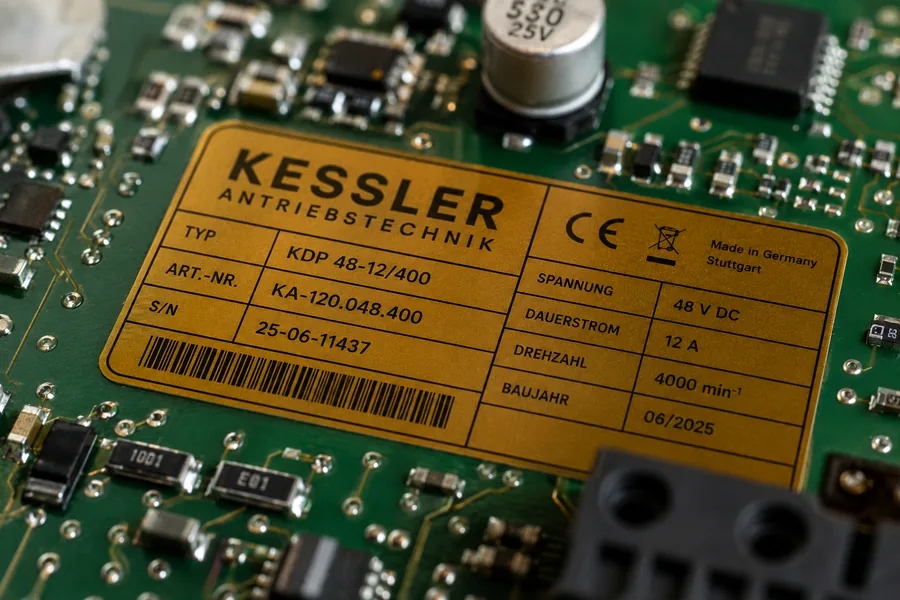
Most high-temperature requests are not about a product that lives hot — they are about a product that goes through something hot once. A circuit board sees 250 °C for a few minutes in reflow and then spends its life at room temperature, but the label has to be applied before the oven and be readable after it. That is exactly what polyimide is for.
Two practical points. The label must be legible after the process, so the print is heat-cured rather than laminated. And the smallest standard size here is 30 × 30 mm, which is generous for a board — for component and cable marking, the industrial films go down to 15 × 20 mm.
- Polyimide
- up to +250 °C
- Standard films
- up to about +80 °C
- Washable paper
- 80 °C, wet
- Freezer film
- down to −40 °C
- Cryogenic
- down to −196 °C
- Smallest size
- 30 × 30 mm
- From
- £162 / 100
Price by quantity
What a run actually costs
Up to 30 × 30 mm, full colour, unprotected — die, setup and printing included.
| Quantity | Run price | Per label |
|---|---|---|
| 100 | £162 | £1.62 |
| 200 | £170 | £0.86 |
| 300 | £180 | £0.60 |
| 500 | £192 | £0.38 |
| 1 000 | £234 | £0.24 |
| 1 500 | £270 | £0.18 |
| 2 000 | £311 | £0.15 |
| 3 000 | £384 | £0.13 |
| 5 000 | £547 | £0.11 |
| 10 000 | £953 | £0.093 |
Excluding VAT and delivery. Other sizes, finishes and quantities are priced in the configurator above.
Where it is used
Products that take this material
FAQ
High temperature — what engineers ask us
What temperature can it actually take?
Up to +250 °C, which covers a lead-free reflow profile, engine-bay components and heating elements. Standard films stop around +80 °C — the gap between the two is the whole reason this material exists.
Does the barcode survive the oven?
That is the point of the material and of the heat-cured print: the label comes out of reflow scannable. It is why electronics assembly uses polyimide rather than a laminated film, whose lamination would blister.
How small can it be cut?
Down to 30 × 30 mm as standard on this film. For smaller marking — components, cables, connectors — the industrial polyester films go to 15 × 20 mm, the smallest die in the catalogue, though they are not rated for reflow.
Can each label carry a serial number?
Yes. Sequential numbers, barcodes and unique QR codes are printed in the run from 100 labels — the standard specification for board-level traceability. See numbered labels.
Is it also chemically resistant?
Polyimide handles solvents and cleaning agents well, which matters after soldering. For labelling chemical containers themselves, the sizing rules and materials are different — see chemical & GHS labels.
+250 °C, and the barcode still scans.
White polyimide film, from £162 per 100.