
Special Application Labels · Industrial & security
For the surfaces that reject labels
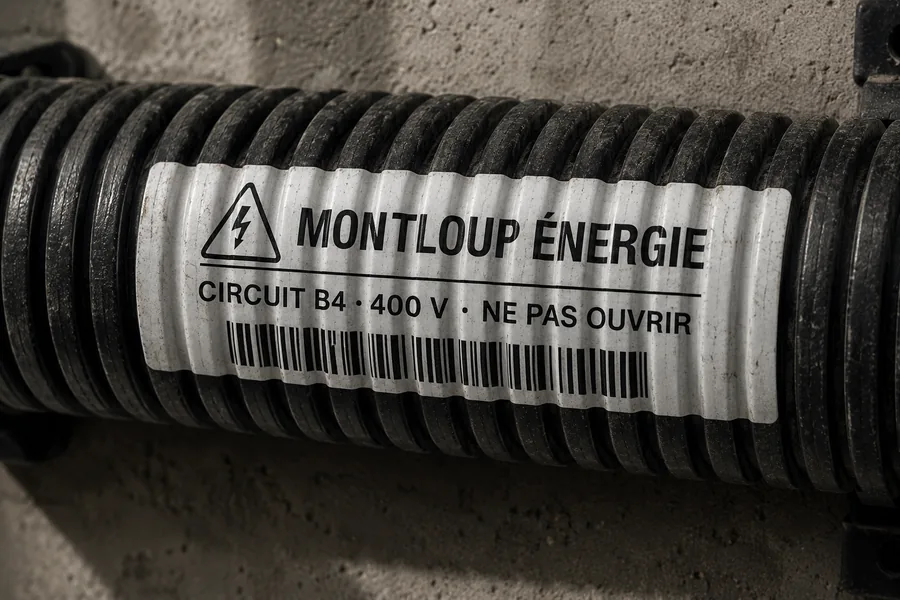
The short answer: some surfaces defeat ordinary labels — a tyre sidewall, a ribbed cable duct, a powder-coated housing, a part with a trace of oil on it. This heavy-duty polyethylene film is thicker and far more flexible than a polyester, with a reinforced adhesive that grabs where a standard one only touches the high points. From €249 per 100.
Any shape within this size — rectangle, round, oval or custom die-cut.
VAT invoice · card or bank transfer · proof before production · ±5 % quantity tolerance
- Printing
- 1 option
- Protection
- 1 option
- Adhesives
- 2
- Sizes
- 16 formats
- Smallest
- 35 × 30 mm
- Largest
- 100 × 105 mm
- Quantities
- 100 → 10 000, more quoted
- Variable data
- quoted on request
Printed from €249 per 100. Production 4 to 10 working days after proof approval.
Diagnosing the surface
Four reasons a label lifts, and only one is the glue
The surface is textured. A rigid film touches the peaks and bridges the valleys — real contact might be half the label area. A thick, flexible film sinks into the texture.
The surface is low-energy. Polypropylene and polyethylene containers, and anything with mould release agent still on it, repel ordinary adhesives. A reinforced adhesive and a clean wipe change everything.
The part moves or vibrates. A rigid label transmits every movement to the adhesive line; a flexible one absorbs it.
It was applied cold. Below about +10 °C an adhesive never flows enough to wet the surface. This is the most common cause, and it costs nothing to fix.
- Film
- thick polyethylene
- Adhesive
- reinforced
- Printing
- full colour
- Protection
- none — the film is the barrier
- Surfaces
- textured, curved, low-energy
- Sizes
- up to 100 × 105 mm
- From
- €249 / 100
Being honest about the limits
Some applications are quoted, not configured
This film covers most awkward surfaces. What it does not cover, we would rather name: labels vulcanised into a tyre during manufacture, labels immersed for months in solvent, and anything requiring a certified standard such as BS5609 for sea freight. Those are specified case by case — send the application and we come back with a material and a price, or with the reason it cannot be done.
Price by quantity
What a run actually costs
Up to 55 × 70 mm, full colour, unprotected — die, setup and printing included.
| Quantity | Run price | Per label |
|---|---|---|
| 100 | €249 | €2.49 |
| 200 | €253 | €1.27 |
| 300 | €258 | €0.86 |
| 500 | €259 | €0.52 |
| 1 000 | €281 | €0.28 |
| 1 500 | €294 | €0.20 |
| 2 000 | €315 | €0.16 |
| 3 000 | €348 | €0.12 |
| 5 000 | €431 | €0.086 |
| 10 000 | €638 | €0.064 |
Excluding VAT and delivery. Other sizes, finishes and quantities are priced in the configurator above.
Where it is used
Products that take this material
FAQ
Awkward surfaces — what engineers ask us
Why does my label lift on a moulded plastic housing?
Usually two reasons at once: the surface is textured, so a rigid film only touches the high points, and moulded parts often carry a residue of release agent that repels adhesives. A thick flexible film plus a reinforced adhesive plus a wipe of the surface fixes almost every case.
Does it stick to tyres?
To a cured tyre sidewall, with a reinforced adhesive and a clean surface, for the purposes of marking and handling — yes. Labels that are vulcanised into the rubber during manufacture are a different product entirely and are quoted case by case.
Is it printable in full colour?
Yes, in four colours. It is supplied without a lamination: the film itself is the barrier, and adding a coating to a material chosen for its flexibility works against it.
What is the difference with the polyethylene product labels?
Thickness and intent. The protected polyethylene at €199 is a product label for squeezable bottles and jerricans. This one is thicker, industrial, and specified for surfaces and environments rather than for shelves.
Can you certify it for marine transport?
BS5609 is a defined standard covering film, adhesive and printing method together, and we quote it as a specification rather than assuming it. Tell us the container and the route — see chemical & GHS labels.
Tell us the surface. That is the whole question.
Heavy-duty polyethylene film, from €249 per 100.