
Sugarcane Fibre Labels · Eco-friendly
Paper made from what is left after the sugar
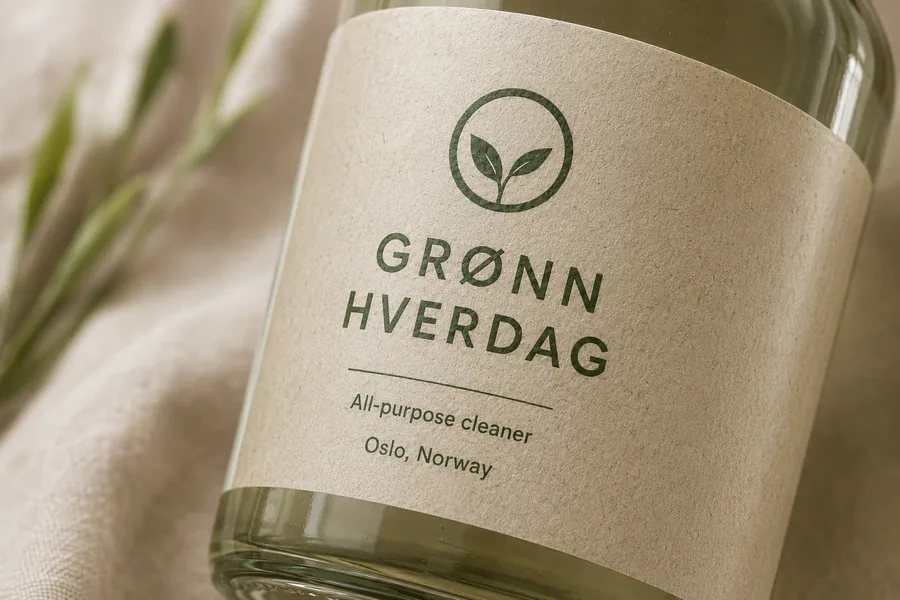
The short answer: bagasse is the fibrous residue left when sugarcane has been pressed — an agricultural by-product, produced in quantity whether anyone uses it or not. Made into label paper it gives a warm, faintly irregular off-white sheet, and at €170 per 100 it is the least expensive material in the eco range.
Any shape within this size — rectangle, round, oval or custom die-cut.
VAT invoice · card or bank transfer · proof before production · ±5 % quantity tolerance
- Printing
- 1 option
- Protection
- 1 option
- Adhesives
- 2
- Sizes
- 16 formats
- Smallest
- 35 × 30 mm
- Largest
- 100 × 105 mm
- Quantities
- 100 → 10 000, more quoted
- Variable data
- quoted on request
Printed from €170 per 100, unprinted on rolls from €66. Production 4 to 10 working days after proof approval.
The claim you can actually make
By-product, not a sacrifice
The argument for bagasse is unusually clean: the cane is grown for sugar, the fibre is what remains afterwards, and it is produced in enormous quantity regardless. Using it displaces wood pulp without creating a new crop — which is a sentence you can print on a pack and defend in front of a customer.
What it is not: compostable at home, recyclable everywhere, or carbon-neutral. If your packaging claim needs to go further than « made from an agricultural by-product », say so and we will point you at the material that actually supports it — usually the cellulose films with a biodegradable adhesive.
- Sugarcane fibre
- €170 / 100
- Bio-based PE
- €208 / 100
- Recycled white
- €212 / 100
- Stone paper
- €212 / 100
- Cellulose film
- €242 / 100
- Grass paper
- €243 / 100
- Plain coated, for reference
- €137 / 100
Printing on it
Warm, absorbent, and better for two colours than for four
Bagasse is uncoated and slightly absorbent, so ink sits into the sheet rather than on top of it. Solid colours come out a shade softer than on coated white, photographs lose contrast, and fine 5-point type thickens very slightly. Type, line drawings and one or two flat colours look excellent — which is how most producers who choose this paper design anyway.
A dry-gum version exists at €267 per 100: the adhesive is activated with water rather than pre-applied, for producers who want a fully separable paper label. Ask for it in a custom request — it is not in the standard configurator.
Price by quantity
What a run actually costs
Up to 55 × 70 mm, full colour, unprotected — die, setup and printing included.
| Quantity | Run price | Per label |
|---|---|---|
| 100 | €204 | €2.04 |
| 200 | €209 | €1.05 |
| 300 | €213 | €0.71 |
| 500 | €216 | €0.43 |
| 1 000 | €238 | €0.24 |
| 1 500 | €252 | €0.17 |
| 2 000 | €273 | €0.14 |
| 3 000 | €307 | €0.10 |
| 5 000 | €390 | €0.078 |
| 10 000 | €597 | €0.060 |
Excluding VAT and delivery. Other sizes, finishes and quantities are priced in the configurator above.
FAQ
Sugarcane — what brands ask us
What exactly is bagasse?
The fibre left over when sugarcane has been crushed for its juice. It is an agricultural residue produced in vast quantity, so turning it into paper displaces wood pulp without planting anything new — which is what makes the claim easy to defend.
Is it compostable?
Not certified as such, and we would rather say so. It is a paper made from an agricultural by-product; the adhesive on the standard version is a conventional permanent. If home compostability is the requirement, look at the cellulose films and ask for the biodegradable adhesive explicitly.
Does it look recycled?
It looks natural rather than recycled: a warm off-white with a faint irregularity in the surface, closer to a fine kraft than to the grey-flecked look of recycled white. Customers usually describe it as soft rather than rough.
Can I print photographs on it?
You can, but the sheet is absorbent and uncoated, so images come out softer and less contrasted than on a coated paper. It rewards type, flat colours and line work. If the design is photographic, either accept the softer rendering as part of the look, or move to a coated stock.
Why is it the cheapest eco material?
Because the raw fibre is a residue rather than a crop, and the paper is produced in reasonable volume. At €170 per 100 it sits below every other material in the eco range and only €33 above plain coated paper — which is why it is the usual first step for a brand changing its packaging.
The eco material that costs the least to try.
Sugarcane fibre paper, from €170 per 100.