
Cryogenic Labels · Functional
Down to −196 °C, which is where labels usually give up
The short answer: a polypropylene raflex rated for liquid nitrogen — the material used on vials, cryoboxes and sample libraries. It is a blank stock: it comes on rolls for your laboratory printer, from £55 per 100. A printed run is possible, but it is quoted rather than configured.
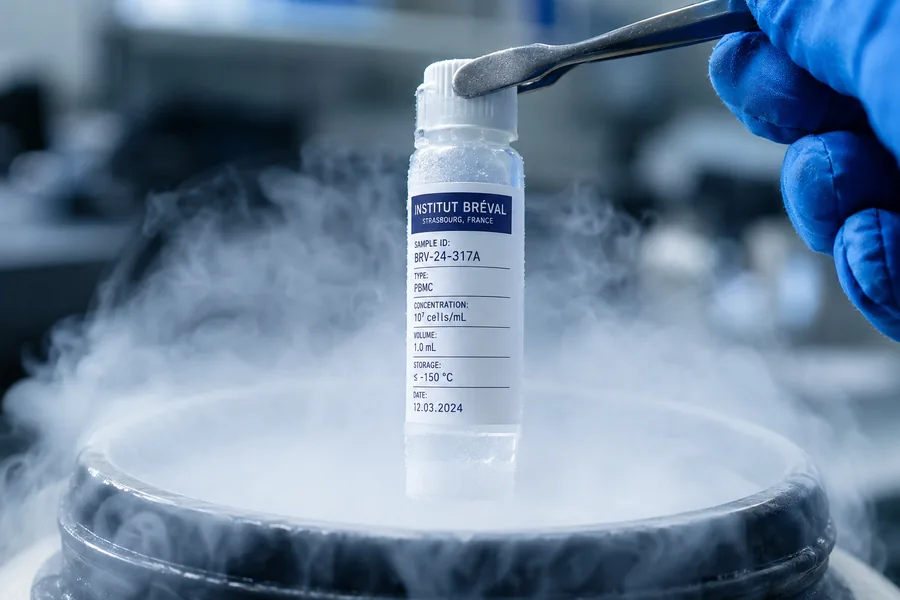
Any shape within this size — rectangle, round, oval or custom die-cut.
VAT invoice · card or bank transfer · proof before production · ±5 % quantity tolerance
- Printing
- none — you print
- Protection
- 1 option
- Adhesives
- 1
- Sizes
- 4 formats
- Smallest
- 35 × 70 mm
- Largest
- 100 × 70 mm
- Quantities
- 100 → 10 000, more quoted
- Variable data
- yours to print
Unprinted on rolls from £55 per 100. Production 4 to 10 working days.
Being straight about it
Blank only, and here is why that suits the job
This stock is not sold pre-printed in the configurator, and in a laboratory that is rarely a problem: sample identifiers change with every rack, so they are printed in-house on a thermal transfer printer with a resin ribbon — the combination that survives the vapour phase and the frost that forms when a box comes out.
What we supply is the material that holds: an adhesive that does not become brittle at −196 °C and a film that does not shatter. If you need a run pre-printed with a laboratory name or a fixed code, ask us — it is produced, simply not priced online.
- Rated to
- −196 °C
- Supplied
- blank, on rolls
- Printing
- yours — thermal transfer
- Ribbon
- resin, not wax
- Apply
- at room temperature
- Sizes
- up to 100 × 70 mm
- From
- £55 / 100
Three rules that decide whether it survives
The material is necessary, not sufficient
Label before freezing
Apply at room temperature on a clean, dry vial and let the adhesive set for a few minutes. Nothing bonds to a frosted surface, whatever the specification says.
Resin ribbon, not wax
A wax ribbon smears when the frost melts on the way out of storage. Resin bonds into the film and survives handling with a wet glove.
Wrap the vial if you can
On a small vial, a label that overlaps itself holds far better than one that ends against the surface — the overlap protects the leading edge.
Price by quantity
What a run actually costs
Up to 55 × 70 mm, unprinted, unprotected — die and setup included.
| Quantity | Run price | Per label |
|---|---|---|
| 100 | £55 | £0.55 |
| 200 | £58 | £0.29 |
| 300 | £60 | £0.20 |
| 500 | £64 | £0.13 |
| 1 000 | £76 | £0.076 |
| 1 500 | £86 | £0.058 |
| 2 000 | £99 | £0.050 |
| 3 000 | £120 | £0.040 |
| 5 000 | £169 | £0.034 |
| 10 000 | £290 | £0.029 |
Excluding VAT and delivery. Other sizes, finishes and quantities are priced in the configurator above.
FAQ
Cryogenic — what laboratories ask us
Does it really survive liquid nitrogen?
It is rated for it: the adhesive stays bonded and the film does not shatter at −196 °C. The usual failures at that temperature are procedural rather than material — a vial labelled after it was frozen, or a wax ribbon that smears when the frost melts.
Why is it not sold printed?
Because laboratory identifiers change constantly, so they are printed in-house rack by rack. The stock is supplied blank for that reason. A pre-printed run with a fixed laboratory name is produced on request — ask us and we quote it.
Which printer and ribbon?
Thermal transfer with a resin ribbon. Direct thermal paper is not an option here: the coating darkens with heat and the print does not survive the handling this application involves.
Can I use it in a −80 °C freezer as well?
Yes — it covers everything colder than a domestic freezer, including −80 °C storage. For ordinary frozen food at −18 to −40 °C, the freezer film at £149 per 100 is the printed, cheaper answer.
How should it be applied to a small vial?
At room temperature, on a clean dry surface, ideally wrapped so the label overlaps itself. The overlap protects the leading edge, which is where lifting starts once the vial has been through a cycle of frost and thaw.
The sample outlives the freezer. The label should too.
Cryogenic polypropylene, blank rolls from £55 per 100.