
Deep-Freeze Adhesive Labels · Functional
The adhesive is the product here
The short answer: a freezer label is defined by its glue. This one bonds on a cold, slightly damp surface from about −20 °C and holds in service down to −40 °C, on a polyethylene film that blast freezing and ice crystals do not soften. From €176 per 100 — the cheapest way to stop labels falling off in a freezer.
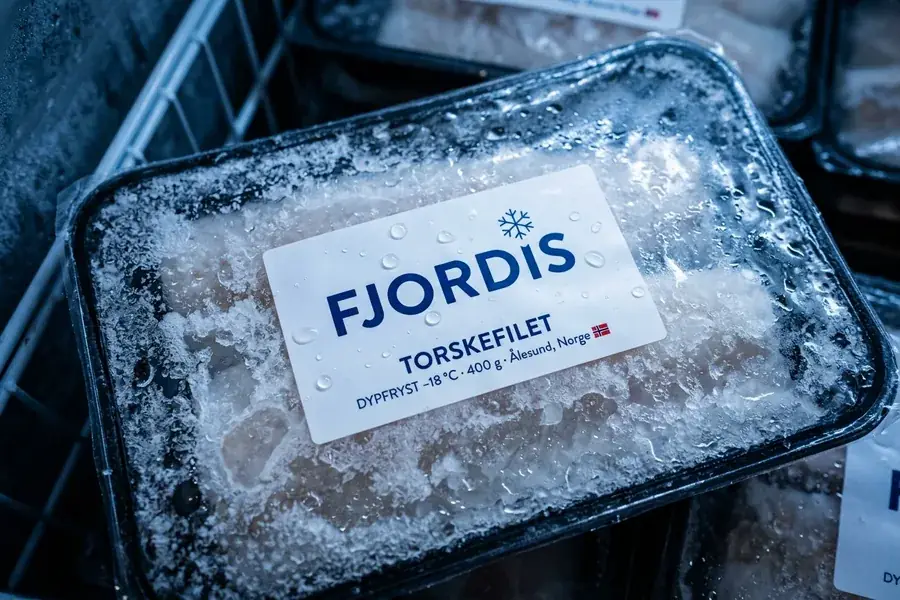
Any shape within this size — rectangle, round, oval or custom die-cut.
VAT invoice · card or bank transfer · proof before production · ±5 % quantity tolerance
- Printing
- 1 option
- Protection
- 1 option
- Adhesives
- 1
- Sizes
- 16 formats
- Smallest
- 35 × 30 mm
- Largest
- 100 × 105 mm
- Quantities
- 100 → 10 000, more quoted
- Variable data
- quoted on request
Printed from €176 per 100. Production 4 to 10 working days after proof approval.
Why ordinary labels fail
A permanent adhesive needs warmth to become permanent
An adhesive is a liquid that stops flowing. It needs a few minutes and a little warmth to wet the surface before it sets — that wetting is the bond. Applied to a pack that is already cold, or already carrying condensation, it freezes before it has flowed anywhere. The label looks stuck and drops off three days later in the display cabinet.
A freezer-grade adhesive is formulated to grab a cold, damp surface on contact and to stay flexible instead of turning brittle at −25 °C. Pair it with this polyethylene film — which does not absorb the water that a paper label soaks up during blast freezing — and the label survives the whole cold chain.
- Chilled +2 to +8 °C
- standard permanent
- Frozen −18 to −25 °C
- this stock
- Deep-freeze −40 °C
- this stock
- Liquid nitrogen −196 °C
- cryogenic film
- Apply from
- about −20 °C
- Face material
- polyethylene film
- From
- €176 / 100
Price by quantity
What a run actually costs
Up to 55 × 70 mm, full colour, gloss varnish — die, setup and printing included.
| Quantity | Run price | Per label |
|---|---|---|
| 100 | €209 | €2.09 |
| 200 | €213 | €1.07 |
| 300 | €218 | €0.73 |
| 500 | €221 | €0.44 |
| 1 000 | €244 | €0.24 |
| 1 500 | €259 | €0.17 |
| 2 000 | €281 | €0.14 |
| 3 000 | €317 | €0.11 |
| 5 000 | €404 | €0.081 |
| 10 000 | €620 | €0.062 |
Excluding VAT and delivery. Other sizes, finishes and quantities are priced in the configurator above.
Where it is used
Products that take this material
FAQ
Deep-freeze — what producers ask us
At what temperature can I apply it?
From about −20 °C, which covers labelling inside a cold room or on packs coming out of a blast tunnel. You still get the strongest bond by labelling before freezing, at room temperature, and letting the label sit a few minutes before the pack goes into the cold.
Why a film rather than a paper?
Because blast freezing and thawing cycles put water on the surface. A freezer coated paper exists at €182 and works well on dry packs; where there is real moisture — ice crystals, condensation, packs going in and out — the polyethylene film does not soften and the label stays flat.
Does it work for chilled products too?
Yes, and it is over-specified for them. A standard permanent adhesive handles +2 to +8 °C perfectly, so unless the pack also goes into a freezer, a coated paper is cheaper and just as reliable.
Is it food safe?
The adhesive is food-grade, which covers a label on the outside of a closed pack — the normal case. If the label touches the food itself, you need the certified direct-contact stock with a freezer-grade adhesive, which we spec on request.
Can I print the dates myself?
Yes — either on blank freezer rolls from €65 per 100, or on overprintable rolls where we print your design and leave a panel bare for the date and the lot.
It holds at −40 °C because the glue was chosen for it.
Freezer polyethylene film, from €176 per 100.