
Grass Paper Labels · Eco-friendly
You can see the grass in it, which is the whole idea
The short answer: grass fibre is dried in the sun rather than cooked, which takes far less water and energy than wood pulp, then blended with pulp to make a sheet. The result is pale, warm and visibly flecked with green — the most immediately recognisable eco material we carry, and the most expensive at €243 per 100.
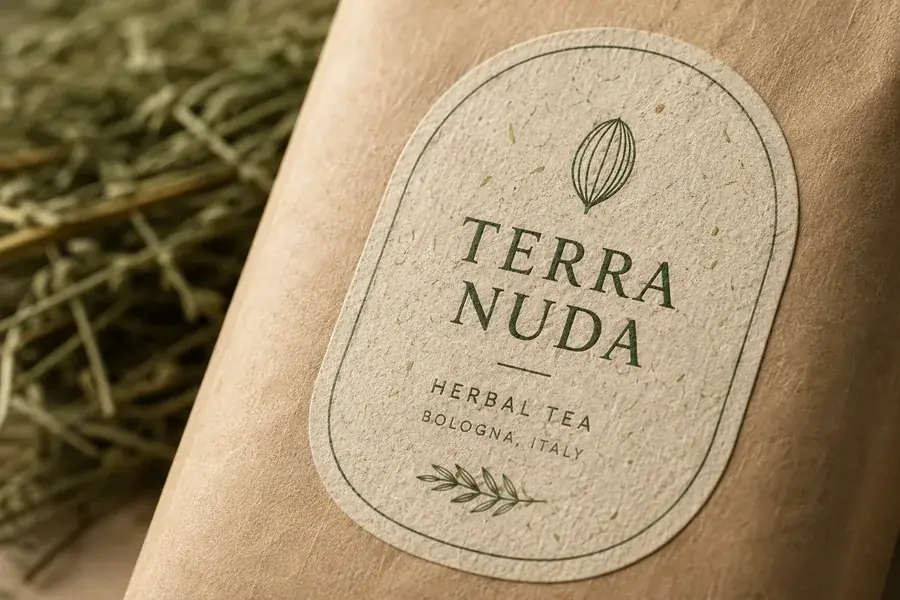
Any shape within this size — rectangle, round, oval or custom die-cut.
VAT invoice · card or bank transfer · proof before production · ±5 % quantity tolerance
- Printing
- 1 option
- Protection
- 1 option
- Adhesives
- 1
- Sizes
- 16 formats
- Smallest
- 35 × 30 mm
- Largest
- 100 × 105 mm
- Quantities
- 100 → 10 000, more quoted
- Variable data
- quoted on request
Printed from €243 per 100. Production 4 to 10 working days after proof approval.
Why it costs more
The most visible material, at the top of the range
Grass paper carries an argument no other stock does: the flecks are visible from a metre away, so the packaging says what it is made of before anyone reads a word. That is worth something on a shelf full of white labels — and it is why this sheet sits at €243 per 100 while sugarcane, which makes a quieter version of the same point, sits at €170.
The production argument is straightforward: grass is dried in the sun rather than pulped with heat and water, so the fibre arrives at the mill having consumed very little. Blended into paper it replaces part of the wood pulp. As always, we describe the composition and leave the claim to you.
- Material
- Grass paper
- Size
- Up to 75 × 70 mm
- Printing
- Full colour
- Protection
- None — flecks visible
- Adhesive
- Permanent
- Quantity
- 500 per reference
- Blank rolls
- €66 / 100
An example of a real order. Quantities are not capped — we print from a hundred pieces to several million.
Practical notes
Three things the flecks change
Every label is slightly different
The flecks fall where they fall. On a run of a thousand, no two labels are identical — charming on a farm product, unacceptable on a technical one.
Small text needs room
A fleck under a 5-point letter breaks it. Keep mandatory text at a normal size and avoid hairline rules; on this stock, generous typography is not a style choice.
No varnish
A coating flattens the surface and dulls the green. The stock ships unprotected, which also means it stays away from water.
Price by quantity
What a run actually costs
Up to 55 × 70 mm, full colour, unprotected — die, setup and printing included.
| Quantity | Run price | Per label |
|---|---|---|
| 100 | €243 | €2.43 |
| 200 | €247 | €1.24 |
| 300 | €252 | €0.84 |
| 500 | €253 | €0.51 |
| 1 000 | €275 | €0.28 |
| 1 500 | €289 | €0.19 |
| 2 000 | €310 | €0.16 |
| 3 000 | €343 | €0.11 |
| 5 000 | €426 | €0.085 |
| 10 000 | €633 | €0.063 |
Excluding VAT and delivery. Other sizes, finishes and quantities are priced in the configurator above.
FAQ
Grass paper — what brands ask us
What is grass paper made of?
Sun-dried grass fibre blended with pulp. The grass is dried rather than cooked, which is where the environmental argument comes from: far less water and energy than conventional pulping, for the share of the sheet it replaces.
Why is it the most expensive material in the eco range?
Small production volumes and a specialist supply chain. At €243 per 100 it is €73 above sugarcane, which makes a similar point more discreetly. You are paying for how visible the material is, and on a shelf that visibility is the argument.
Will my labels all look the same?
Not exactly, and that is inherent to the material: the green flecks are distributed at random, so each label differs slightly. On artisan products this reads as authenticity; if strict consistency matters, choose sugarcane or recycled white instead.
Is it food safe?
The standard adhesive is food-grade, which covers a label on the outside of a closed pack — the normal case for tea, dry goods and preserves. For a label touching food directly you need a certified direct-contact material; see direct food contact.
Does it resist moisture?
No. It is uncoated paper and it marks with a wet thumb. For a chilled or damp product the honest answer is a different material — either the wet-strength aquaproof or a synthetic film, neither of which carries the eco argument.
The material is visible from a metre away.
Sun-dried grass fibre paper, from €243 per 100.