
Sustainability
We are not going to call ourselves green
The short answer: printing labels consumes paper, film, ink and transport. What we can do is sell the stock that fits, in the quantity you will actually use, and be precise about what each material is and is not — which, from September 2026, is also what European law requires of everyone.
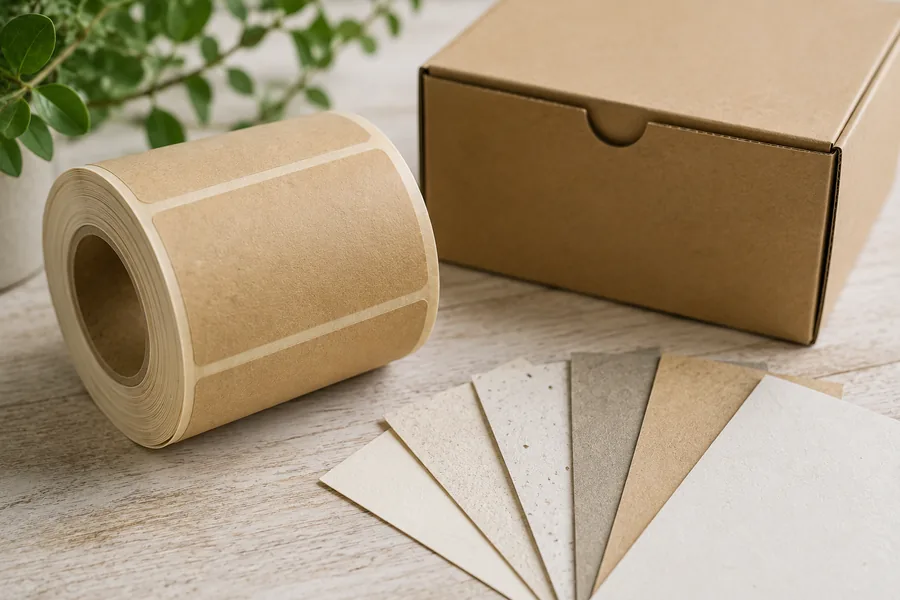
What we actually offer
The eco range, and what each stock really means
| Stock | What is true about it | From / 100 |
|---|---|---|
| Sugarcane fibre | Made from bagasse, a by-product of sugar production — no crop is grown for it. The cheapest of the range. | £144 |
| Recycled paper | Post-consumer fibre, and it looks like it. The grey flecks are the message; bleaching them out would defeat the point. | £180 |
| Stone paper | Tree-free and water-free to make. Not compostable, and it does not belong in a paper recycling stream. | £180 |
| Grass paper | Part grass fibre, visible at arm's length. Lower energy and water use than pure wood pulp. | £206 |
| Bio-based film | Plant-derived polyethylene. That is a statement about origin, never about end of life. | £176 |
| Cellulose film | Compostable to standard — but only as a label if the adhesive composts too. Ask for it explicitly. | £205 |
The full range and its distinctions are on eco-friendly labels. Every certification we can supply comes with documentation — if we cannot document it, we do not print it as a claim.
The part nobody advertises
The greenest label is the one you do not throw away
Most of the waste in this trade is not the material — it is the run that became obsolete. A recipe changed, an address moved, a regulation landed, and three thousand perfectly good labels went into a bin.
That is why this site prices from 100 labels, why the guides tell you when a shorter run is cheaper per year than a long one, and why the claims guide ends by telling you not to print five years of sorting signage before the European marking settles. It costs us turnover today and saves you a skip tomorrow.
The same logic underlies overprintable rolls: print the brand once, add the changing data yourself, and stop discarding labels because a date moved. And it is why the kraft packing tape is on the site: a paper tape on a paper carton leaves one object of one material, with nothing to peel off before recycling.
- Minimum run
- 100 labels
- Advice given
- order what you will use
- Changing data
- overprint rather than reprint
- Obsolete stock
- the real waste
Being precise
Four things we will not say
« Eco-friendly » on its own
A generic claim with nothing behind it. From 27 September 2026 it is also unlawful across the Union unless it can be substantiated.
« Biodegradable » as a selling point
Prohibited on packaging in France, and meaningless without a standard and a timeframe. We sell certified compostable stocks and say exactly that.
« Carbon neutral »
We do not measure our footprint precisely enough to make that claim, so we do not make it. When we can substantiate it, we will publish the method with it.
A logo we designed ourselves
A self-made green badge is now a liability rather than a reassurance — for us and for you. Certifications we can document, decoration no.
If a claim on your artwork worries us, we raise it on the proof. The claim remains yours — but a printer who says nothing is not doing you a favour.
Certified stocks, documented, priced online.
Sugarcane from £144, recycled from £180, compostable film from £205.