
Guides · updated 9 November 2026
EU Battery Regulation: the labelling and QR code rules coming on 18 February 2027
The short answer: Regulation (EU) 2023/1542 gives every battery sold in the EU one marking system. Two parts already apply — the CE marking and the crossed-out wheeled bin. From 18 February 2027 every battery must also carry a QR code, and LMT, EV and industrial batteries above 2 kWh get a battery passport behind it. The full information label of Annex VI has no fixed date yet: it starts 18 months after an implementing act that, on 9 November 2026, has not been published.
In 30 seconds
The 30-second answer: two marks today, a QR code in February 2027, the full label later
Battery labelling under Regulation (EU) 2023/1542 arrives in steps, and only some have a fixed date:
- CE marking applies now: conformity assessment since 18 August 2024 (Article 96(2)(b)), mark at least 5 mm high.
- The crossed-out wheeled bin is compulsory since 18 August 2025 (Article 13(4)), at 3 % of the largest side, with Cd or Pb beneath above 0.002 % cadmium or 0.004 % lead.
- From 18 February 2027 every battery carries a QR code (Article 13(6)), printed or engraved visibly, legibly and indelibly (Article 13(7)).
- The same day, LMT, EV and industrial batteries above 2 kWh need a battery passport (Article 77) — one record, so one code, per battery.
- The Annex VI information label waits for an implementing act not yet in EUR-Lex on 9 November 2026.
- The label must outlast the battery’s working life: film, adhesive and protection are chosen for heat and fluids.
Scope
Five categories, and the category decides what the QR code must open
Every battery falls into one of the categories of Article 3, which sets the extra particular on the label (capacity or minimum duration) and what sits behind the QR code (a passport or an information page). Weight and use decide, not chemistry: a 4 kg power-tool pack is portable, the same cells in a 20 kg e-scooter pack are an LMT battery.
| Category | Definition (Art. 3) | Typical products | Extra on the label | The QR code opens |
|---|---|---|---|---|
| Portable, non-rechargeable | Sealed, 5 kg or less, not industrial, EV, LMT or SLI | AA cells, button cells | Minimum average duration, « non-rechargeable » (13(3)) | Label information, declaration of conformity, waste information (13(6)(b)) |
| Portable, rechargeable | Same definition | Power-tool and laptop packs | Capacity (13(2)) | Same as above |
| LMT battery | Sealed, 25 kg or less, traction of e-bikes, e-scooters and other light vehicles | E-bike and e-scooter packs | Capacity (13(2)) | Battery passport (Art. 77) |
| SLI battery | Starting, lighting or ignition, also backup in vehicles and machinery | Starter batteries | Capacity (13(2)) | Information as above, plus recovered cobalt, lead, lithium or nickel (13(6)(c)) |
| Industrial battery | Designed for industrial use, or any other battery above 5 kg that is not EV, LMT or SLI | Stationary storage, forklift packs | — | Passport above 2 kWh; information page at or below |
| Electric vehicle battery | Traction in M, N or O vehicles, or L vehicles above 25 kg | Car and van packs | — | Battery passport (Art. 77) |
The dates
Four dates are fixed, the information label is still open
The table reads the consolidated text of 13 August 2026, which includes every amendment published so far; none of them changed Article 13.
| Date | What applies | Article | Status |
|---|---|---|---|
| 18 February 2024 | The Regulation applies; Cd and Pb symbols (no separate date in 13(5)) | 96(2), 13(5) | In force |
| 18 August 2024 | Conformity assessment, the basis of the CE marking | 96(2)(b), 17, 19, 20 | In force |
| 18 August 2025 | Separate collection symbol on all batteries | 13(4) | In force |
| 18 February 2027 | QR code on all batteries; passport for LMT, EV and industrial above 2 kWh | 13(6), 77(1) | Fixed |
| 18 August 2026 or 18 months after the implementing act, whichever is later | Annex VI label; capacity; minimum duration and « non-rechargeable » | 13(1) to 13(3), 13(10) | Not yet applicable |
Article 13(10) asked the Commission to adopt, by 18 August 2025, implementing acts with harmonised specifications for these labels. A draft was notified to the World Trade Organization on 22 December 2025, comments closing on 20 February 2026 (G/TBT/N/EU/1181); on 9 November 2026 we found no adopted act in EUR-Lex. Since the later date wins, the label becomes compulsory 18 months after that act enters into force — May 2028 if it entered into force today. We do not guess the real date; watch the Official Journal.
A proposal is also pending: COM(2025) 981 would rewrite point 8 of Annex VI, Part A to cover substances of very high concern at 0.1 % weight by weight or more (COM(2025) 981). Until it is adopted, the current wording applies.
The content
What the label must show: ten particulars, three marks and a code
A compliant battery label combines the ten particulars of Annex VI, Part A, the contact details required of manufacturers and importers, the CE marking, the collection symbol and, from 18 February 2027, the QR code. Annex VI, Part A lists:
- information identifying the manufacturer (Article 38(7));
- the battery category and its identification (Article 38(6));
- the place of manufacture;
- the date of manufacture, month and year;
- the weight;
- the capacity;
- the chemistry;
- hazardous substances present, other than mercury, cadmium or lead;
- a usable extinguishing agent;
- critical raw materials above 0.1 % weight by weight.
Two articles add what is often forgotten. Article 38(6) wants a model identification and a batch, serial or product number; Article 38(7) wants the manufacturer’s name or trade mark, a postal address with a single contact point and, if available, web and e-mail addresses, in a language end-users understand — and Article 41(3) asks the same of the importer. Mercury has left the marking list: above 0.0005 % it is simply restricted (Annex I).
Article 13(7) puts the labels and the QR code on the battery itself; only where its nature and size make that impossible or unwarranted do they move to the packaging and the accompanying documents — the housing for a pack, the blister card and leaflet for a coin cell. The text does not define « indelibly » and names no test, which is why the material choice matters.
On the label
Size and legibility: the bin scales with the battery, the CE has a floor, the QR has neither
The collection symbol is the only element whose size the Regulation calculates: at least 3 % of the largest side, or 1.5 % of the surface on a cylindrical cell, capped at 5 × 5 cm. Below 0.47 × 0.47 cm it leaves the battery for the packaging, at no less than 1 × 1 cm (Article 13(4)). The Cd or Pb symbol sits beneath it and covers a quarter of its area (Article 13(5)).
| Battery | Reference surface | Required area | Square side | Where |
|---|---|---|---|---|
| Storage cabinet, face 600 × 1 000 mm | 3 % of 600 000 mm² | 18 000 mm² | capped at 50 mm | Battery |
| E-bike pack, face 300 × 100 mm | 3 % of 30 000 mm² | 900 mm² | 30.0 mm | Battery |
| Power-tool pack, face 120 × 80 mm | 3 % of 9 600 mm² | 288 mm² | 17.0 mm | Battery |
| Pouch cell, 60 × 40 mm | 3 % of 2 400 mm² | 72 mm² | 8.5 mm | Battery |
| AA cell, Ø 14.5 × 50.5 mm | 1.5 % of about 2 630 mm² | 39.5 mm² | 6.3 mm | Battery |
| Coin cell, Ø 20 mm | 3 % of 314 mm² | 9.4 mm² | 3.1 mm, below 4.7 | Packaging, 10 × 10 mm min. |
The AA line counts the whole cylinder, ends included; on the side wall alone it is 5.9 mm. If your authority reads « surface area » differently, its reading wins.
The CE marking keeps the proportions of its graduated drawing and is at least 5 mm high where no other dimension is set (Regulation (EC) No 765/2008, Annex II). The QR code has no size in millimetres: Annex VI, Part C asks for high contrast and a size a phone reads easily. We work to modules of at least 0.4 mm — the GS1 retail figure explained in our guide to GS1 Digital Link and QR codes — with a four-module quiet zone. A passport address of about 60 characters fits a 33 or 37-module symbol at medium error correction: roughly 16 to 23 mm square with its margin, against 10 mm for a marketing QR.
The code
The QR code links to hosted information — and for passport batteries, one code per battery
The QR code is a door, not a container: Article 3(24) defines it as a matrix code that links to information. For LMT, EV and industrial batteries above 2 kWh, behind it is the battery passport. For the others, it is the label information, the EU declaration of conformity, the due diligence report of Article 52(3) and the waste information of Article 74(1); SLI batteries add their recovered cobalt, lead, lithium or nickel. It must be complete, up to date and accurate — so it lives on a server you control, for the life of the battery.
The passport is individual. Article 77(2) covers information specific to each battery, including from its use, and Article 77(3) links the QR code to a unique identifier, both compliant with ISO/IEC 15459, parts 1 to 6, or equivalent. GS1 in Europe confirms that for these batteries the granularity level for the product passport is at item level (GS1, January 2025). Every pack carries a different code.
GS1 Digital Link is one way to build it: GS1 is an ISO/IEC 15459 issuing agency, and a Digital Link puts the
GTIN and serial number in an ordinary web address —
https://id.your-domain.eu/01/09520123456788/21/B26004817. The Regulation does not name GS1; other
issuing agencies exist. Choose with your passport provider, send us the list, and we print it as
numbered, barcode and QR labels, one code per label in the same run.
For portable and SLI batteries the text ties the code to information, not to an individual record, so a code
per model can do the job — confirm that reading with your authority.
- Compulsory from
- 18 February 2027
- On
- all batteries
- Marking
- visible, legible, indelible
- Passport batteries
- LMT, EV, industrial > 2 kWh
- Identifier
- ISO/IEC 15459-1 to -6
- Passport granularity
- each battery
- Unique QR, run of 100
- + €127excl. VAT
- Unique QR, run of 3 000
- + €166excl. VAT


The substrate
Durability: a film, a reinforced adhesive and a protection chosen for heat and fluids
Because « indelibly » is not defined, the practical target is a label that stays legible and scannable for the battery’s working life: a synthetic film, never paper, a reinforced permanent adhesive, and a lamination or heat-cured print depending on temperature. Four questions decide: temperature at the label, fluids around it, the housing surface, and whether data is printed on your own line.
| Situation | Film | Adhesive | Protection | From, per 100 |
|---|---|---|---|---|
| Pack housing, brand and pictograms | Industrial white polyester, full colour | Reinforced | Gloss lamination; matt over a QR | €267excl. VAT, up to 35 × 30 mm |
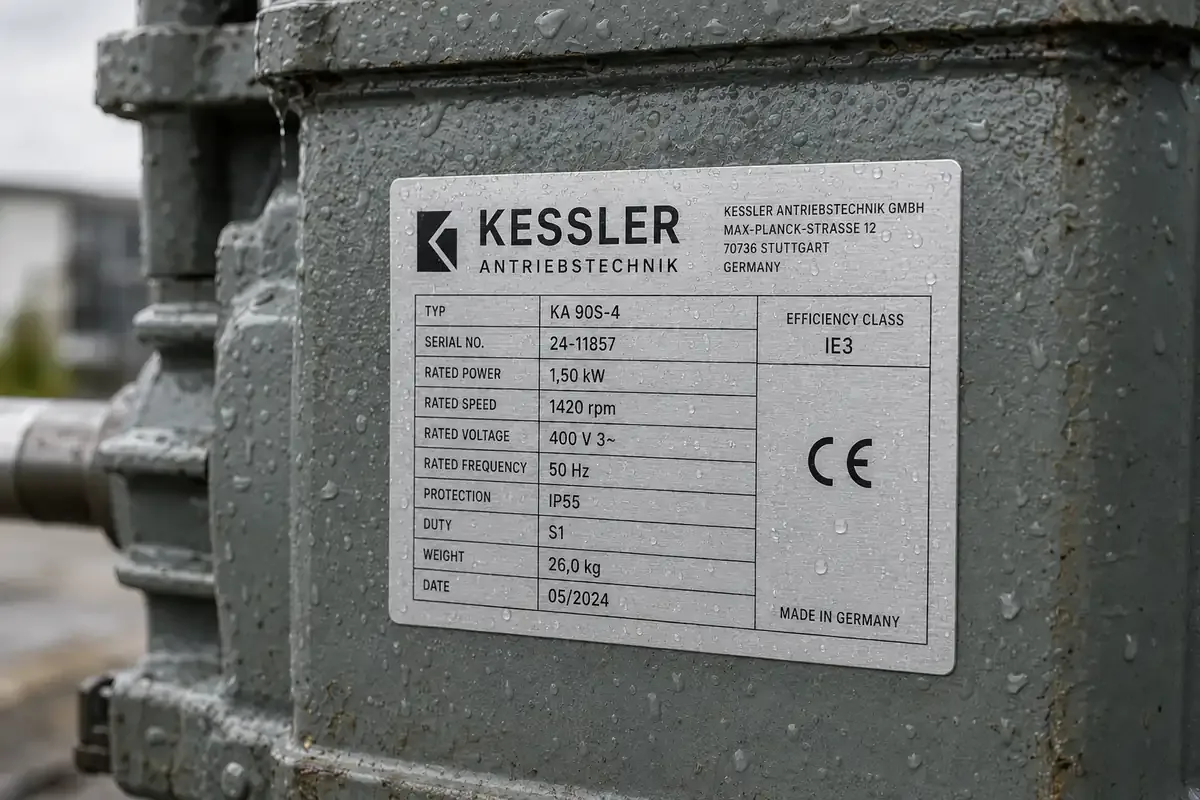
| Rating-plate look on a metal enclosure | Matt aluminium polyester, one colour | Reinforced | Gloss lamination | €211excl. VAT, up to 35 × 30 mm |
| Cell or module through a hot process | White polyimide, to +250 °C | Permanent, high temperature | None, print heat-cured | €191excl. VAT, up to 30 × 30 mm |
| Date and serial printed on your line | Overprintable white polyester | Reinforced | None on the bare panel | quote tool |
| Electrolyte, acid or solvents | Polyester or polyimide, tested | Per test | Per test | custom request |
Heat
Standard films are rated to about +80 °C, enough for most pack housings. Above that, polyimide holds to +250 °C on our high-temperature labels, print heat-cured because a lamination would blister.
Fluids
Laminated polyester handles wiping, alcohol and oils. Electrolyte and acid are another matter: we test on your fluid through a custom request rather than promise from a datasheet. The same logic for solvents is in our GHS and CLP chemical labels guide.
Adhesive
Textured or powder-coated housings defeat a standard adhesive, which only touches the high points; the reinforced one flows into the texture — see choosing your label adhesive. Full strength comes after about 24 hours, so judge a test label the next day.

For the QR code itself: black on white, matt rather than gloss over it, and a white panel on a dark or metallic film instead of printing the code in reverse. All films for this work are on our page of industrial labels in polyester, aluminium polyester and polyimide; the four-colour version is industrial full colour, and the film with a bare panel for your own date and serial is overprintable polyester.
Being straight about it
Five mistakes that turn a battery label into a reprint
One QR code for a whole passport range. A code per model suits a portable battery, not an LMT, EV or industrial pack above 2 kWh. Plan the identifier list before the artwork.
A rented short link. When a shortener or QR subscription ends, every pack in the field points nowhere. Encode an address on a domain you control.
A bin drawn to fit the space. Its size follows the battery: calculate it first, then design around it.
Paper because the prototype used paper. Coated paper survives a dry shelf, not a pack’s working life. Start from a synthetic film.
Waiting for the implementing act. The QR code and passport have a date and share the label with the Annex VI particulars. Reserve that space now rather than redesign twice.
Before 18 February 2027
Checklist: ten points to settle before 18 February 2027
What a label printer can check; the legal checks belong to you, your notified body and the authority.
- Category confirmed for each battery under Article 3.
- CE marking at least 5 mm high, conformity assessment done (Articles 17 to 20).
- Collection symbol at 3 % of the largest side, or 1.5 % on a cylinder, official artwork.
- Cd or Pb beneath the bin above 0.002 % cadmium or 0.004 % lead.
- Manufacturer and importer name, postal and web address, in the right language.
- Model identification and batch or serial number (Article 38(6)).
- QR destination on your own domain, live and complete for each category.
- Passport batteries: one ISO/IEC 15459 identifier per unit, list ready for printing.
- Space reserved for the Annex VI particulars pending the implementing act.
- Film, adhesive and protection tested on the housing, at temperature, with the fluids around it.
Selling in Great Britain too? Check the UK rules separately — see EU vs UK labelling requirements. And keep green wording off the label unless it can be proved: environmental claims and sorting labels.
FAQ
Battery labels and the QR code — what manufacturers ask us
When do battery labels need a QR code in the EU?
From 18 February 2027, under Article 13(6) of Regulation (EU) 2023/1542, for every battery category. The code is printed or engraved visibly, legibly and indelibly on the battery, or on the packaging and accompanying documents where the battery’s size or nature makes that impossible.
Which batteries need a battery passport?
LMT batteries such as e-bike and e-scooter packs, electric vehicle batteries and industrial batteries above 2 kWh, from 18 February 2027 (Article 77(1)). The QR code links to a unique identifier attributed to each individual battery.
Is the full information label compulsory since 18 August 2026?
Not yet. Article 13(1) to (3) apply from 18 August 2026 or 18 months after the implementing act of Article 13(10), whichever is later, and on 9 November 2026 that act was not in EUR-Lex. The collection symbol and the CE marking already apply.
How big must the crossed-out wheeled bin be on a battery?
At least 3 % of the largest side, or 1.5 % of the surface on a cylindrical cell, up to 5 × 5 cm. Below 0.47 × 0.47 cm it goes on the packaging at 1 × 1 cm minimum. An e-bike pack with a 300 × 100 mm face needs about 30 × 30 mm.
Can the battery QR code use GS1 Digital Link?
It can be one way. The QR code and identifier must comply with ISO/IEC 15459 or equivalent, and GS1 is an ISO/IEC 15459 issuing agency; a Digital Link carries GTIN and serial in a web address on your own domain. The Regulation does not name GS1.
Can you print a different QR code on every battery label?
Yes, in the same run as the design, from 100 labels, on the industrial polyester films that offer it: + €127 excl. VAT on a run of 100, + €166 excl. VAT on 3 000. You send the list; we print it in order.
This guide is a practical summary written by a label manufacturer, not legal advice. The category of your battery, the content of its label and the conformity route are decided by the economic operator placing it on the market: check the current text of Regulation (EU) 2023/1542 on EUR-Lex and confirm with your notified body or the market surveillance authority of the Member State concerned before printing.
Official texts: Regulation (EU) 2023/1542 concerning batteries and waste batteries — EUR-Lex · Consolidated text of Regulation (EU) 2023/1542, 13 August 2026 — EUR-Lex · Proposal COM(2025) 981 amending Regulation (EU) 2023/1542 — EUR-Lex · Regulation (EC) No 765/2008, Annex II (CE marking) — EUR-Lex · WTO notification G/TBT/N/EU/1181, draft labelling implementing regulation — European Commission · GS1 Standards enabling the EU digital product passport, release 2.2 — GS1 in Europe
Still unsure?
Ask the person who makes them
The guide covers the general case — your label lives on a real product. Describe it in two lines and a label specialist (not a bot) answers within 2 working hours.
All guides
Everything else we have written down
- Choosing your label material
- Choosing your label adhesive
- Bottle and jar label sizes
- EU food labelling — the INCO rules
- EU wine label rules
- Environmental claims and sorting labels
- Preparing print-ready files
- Variable data, explained
- Label material comparison chart
- EU vs UK labelling requirements
- What drives the price of a label
- Label glossary
- Direct thermal vs thermal transfer
- GS1 Digital Link and QR codes
- Barcode print quality and ISO 15416 grades
- GHS and CLP chemical labels, BS5609 included
- Printed packing tape vs labels, cost per parcel
- EU Battery Regulation labels and QR code — you are here
- Cold-chain labelling: freezer, fridge, steam
- Cosmetics labelling — Regulation 1223/2009
- Batch numbers, lot codes and expiry dates
- Label unwind direction and roll specs
Battery labels with the QR code built in
Polyester, aluminium polyester and polyimide films, one QR code per battery from 100 labels, a proof before production.