
Guides · updated 28 September 2026
Printed packing tape vs labels: what branding a parcel really costs
The short answer: a 400 × 300 × 200 mm carton sealed with one strip on top and one underneath uses about 1.04 m of tape. Printed on clear polypropylene, that tape costs 14 cents a parcel on the smallest run and 5 cents on the largest. A full-colour 55 × 105 mm seal label costs 16 cents at 2 000 and 7.5 cents at 10 000 — plus the plain tape the box still needs. Below about 2 000 parcels a year, labels win on cash and flexibility; from about 3 500, one minimum tape run a year, printed tape brands every carton in the same movement that closes it. Many shippers end up using both.
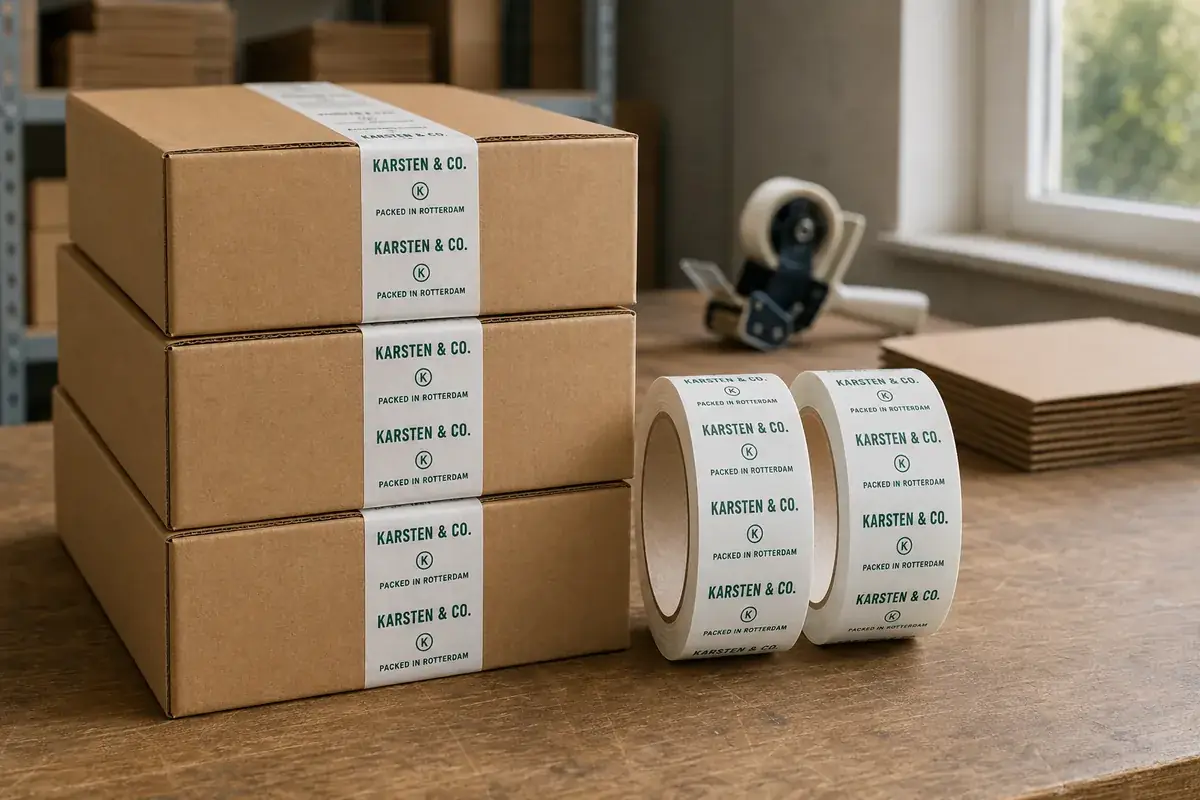
In 30 seconds
The 30-second answer: count metres per parcel, not price per roll
Printed packing tape and printed labels do not compete on the price of a roll or a run: they compete on the cost per parcel, which depends on how many metres of tape your cartons use and how many parcels you ship a year. Six facts settle most cases:
- A carton uses less tape than people think. One strip on top and one underneath: the length of the carton plus 12 cm of overhang, twice — 1.04 m for a 400 × 300 × 200 mm box. The H pattern roughly multiplies that by 2.6.
- Printed tape is priced by surface. Clear PP runs from 13.4 cents a metre on 36 rolls to 5.2 cents on 360; white PVC from 15.4 to 7.5 cents; kraft paper from 31 to 12 cents.
- A label is priced by the run. A full-colour 55 × 105 mm seal falls from €0.27 at 1 000 to €0.075 at 10 000; a 35 × 30 mm round seal from €0.19 to €0.036.
- The label route still needs tape. Whatever you pay for plain tape today stays on the bill; printed tape replaces it.
- Minimums and lead times differ. Tape: 36 rolls of 50 mm or 24 of 75 mm, one Pantone colour, 15 working days. Labels: from 100, full colour, 4 to 10 working days.
- Both is often the answer. Printed tape on the seam for every carton, a full-colour label where the message changes — a campaign, a returns route, a batch number.
Tape length per carton
How much tape does one parcel use?
One strip of tape along a seam uses the length of that seam plus the overhang folded down each end; on an everyday regular slotted carton, whose outer flaps meet in the middle, the seam runs along the length of the box. With 60 mm of overhang at each end — the figure we use throughout this guide — a 400 mm carton takes 520 mm per strip.
Two patterns cover almost every packing bench. The single strip closes the centre seam only, on the top and the bottom. The H pattern adds a strip across each end, where the flap edges meet the side panels, so each face uses (L + 2 × 60 mm) + 2 × (W + 2 × 60 mm). Carrier packing guides favour the second: the FedEx How to Pack guide asks for tape applied evenly across flaps and seams, top and bottom, using the H taping method.
| Carton (L × W × H) | Top seam only | Top and bottom, single strip | H pattern, top and bottom | Cartons per 100 m roll, single strip |
|---|---|---|---|---|
| 310 × 220 × 150 mm — small e-commerce box | 0.43 m | 0.86 m | 2.22 m | 116 |
| 400 × 300 × 200 mm — the reference in this guide | 0.52 m | 1.04 m | 2.72 m | 96 |
| 600 × 400 × 400 mm — large shipping carton | 0.72 m | 1.44 m | 3.52 m | 69 |
Measure your own: the overhang, the pattern and the number of faces taped change the result far more than the tape itself. Height does not appear in the formula — the strips run across the top and bottom faces and only fold a few centimetres down the ends.
Printed tape
What printed tape costs per metre and per parcel
Printed tape is priced by the surface printed, so the useful figure is the price per metre: divide the run price by the metres supplied, then multiply by the metres your carton uses. At 1.04 m per parcel, clear PP costs €0.139 a parcel on its smallest run and €0.054 on 360 rolls.
| Tape | Roll | 36 rolls | Per metre | Per parcel at 1.04 m | 360 rolls | Per metre | Per parcel at 1.04 m |
|---|---|---|---|---|---|---|---|
| Clear acrylic PP, 32 µ | 100 m | €482 | €0.134 | €0.139 | €1 862 | €0.052 | €0.054 |
| White PVC, 33 µ | 100 m | €556 | €0.154 | €0.161 | €2 717 | €0.075 | €0.078 |
| High-resistance white PVC, 60 µ | 66 m | €641 | €0.270 | €0.281 | €3 693 | €0.155 | €0.162 |
| Brown kraft paper, 60 gsm | 50 m | €561 | €0.312 | €0.324 | €2 095 | €0.116 | €0.121 |
Intermediate runs of 72, 108, 144 and 180 rolls sit between the two columns — the custom printed packing tape page prices every step. A 75 mm width costs one and a half times the 50 mm price per metre: 24 rolls of 75 mm cost exactly what 36 rolls of 50 mm cost, for the same surface.
Two things change the per-parcel figure more than the choice of film. The pattern first: the same carton H-taped uses 2.72 m, which puts clear PP at €0.141 a parcel even on 360 rolls. Then where the print goes: branding only the top seam, with plain tape underneath and on the ends, uses 0.52 m of printed tape — €0.050 a parcel on 72 rolls of clear PP for a shipper sending 10 000 cartons of this size a year. The printed tape is the part the customer sees on arrival; the bottom rarely needs it.
The minimum is the real threshold. 36 rolls of 100 m is 3 600 m, enough for about 3 460 reference cartons sealed top and bottom. Order it for 1 000 parcels a year and you are buying more than three years of stock — while the adhesive ages on the shelf.
Printed labels
What a printed seal or closure label costs per parcel
A label is priced by the run, and its price per piece falls steeply with quantity: a full-colour 55 × 105 mm seal on satin coated paper costs €0.268 at 1 000 and €0.075 at 10 000. Unlike tape, one label per parcel is the whole cost of the branding — the sealing still has to be done with plain tape. The rest of the dispatch bench, from carrier labels on thermal rolls to returns labels, is on our shipping and e-commerce labels page.
| Quantity | Seal 55 × 105 mm | Per label | Round seal 35 × 30 mm | Per label |
|---|---|---|---|---|
| 1 000 | €268 | €0.268 | €189 | €0.189 |
| 2 000 | €317 | €0.159 | €204 | €0.102 |
| 3 000 | €363 | €0.121 | €218 | €0.073 |
| 5 000 | €473 | €0.095 | €258 | €0.052 |
| 10 000 | €748 | €0.075 | €355 | €0.036 |
Formats are the configurator’s steps, up to 55 × 105 mm and up to 35 × 30 mm; any shape inside the step costs the same. Above 10 000 labels, quantities are quoted at volume rates — up to millions. Labels start at €137 per 100 on coated paper; for cartons stored outside, a white polypropylene seal of the same 55 × 105 mm size, full colour and varnished, costs €735 for 10 000.
What a label does that tape cannot
Full colour, photographs, a QR code, a different message for every campaign: a label is printed digitally, so changing the design costs a new run of a few hundred, not a new tape order. It can also carry data that changes parcel by parcel — an order number, a barcode — printed in the same run; see numbered and barcode labels.
The counterpart is one more movement on the packing bench for every parcel, and a brand that appears in one spot rather than along every seam.

Side by side
Printed tape vs labels at the same volume
At the same yearly volume, clear printed tape and a large full-colour seal cost about the same per parcel from 5 000 parcels a year, and a small round seal always costs less — but only the tape seals the box. The table puts the three routes side by side for the reference carton, single strip top and bottom.
| Parcels a year | Printed clear PP tape (smallest run that covers the year) | Per parcel | Seal 55 × 105 mm + plain tape | Round seal 35 × 30 mm + plain tape |
|---|---|---|---|---|
| 2 000 | 36 rolls, €482 — 3 600 m, about 1.7 years of stock | €0.139 | €0.159 + your tape | €0.102 + your tape |
| 5 000 | 72 rolls, €691 — 7 200 m | €0.100 | €0.095 + your tape | €0.052 + your tape |
| 10 000 | 108 rolls, €835 — 10 800 m | €0.080 | €0.075 + your tape | €0.036 + your tape |
| 30 000 | 360 rolls, €1 862 — 36 000 m | €0.054 | volume quote, under €0.075 + your tape | volume quote, under €0.036 + your tape |
Per parcel figures for tape assume the whole run is used; a run larger than one year’s need is stock, not a saving, until it is consumed.
The one-line rule, with your own tape price
Printed tape is the less expensive route when the extra it costs per metre, times the metres per parcel, is less than the label. Written out: (printed tape per metre − your plain tape per metre) × metres per parcel < price of one label. At 10 000 parcels, clear printed tape at €0.077 a metre beats the large seal as soon as your plain tape costs more than half a cent a metre — which it always does. Against the small round seal, your plain tape would have to cost more than 4.3 cents a metre.
What the table does not price is often what decides. The label route adds a second item to order, store and stick on every box; the tape route fixes one design for a whole run and takes 15 working days to replace. Those two facts, more than a cent either way, usually settle the question.
Decision
When to choose printed tape, labels — or both
Choose printed tape when volume is steady and the message is fixed, labels when volume is small or the message changes, and both when the parcel has to sell the brand and carry information. The table sorts the usual situations.
| Situation | Choose | Why |
|---|---|---|
| Under about 2 000 parcels a year | Labels | The tape minimum would sit on the shelf for years; a run of 1 000 small full-colour seals costs €189 |
| From about 3 500 parcels a year, one carton size | Printed tape | One minimum run a year; branding done in the same movement as sealing |
| Seasonal designs, campaigns, several brands | Labels | A new design is a new run from 100, in full colour |
| Needed within two weeks | Labels | 4 to 10 working days against 15 for tape |
| Visible opening needed | Printed tape across the seam, or a security label | A cut printed tape cannot be closed again with the same print; VOID and destructible labels show removal |
| Order number, barcode or returns data on the box | Both | Tape for the brand, a label for the data that changes |
| Premium unboxing | Both | One-colour tape outside, a full-colour seal on the tissue or the inner box |
For tamper evidence beyond a printed seam — VOID messages, films that break on removal — see security labels, from €285 per 100.
Why both is not a luxury
Tape and label do different jobs. The tape is seen from the loading bay to the doorstep, on every carton, in one colour; the label is seen at arm’s length, when the customer opens the box, in full colour. Splitting the roles keeps each one affordable: one Pantone on the tape, a small round seal inside rather than a large one outside.
The worked example on the right is a typical order for a shop sending 10 000 parcels a year in the reference carton: €835 of tape and €355 of seals, €0.119 a parcel for both, before your plain tape savings.
- Tape
- Clear acrylic PP, 32 µ, 50 mm × 100 m
- Tape print
- One Pantone colour
- Tape quantity
- 108 rolls — €835
- Label
- Round seal, up to 35 × 30 mm
- Label print
- Full colour, gloss varnish
- Label quantity
- 10 000 — €355
A typical order, shown as an example. Quantities are not capped — we print from a hundred pieces to several million.
Tape materials
Which printed tape for which carton
The carton decides the tape: clear PP for everyday boxes where the print should appear to sit on the cardboard, white PVC when the print must read from a distance, high-resistance PVC for heavy cartons, kraft paper when the box should go to paper recycling in one piece.
| Tape | Adhesive | Roll | Best for | From |
|---|---|---|---|---|
| Clear acrylic PP, 32 µ | Acrylic | 100 m | Everyday cartons; the print seems to float on the board | €482 / 36 rolls |
| White PVC, 33 µ | Permanent | 100 m | Maximum contrast on brown board; covers old markings | €556 / 36 rolls |
| High-resistance white PVC, 60 µ | Permanent | 66 m | Heavy or overfilled cartons, rough handling — nearly twice the thickness of standard PVC | €641 / 36 rolls |
| Brown kraft paper, 60 gsm | Natural rubber | 50 m | Paper-only packaging: nothing to peel off before the carton goes to paper recycling | €561 / 36 rolls |
Minimum 36 rolls in 50 mm or 24 in 75 mm on every tape. Production takes 15 working days after proof approval; delivery is quoted with the order. On kraft we make no biodegradability claim — our guide to environmental claims explains why.


Width follows weight. A 50 mm tape closes a standard carton; 75 mm covers a wider seam and holds heavier boxes, and gives the design half as much room again. Since the price follows the surface, choosing 75 mm is a choice of metres per euro, not of a different price list: 24 rolls of 75 mm hold 2 400 m for the price of 3 600 m in 50 mm.
Artwork
Designing tape and labels that work on a parcel
Tape artwork is a loop printed in one Pantone colour and repeated every 30.06 cm, the circumference of the printing cylinder; label artwork is a full-colour rectangle or shape seen close up. Designing each for its distance is what makes the pair work.
Tape: design for the strip you actually see
A top strip on the reference carton is 520 mm long, so a 30.06 cm repeat shows the logo once or twice depending on where the roll starts. Put the name twice inside each repeat and it appears on every face, including the 60 mm folded down the ends. Keep it well inside the width — hand-applied tape rarely lands straight — and let contrast do the work of colour.
Send vector artwork in one ink with your order: we check the repeat on the proof before anything is printed. The file rules are in our guide to preparing print-ready files.
Label: design for arm’s length
A seal is read when the box is already in the customer’s hands. That is the place for full colour, a short message, a QR code to a returns page or a reorder link. A seal meant to show opening goes across the flap edge, on a paper that tears rather than peels.
Keep brand colours consistent between the two: the Pantone of the tape is your reference, and the full-colour label is matched to it on the proof.

Before you order
Six mistakes in branded parcel packaging — and a checklist
Most branded-packaging budgets go wrong on arithmetic rather than design: a tape run sized to the minimum instead of real consumption, a label compared without the tape it still needs, a width chosen on price when the price follows the surface. The six we see most often:
- Comparing a roll price with a label price, instead of cost per parcel.
- Forgetting the plain tape in the label route — or the H-pattern metres in the tape route.
- Ordering tape for three years of parcels because the minimum felt small: the adhesive ages on the shelf.
- Printing a design that will change next season on 36 rolls of tape.
- Choosing 50 mm because it looks less expensive per roll: per metre of surface, 50 and 75 mm cost the same.
- Waiting for stock to run out before reordering tape: production takes 15 working days.
- Parcels a year, and how many carton sizes.
- Metres per parcel measured on your bench: pattern, overhang, faces taped.
- Your current plain tape price per metre, for the one-line rule.
- Printed tape run sized to about a year of consumption, not more.
- Messages that change — campaigns, returns, order numbers — moved to labels.
- Tape design repeat checked on the strip length of your smallest carton.
- Tape reordered at least three weeks before the last roll.
FAQ
Printed tape and labels — what shippers ask us
Does printed packing tape cost less than labels?
Per parcel, it depends on volume and label size. For a 400 × 300 × 200 mm carton sealed top and bottom (1.04 m), clear printed tape costs €0.139 a parcel on its 36-roll minimum and €0.054 on 360 rolls. A full-colour 55 × 105 mm seal costs €0.159 at 2 000 and €0.075 at 10 000, and a 35 × 30 mm round seal €0.102 and €0.036 — but the label route still needs plain tape, which printed tape replaces.
How much tape do I need per box?
One strip per seam: the carton length plus the overhang folded down each end. With 60 mm of overhang, a 400 mm long carton takes 0.52 m per face, 1.04 m top and bottom. The H pattern adds a strip across each end and brings the same carton to 2.72 m. A 100 m roll seals about 96 of these cartons with a single strip top and bottom.
What is the minimum order for custom printed tape?
36 rolls in 50 mm or 24 rolls in 75 mm, in one Pantone colour. On clear PP that is 3 600 m from €482, enough for about 3 460 cartons of 400 × 300 × 200 mm sealed top and bottom. Labels start from 100 pieces.
Which is faster, printed tape or labels?
Labels. Printed labels take 4 to 10 working days after proof approval, printed tape 15 working days. If you need branding within two weeks, start with labels and order tape for the next quarter.
Can printed tape show that a parcel has been opened?
A printed tape across the seam has to be cut to open the carton, and a box closed again with plain tape shows it. For proof on the carton itself, VOID and destructible security labels leave a visible trace when removed.
Should I use 50 mm or 75 mm tape?
Choose the width the carton needs: 50 mm for standard boxes, 75 mm for wide seams and heavy cartons. The price follows the printed surface, so 24 rolls of 75 mm cost the same as 36 rolls of 50 mm — you get the same square metres in fewer, wider rolls.
Official texts: How to Pack — packaging guidelines, FedEx
Still unsure?
Ask the person who makes them
The guide covers the general case — your label lives on a real product. Describe it in two lines and a label specialist (not a bot) answers within 2 working hours.
All guides
Everything else we have written down
- Choosing your label material
- Choosing your label adhesive
- Bottle and jar label sizes
- EU food labelling — the INCO rules
- EU wine label rules
- Environmental claims and sorting labels
- Preparing print-ready files
- Variable data, explained
- Label material comparison chart
- EU vs UK labelling requirements
- What drives the price of a label
- Label glossary
- Direct thermal vs thermal transfer
- GS1 Digital Link and QR codes
- Barcode print quality and ISO 15416 grades
- GHS and CLP chemical labels, BS5609 included
- Printed packing tape vs labels, cost per parcel — you are here
Price your tape and your seals
Printed packing tape from €482 a run, labels from €137 per 100, a proof before production.