
Guides · updated 17 November 2026
Batch numbers, lot codes and expiry dates: getting them onto the label
The short answer: a lot number and a date reach the label in one of two ways. Either we print them with the design — one version per batch, or a number that changes label by label — or we leave a bare, unvarnished panel and your coder adds them on the packing line. EU law decides what must appear: a lot on every prepacked food (Directive 2011/91/EU) and every cosmetic, a “use by” or “best before” date written in words and in plain figures (Regulation (EU) No 1169/2011, Annex X). The label decides whether it stays readable.
In 30 seconds
The 30-second answer: one rule for the lot, two for the date, one choice for the label
Most questions about batch and date printing come down to six facts:
- Every prepacked food sold in the EU carries a lot indication, preceded by “L” unless it is clearly distinguishable from the other mentions (Directive 2011/91/EU, Articles 2 and 3).
- A date with at least the day and the month, uncoded, may stand in for the lot (Article 5).
- Highly perishable food carries a “use by” date; other food a “best before” date. Both are written with the official words and in plain figures, day before month (Regulation 1169/2011, Annex X).
- Cosmetics carry a batch number and, when they keep 30 months or less, a date of minimum durability (Regulation 1223/2009, Article 19).
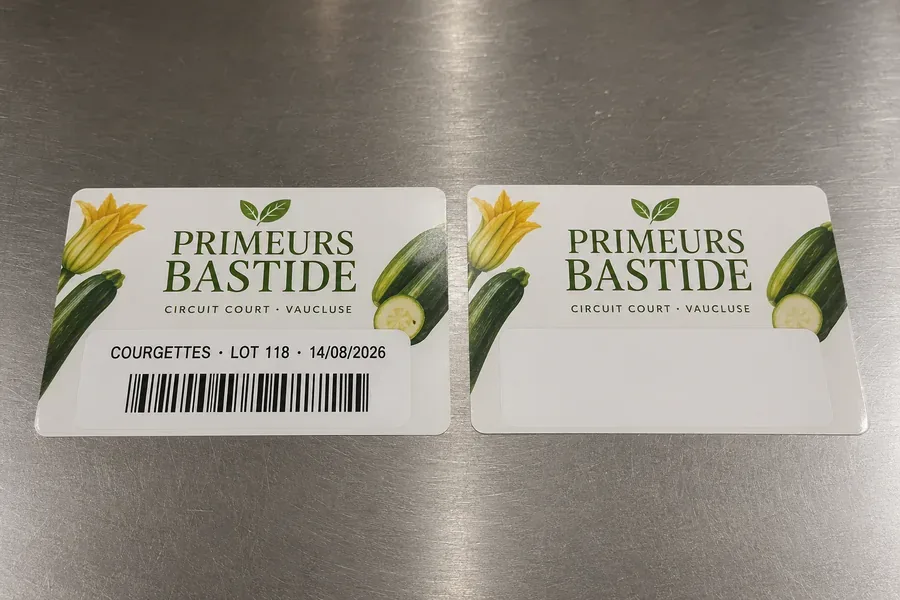
- When the lot is known at order time, we print it with the design; when it changes every day, we leave a bare panel and your coder prints it as you pack.
- The panel carries no varnish and no lamination, and it is big enough for what your coder prints: about 40 × 12 mm for a date and a lot.
The legal frame
Is a lot number mandatory on a label?
For prepacked food and for cosmetics, yes. Directive 2011/91/EU forbids marketing a food without an indication of the lot it belongs to — a batch of sales units produced, made or packed under practically the same conditions. The producer, manufacturer or packer decides what the lot is; the label only has to carry it, easily visible, clearly legible and indelible.
| Product | Lot or batch | Date | Text |
|---|---|---|---|
| Prepacked food | Mandatory; “L” in front unless clearly distinguishable | “Use by” for highly perishable food, “best before” for the rest, with listed exemptions | Directive 2011/91/EU; Regulation (EU) No 1169/2011, Art. 9(1)(f), Art. 24, Annex X |
| Frozen meat, meat preparations, unprocessed frozen fishery products | Mandatory | Date of first freezing as well: “Frozen on …”, day, month and year | Regulation (EU) No 1169/2011, Annex III point 6, Annex X point 3 |
| Cosmetics | Batch number or product reference; on the box alone if the container is too small | Date of minimum durability when the product keeps 30 months or less; period after opening above that | Regulation (EC) No 1223/2009, Art. 19(1)(c) and (e) |
| Other consumer products | A type, batch or serial number, or another element that identifies the product | No general date rule | Regulation (EU) 2023/988, Art. 9(5), applicable since 13 December 2024 |
The lot is not required on packs whose largest side is under 10 cm², on food that is not prepacked or packed at the customer’s request, on individual ice-cream portions (the lot goes on the multipack) and on farm produce leaving the holding for packing or processing (Directive 2011/91/EU, Article 2(2)).
Use by or best before: which one goes on the label?
The food business decides, not the printer, and the test is safety. Article 24 of Regulation 1169/2011 reserves “use by” for food that is microbiologically highly perishable and could become a danger to health after a short time — fresh meat, chilled ready meals, fresh fish. After that date the food is deemed unsafe. Everything else carries a “best before” date, a quality promise. “Expiry date” is the everyday word for both; it is not a legal mention on food.
| Date | English | French | Spanish |
|---|---|---|---|
| Best before, day given | Best before … | À consommer de préférence avant le … | Consumir preferentemente antes del … |
| Best before, month or year only | Best before end … | À consommer de préférence avant fin … | Consumir preferentemente antes del fin de … |
| Use by | Use by … | À consommer jusqu’au … | Fecha de caducidad … |
| Date of freezing | Frozen on … | Produit congelé le … | Fecha de congelación: … |
No “best before” date is needed on whole fresh fruit and vegetables, wines, other drinks of 10 % alcohol or more, bakery products eaten within 24 hours, vinegar, cooking salt, solid sugar, sugar confectionery and chewing gum (Annex X, point 1(d)). The lot is still required. For the rest of a food label, see our guide to the EU food labelling rules; for cosmetics, our cosmetics labelling guide.
Annex X and Article 13
How must the date and the lot be written?
The date is written in plain figures, in the order day, month, year, after the official words; the lot can be any code the business chooses. That difference matters on the packing line: a Julian code such as L26318 (year 26, day 318) is a valid lot, but never a valid date.
| The food keeps | Minimum to print | Example |
|---|---|---|
| Up to 3 months | Day and month | Best before 14.12 |
| More than 3 and up to 18 months | Month and year | Best before end 06.2027 |
| More than 18 months | Year | Best before end 2028 |
| “Use by” date, any shelf life | Day and month, year possible; storage conditions follow | Use by 24.11.2026 — keep at 0–4 °C |
- The words and the figures can be apart. Annex X allows the words followed by a reference to where the date is: “Best before: see lid”. The words then belong to the printed design and only the figures are coded.
- The date is a mandatory particular. Article 13 asks for an x-height of at least 1.2 mm, or 0.9 mm when the largest surface of the pack is under 80 cm². Check that your coder’s font reaches it.
- A “use by” date goes on every prepacked portion (Annex X, point 2(d)), not only on the outer pack.
- Cosmetics: the date of minimum durability follows the hourglass symbol or “best used before the end of”, as month and year or day, month and year.
Who prints what
Printed by us, or coded on your line?
Print the lot and the date with the label when they are known at order time; leave a panel when they change faster than you reorder labels. A batch number that is the same on the whole run is ordinary printing, included in the price. Only a value that changes label by label — a serial number, a sequential barcode — is variable data, priced as a supplement per run.
| Route | Who prints the lot and date | Best when | 100 labels | 1 000 labels |
|---|---|---|---|---|
| Lot and date in the artwork — white polypropylene, gloss varnish | We do, one version per batch | Batches planned ahead: drinks, preserves, cosmetics | €211 | €244 |
| Serial number or barcode changing label by label | We do, in the same pass | Traceability unit by unit, numbered cases | + €112 | + €123 |
| Overprintable roll — protected direct thermal paper | You do, on a thermal printer | A date that changes every day, chilled food | €218 | €251 |
| Overprintable roll — white polyester | You do, in thermal transfer | Wet, chemical or long-life products | €190 | €238 |
The supplement for changing data is added to the price of the label itself. Above 10 000 labels, quantities are quoted at volume rates — up to millions. Production takes 4 to 10 working days after proof approval; delivery is free in France and calculated by country elsewhere.
When we print it
Each batch is its own version of the file, with its own proof and its own run in the configurator. It suits batches planned weeks ahead and gives the cleanest result: the lot sits in the design, in the same inks, under the same varnish. For numbers that change label by label, send a starting value and a step — “from 1 001, one by one, four digits” is a complete brief — and see our page on numbered and barcode labels.

When you code it
One design serves every batch: you order the brand once and add the day’s data on your bench printer or on a coder mounted on the labeller. It is the usual choice for fresh and chilled food, where the date changes every morning. Our overprintable rolls are made for it; the range starts at €173 per 100, excluding VAT, on white polyester.
Printing everything yourself is the third route: blank rolls start at €63 per 100 in protected direct thermal paper and €61 in matt inkjet paper, excluding VAT — at the cost of a label without colour or brand.
- Material
- Protected direct thermal paper
- Format
- Up to 75 × 50 mm, any shape
- Printed by us
- Full colour design
- Free panel
- 45 × 20 mm, unvarnished
- You overprint
- Use-by date, lot, storage
- 1 000 labels
- €251 per recipe, excluding VAT
- 5 000 labels
- €400 per recipe, excluding VAT
Configurator prices read on 10 November 2026. Quantities are not capped — we print from a hundred pieces to several million.
Overprinting
Which label can your coder print on?
The coder decides the surface: a thermal head needs a smooth, bare face, an inkjet needs a surface its ink can grip, and none of them marks reliably through a varnish or a laminate. Name the machine with your order and we match the stock; the settings of the machine itself — head pressure, ribbon, ink — stay with its manufacturer.
| Coder | How it marks | Label face to choose | Watch out for |
|---|---|---|---|
| Direct thermal printer | The head darkens a heat-sensitive paper, no ribbon | Direct thermal paper, protected grade for damp rooms | Heat, sunlight and time fade the mark: short-life products |
| Thermal transfer printer or overprinter | The head melts ink from a ribbon onto the label | Coated paper, polypropylene or polyester with a bare panel | Ribbon grade matched to the face; any varnish on the panel |
| Inkjet coder, cartridge or continuous | Drops of ink sprayed onto the label | Uncoated or inkjet-receptive face for water-based inks; films with the coder’s solvent inks | Drying time and rub resistance: test on your stock |
| Laser coder | Removes a layer of ink or marks a reactive coating | A printed block or coating specified by the laser supplier | Quoted per job through a custom request |
| Hot-stamp coder | Heated type presses a foil onto the label | Paper with a bare panel | Pressure on thin films |
Five rules for the panel
- No varnish and no lamination over it. Our overprintable range ships unprotected for that reason.
- Big enough for what the coder prints, plus 2 mm all round: about 40 × 12 mm for a date and a lot, 40 × 25 mm with a Code 128 barcode.
- A white or light, plain ground: a tint or a pattern behind black figures breaks contrast.
- Where the head actually prints. A coder prints at a fixed distance from the edge of the web: send a label it has produced and we place the panel around it on the proof.
- Inside the safety area, never across the cut — see our guide to preparing print-ready files.

Thermal paper or thermal transfer? Our guide direct thermal vs thermal transfer compares them printer by printer. On damp, chilled or frozen packs, the stock must also survive the cold: see the cold-chain labelling guide.
GS1 Application Identifiers
Can a barcode carry the lot and the expiry date?
Yes: GS1-128 barcodes and GS1 DataMatrix codes carry them through Application Identifiers, the two- or more-digit prefixes in brackets. A lot or a date never travels alone: it qualifies a product number, the GTIN, which usually comes first. The human-readable date in words and figures stays mandatory on food — the barcode is for scanners, not a substitute.
| AI | Data | Format |
|---|---|---|
| (01) | GTIN, the product number | 14 digits |
| (10) | Batch or lot number | Up to 20 characters |
| (11) | Production date | YYMMDD |
| (13) | Packaging date | YYMMDD |
| (15) | Best before date | YYMMDD |
| (17) | Expiration date — use by | YYMMDD |
| (21) | Serial number | Up to 20 characters |
Example: (01)09506000134352(17)261124(10)L26318 — the GS1 demonstration GTIN, a use-by date of 24 November 2026 and lot L26318. Note the order: the barcode writes the date year first, the label day first.
A barcode carrying the day’s lot and date is printed where the date is: by your coder in the panel, or by us when the batch is known — and if every label carries its own serial number (21), that is variable data. A code that must scan first time needs room and contrast: see barcode print quality; to carry the same data in a QR code a phone can read, see GS1 Digital Link.
Before you order
Seven lot and date mistakes — and a checklist
The label rarely fails on the law itself; it fails at the moment the coder meets the label. The seven we see most often:
- A varnish or a laminate over the coding panel: the thermal head leaves nothing, the ink smears.
- A panel smaller than what the coder prints, or not where its head prints.
- A date printed in code — 26318, or a month as a letter — where Annex X asks for plain figures.
- “Best before” on a product that needs “use by”, or the reverse.
- A lot with no “L” in front, lost among other numbers on the label.
- Direct thermal paper on a product kept for months, in the light or near heat: the date fades.
- A batch printed in the artwork for a run larger than the batch: the leftover labels cannot be used.
- Lot route decided: printed with the design, numbered label by label, or coded on your line.
- Date type confirmed by the food business: use by, best before, or none.
- Official words printed in the design, in the language of each country of sale.
- Panel size and position checked against a label your coder has printed.
- No varnish or lamination on the panel; light, plain ground.
- Stock matched to the coder: direct thermal, thermal transfer, inkjet.
- Coder make and model written in the order notes.
Price a run with a free panel on our overprintable rolls, printed by us and dated by you, from €183 per 100 excluding VAT, or a numbered run in the configurator. For a laser or inkjet coder, an unusual panel or a stock to test with your machine, send a custom request.
FAQ
Lot numbers and dates on labels — what producers ask us
Is a lot number mandatory on food labels in the EU?
Yes. Directive 2011/91/EU forbids marketing a food without an indication of its lot. It is preceded by the letter L unless it is clearly distinguishable from the other mentions. Exceptions: packs whose largest side is under 10 cm², food that is not prepacked, individual ice-cream portions and farm produce leaving the holding for packing or processing.
What is the difference between a use-by date and a best-before date?
A use-by date is for food that is microbiologically highly perishable: after it, the food is deemed unsafe (Regulation 1169/2011, Article 24). A best-before date is a quality date for everything else. Both are printed after their official words, in plain figures, day before month.
Can the date replace the lot number?
Yes, for food: Article 5 of Directive 2011/91/EU allows the use-by or best-before date to stand in for the lot, provided it shows at least the day and the month, uncoded and in that order. A date given only as month and year does not replace the lot.
Can you print a different number on every label?
Yes. Serial numbers and sequential barcodes are printed in the same pass as the design, from 100 labels. It is a supplement per run, not per label: + €112 on 100 labels and + €123 on 1 000, excluding VAT. A batch number that is the same on the whole run is included in the price.
Which labels can I overprint with my own printer?
Labels with a bare, unvarnished panel matched to your machine: protected direct thermal paper from €183 per 100 for a direct thermal printer, white polyester from €173 for thermal transfer, excluding VAT. For inkjet or laser coders, tell us the machine through a custom request.
How big should the coding panel be?
Big enough for what your coder prints, plus about 2 mm all round: roughly 40 × 12 mm for a date and a lot, 40 × 25 mm with a Code 128 barcode. Send a label your machine has printed and we place the panel around it on the proof.
Does a cosmetic product need a batch number?
Yes. Article 19 of Regulation 1223/2009 requires a batch number or a product reference, on the container and the packaging, or on the packaging alone if the container is too small. Products that keep 30 months or less also carry a date of minimum durability.
This guide is a practical summary written by a label manufacturer, not legal advice. The lot, the date and the wording on a label are the responsibility of the business that places the product on the market. Texts read on EUR-Lex and on the GS1 reference site on 10 November 2026: check the version in force and your sector’s specific rules before printing.
Official texts: Directive 2011/91/EU on indications or marks identifying the lot to which a foodstuff belongs — EUR-Lex · Regulation (EU) No 1169/2011 on food information to consumers, consolidated text of 1 April 2025 — EUR-Lex · Regulation (EC) No 1223/2009 on cosmetic products — EUR-Lex · Regulation (EU) 2023/988 on general product safety — EUR-Lex · GS1 Application Identifiers — GS1
Still unsure?
Ask the person who makes them
The guide covers the general case — your label lives on a real product. Describe it in two lines and a label specialist (not a bot) answers within 2 working hours.
All guides
Everything else we have written down
- Choosing your label material
- Choosing your label adhesive
- Bottle and jar label sizes
- EU food labelling — the INCO rules
- EU wine label rules
- Environmental claims and sorting labels
- Preparing print-ready files
- Variable data, explained
- Label material comparison chart
- EU vs UK labelling requirements
- What drives the price of a label
- Label glossary
- Direct thermal vs thermal transfer
- GS1 Digital Link and QR codes
- Barcode print quality and ISO 15416 grades
- GHS and CLP chemical labels, BS5609 included
- Printed packing tape vs labels, cost per parcel
- EU Battery Regulation labels and QR code
- Cold-chain labelling: freezer, fridge, steam
- Cosmetics labelling — Regulation 1223/2009
- Batch numbers, lot codes and expiry dates — you are here
- Label unwind direction and roll specs
Labels ready for your lot and date
Overprintable polyester from €173 per 100, thermal paper from €183, numbering from + €112 per run, excluding VAT.