
Guides · updated 14 September 2026
GS1 Digital Link and QR codes on labels: the 2027 barcode transition
The short answer: Sunrise 2027 is a target for tills, not a ban on the EAN. By the end of 2027 retail point-of-sale scanners should read a QR code carrying a GS1 Digital Link, and until they do your pack keeps its linear barcode next to the new one. The QR itself is a web address with the GTIN inside it — one symbol for the checkout, the consumer page and traceability. On the label it needs modules of at least 0.396 mm, a four-module quiet zone, black on white and no gloss over it.
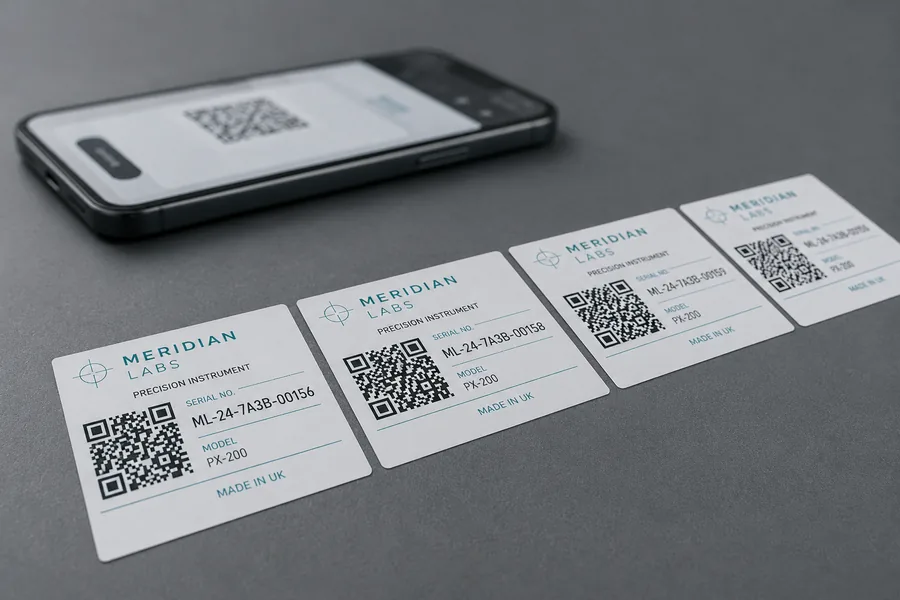
The date
Sunrise 2027 is a scanner target, not the end of the EAN
The GS1 General Specifications state it in one sentence: GS1 supports industry’s ambition to read 2D barcodes at retail points of sale around the world by the end of 2027 (GS1 General Specifications, release 26.0, January 2026). The obligation falls on the till, not on your label — yet.
The retail implementation guideline is equally plain: linear barcodes will not go away and will coexist with 2D barcodes for as long as there are uses for them. Until 90 % of POS scanning solutions can process a GS1-compliant 2D code, any product carrying one will need to be accompanied by a POS linear barcode (2D Barcodes at Retail Point-of-Sale Implementation Guideline, release 1.1.0, December 2025). That is « dual marking »: EAN-13 and QR side by side on the same label.
The industry letter behind the initiative, signed in June 2024 by the GS1 Management Board companies, sets the same horizon — QR codes with GS1 standards widely adopted by the end of 2027, with pilots in 48 countries (GS1 endorsement statement, 2024). GS1 US adds that it is not necessary to implement all the capabilities of 2D by that date (GS1 US, Sunrise 2027).
So the decision in 2026 is not « replace the barcode » but « add a second symbol on the next artwork revision, so the pack is ready when the tills are ».
- Who must change
- retail POS scanners
- By when
- end of 2027
- EAN / UPC
- kept, not abolished
- Transition
- dual marking
- Linear code dropped
- once 90 % of tills read 2D
The standard
GS1 Digital Link puts the GTIN inside a web address
A GS1 Digital Link is a URI syntax, not a new kind of barcode. It writes GS1 identifiers as
path segments of an ordinary URL: https://id.gs1.org/01/09520123456788 is the canonical
form for GTIN 9520123456788, and the same product with batch ABC123 and serial 12345 becomes
/01/09520123456788/10/ABC123/21/12345
(GS1 Digital Link URI Syntax, release 1.7.0, August 2026).
The numbers after the slashes are the familiar GS1 Application Identifiers: 01 for GTIN, 10 for
batch, 21 for serial, 17 for expiry.
That structure is the whole point. A till decodes the string offline, finds the 01 segment and prices the item as it does with an EAN today. A phone opens the same string as a link, and a resolver on your domain sends the visitor to the right page — ingredients, a recall notice, a wine e-label. GS1 calls it a single multipurpose 2D barcode whose content can be continually updated by a brand owner, without the need to change the QR Code (GS1, GS1 Digital Link).
Two consequences. GS1 recommends brand owners use their own domain name in the URI (implementation guideline, section 3.3): the printed code should belong to you, not to a service. And a plain marketing link to your home page is a QR code, but not a GS1 Digital Link — no till will price it.
Three symbols
QR code for the shelf, GS1 DataMatrix for healthcare, EAN-13 until the tills catch up
All three are conformant at retail POS during the transition. The figures below are GS1’s own (capacities, symbol specification tables); the « where used » column is GS1’s guidance, summarised.
| Symbol | Data it carries | Capacity | X-dimension at POS | Quiet zone | Read by | Where used |
|---|---|---|---|---|---|---|
| QR code (GS1 Digital Link URI) | GTIN + batch, serial, expiry, in a URL | 7 089 numeric · 4 296 alphanumeric | 0.396 – 0.990 mm (target 0.495) | 4 modules, all sides | Imager tills, every phone camera | Consumer goods, food, drinks, cosmetics |
| GS1 DataMatrix (element string) | GTIN + batch, serial, expiry, no URL | 3 116 numeric · 2 335 alphanumeric | 0.396 – 0.990 mm (target 0.495) | 1 module, all sides | Imager tills and industrial scanners; not all phone cameras | Healthcare, pharmacy, small industrial parts |
| EAN-13 | GTIN only | 13 digits | 0.264 – 0.660 mm (target 0.330) | 11 modules left, 7 right | Every till, laser or imager | Everything sold at retail today |
The 2D symbols are printed at 1.5 times the module width of linear codes because the imager needs it — hence 0.396 mm rather than 0.264. And GS1’s support desk says why QR wins on the shelf: the default camera application on any mobile device in the world can automatically scan the QR Code, whereas not every phone camera processes Data Matrix (GS1 GO, May 2025). For a consumer product, choose the QR.
On the label
Count on 16 to 20 mm, not the 10 mm of a marketing QR
A QR only phones will read can be small — our print-ready guide asks for 10 × 10 mm with 3 to 4 mm clear. A QR the till must read follows GS1 table 5-46: modules of 0.396 mm minimum, 0.495 mm target, 0.990 mm maximum, a quiet zone of four modules on every side, and a minimum grade of 1.5 measured with a 12-mil aperture under 660 nm light.
The arithmetic follows from the module count. A GTIN-only URI on a short brand domain fits comfortably in a 33 × 33-module symbol. At the minimum module that is 13.1 mm of code plus 1.6 mm of quiet zone each side — 16.3 mm square. At the target module, 20.3 mm square. Add a batch and a serial and the symbol grows a version step or two. GS1’s own example: at 0.495 mm the quiet zone alone is 1.980 mm (implementation guideline, section 4.6.4).
Error correction is the other lever. QR offers L 7 %, M 15 %, Q 25 % and H 30 %, and a higher level means a bigger symbol for the same data (section 4.6.3). For a label that will be handled and possibly wrapped round a bottle, M is the sensible floor; do not buy H and then spend it on a logo in the middle of the code.
Place it inside the safety area, never across a cut or a fold, with the margin free of type and background art — the rules are in preparing print-ready files; the formats that leave room for two barcodes are in bottle and jar label sizes.
- Module, minimum
- 0.396 mm
- Module, target
- 0.495 mm
- Module, maximum
- 0.990 mm
- Quiet zone
- 4 modules, all sides
- Minimum grade
- 1.5 / 12 / 660
- 33-module QR, min.
- 16.3 mm square
- 33-module QR, target
- 20.3 mm square
The substrate
Black on white, matt over it, and no red — the material rules
The reasoning is optical. Scanners and verifiers illuminate the code with red light at 660 nm, therefore red, orange and yellow 2D barcodes will be difficult to decode; the best colour combination to support consistent reading is black and white (guideline, section 4.6.5). Sheen matters as much: the shiny surface will reflect light back on to the scanner’s imager, and glossy coatings are not commonly used because they reflect light and could distort a 2D barcode (same guideline, notes on label materials).
In our catalogue, four rules. A white coated paper, a white polypropylene or a white polyester takes a black QR without further thought — the material choice is in choosing your label material and the comparison chart. On clear polyester, print an opaque white panel under the code: the guideline’s cautionary example is the translucent salad bag whose contents show through and defeat the decoder. On a dark or metallic design, reserve a white panel rather than printing the code in reverse — a light-on-dark QR reads on some phones and fails at the till.
Lamination is the one to think about. Where the film needs protecting — on synthetics our configurator adds it automatically — choose matt lamination: same price as gloss, about + £8 on a run of 100, and it does not throw the imager’s light back. Textured and uncoated creative or eco stocks are the ones we decline for codes that must scan every time; the list is in the variable-data guide.
Thermal overprint is legitimate when the batch changes daily: we print the design and the static QR, you print the batch in the blank panel. The mark then depends on your printer and ribbon — the pairings are in direct thermal vs thermal transfer; for grade 1.5 at 0.396 mm modules, use a resin or wax-resin ribbon on a coated face and verify the first roll.
- White coated paper
- yes
- White PP / PET
- yes
- Clear PET
- with white panel
- Dark or metallic
- white panel only
- Matt lamination
- yes
- Gloss lamination
- avoid over the code
- Red / orange / yellow code
- no
- Kraft, textured, eco
- not for POS codes
Static or serialised
One code per SKU is ordinary printing; one per unit is variable data
A GS1 Digital Link with the GTIN alone is the same on every label in the run: printed with the artwork, nothing extra, and it already does both jobs — pricing at the till and a consumer page per product. For most small brands this is the whole migration.
Add /10/ batch or /21/ serial and the code changes from batch to
batch, or unit to unit. GS1 calls this dynamic data: EAN/UPC barcodes can only accommodate
static data while 2D barcodes like GS1 DataMatrix or QR Codes can use dynamic data — the basis
of targeted recalls (implementation guideline, section 4.7.1). On our press that is the « unique QR
codes » option: from + £109 per run, a supplement on the run rather than a price per label, so
+ £142 on three thousand. The file to send and the materials that accept it are in the
variable-data guide; the product page is
numbered, barcode and QR labels.
The rule of thumb: serialise when a unit has its own story — a bottle to authenticate, a part to recall individually. Otherwise encode GTIN plus batch, which changes once per run, not once per label, and is set at order time like any batch number.
- GTIN only, same on all
- included
- GTIN + batch, fixed per run
- included
- GTIN + serial, one per unit
- from + £109 per run
- Same at 3 000 labels
- + £142 per run
- Batch printed by you
- overprintable roll
Proof
Verify against ISO/IEC 15415 — a phone that scans proves nothing
Print quality of 2D symbols is graded under ISO/IEC 15415, which GS1 references normatively; the grade runs from 4 (best) to 0 and only means something with the aperture and light it was measured under — hence the retail requirement written 1.5/12/660 (GS1 DataMatrix Guideline, section 4.6; implementation guideline, section 7.2). The QR symbology itself is ISO/IEC 18004.
Our sequence before a run with a POS code. One: the URI parses as a GS1 Digital Link and the GTIN check digit is right. Two: the code sits at final size on the proof, quiet zone drawn, and you approve it. Three: the first labels are read with three phones — a current iPhone, a current Android, an older handset — in daylight and under warm shop light, on the actual container. Four: for a product going into a national retailer, a verifier report to ISO/IEC 15415 from the first roll, because a barcode that works well with a consumer device may not read well at retail point-of-sale (guideline, section 4.6.5). The phone test catches the gross errors; the grade catches the ones a buyer sends back.
The plan
Six steps between now and the end of 2027
1 · Autumn 2026 — audit the GTINs
List every SKU, its GTIN and who owns the prefix; a product on an internal code cannot be migrated. Decide the domain the codes will live on — yours.
2 · By December 2026 — build the URIs
One canonical URI per SKU in the /01/ form, plus /10/ batch where you want traceability. Point the domain at a resolver, even a simple redirect table.
3 · Q1 2027 — revise the artwork
Keep the EAN-13. Add the QR at 0.495 mm modules with its four-module margin on a white panel, matt over it, inside the safety area. Send us the file and the URIs.
4 · Q1 2027 — proof and verify
Approve the proof at final size. Test the first labels on three phones and the container. Ask for a verifier grade if a retailer will scan it — at least 1.5/12/660.
5 · Q2 2027 — ship dual-marked
Run the new artwork on the next order, from 100 labels. Tell your retailers the pack carries a GS1 Digital Link and ask which tills already read 2D.
6 · 2028 and after — decide on the EAN
Keep the linear code until your retailers confirm their tills read 2D. GS1 sets the bar at 90 % of POS solutions; nobody asks you to drop the EAN in 2027.
The artwork brief in one line: GTIN verified · URI on your own domain · EAN-13 kept · modules 0.495 mm · quiet zone four modules · black on white · matt over the code · inside the safety area · proof at final size · phones and verifier tested. Send the URIs and the file through the custom request form and we quote the run with both codes in place.
Being straight about it
Five mistakes that turn a compliant pack into a reprint
A shortened URL. A shortener hides the GTIN behind an opaque token, so the till cannot find the 01 segment: it is a QR, not a Digital Link. Encode the full URI on your domain.
A rented dynamic QR. Subscription QR services redirect through their domain; when the plan lapses, every printed pack points nowhere. A Digital Link on your own domain changes destination just as freely, without reprinting.
Too small on a curve. On small items and curved surfaces the size becomes a critical factor, says the guideline, and its bi-optic scanner image of a QR on a curve shows why. Put the code on the flattest face — or on the back label — and size it at the target module.
Art inside the code. Logos, colours and rounded modules spend the error correction before the scuffs do. GS1 asks for every modified code to be verified to ISO/IEC 15415; a plain black symbol needs no such argument.
Two codes, wrong placement. During dual marking both symbols sit on the pack. Keep them apart, and never let the QR eat the EAN’s own quiet zone — 11 modules on the left, 7 on the right.
- Full URI, own domain
- always
- Destination changes
- at the resolver
- Curved bottle
- target module, flat face
- Design in the code
- none
- EAN quiet zones
- 11 left · 7 right
- QR quiet zone
- 4 modules
FAQ
GS1 Digital Link and QR codes — what customers ask us
Do I have to replace my EAN-13 barcode with a QR code by 2027?
No. Sunrise 2027 is a target for retail point-of-sale scanners to be able to read the GTIN from a 2D code by the end of 2027. GS1 states that linear barcodes will not go away, and that a product carrying a 2D code must also carry its linear barcode until 90 % of POS scanning solutions can read 2D. The practical move for a brand is to add a GS1 Digital Link QR next to the EAN on the next artwork revision.
What is the difference between an ordinary QR code and a GS1 Digital Link?
The syntax of what is encoded. A GS1 Digital Link is a web address whose path carries GS1 identifiers — https://your-domain/01/09520123456788 for a GTIN, with /10/ for batch and /21/ for serial. A till reads the GTIN from it offline; a phone opens it as a link. An ordinary marketing QR pointing at a home page is scannable by phones but carries no GTIN and cannot be priced at the checkout.
How big must a QR code be to scan at a retail till?
GS1 specifies modules of 0.396 mm minimum, 0.495 mm target and 0.990 mm maximum, with a quiet zone of four modules on every side and a minimum print grade of 1.5/12/660. For a GTIN-only URI on a short domain, that gives roughly a 16 mm square at the minimum module and 20 mm at the target — noticeably larger than the 10 × 10 mm a phone-only QR gets away with.
Can I print the QR code in my brand colour, or on a dark label?
Scanners illuminate the code with red light at 660 nm, so red, orange and yellow codes are difficult to decode, and GS1 states that black on white is the best combination. On a dark, metallic or clear label, reserve an opaque white panel and print the code black on it. Prefer a matt lamination or varnish over the code: gloss reflects the scanner light back at the imager.
Is a different QR code on every unit expensive?
It is a supplement on the run, not a price per label: unique QR codes start at + £109 per run and are + £142 on three thousand labels. A GS1 Digital Link with the GTIN alone, or GTIN plus a batch number that is fixed for the run, is the same on every label and is ordinary printing, included in the price. Serialise only when each unit needs its own record — authentication, individual recall, a per-bottle e-label.
Still unsure?
Ask the person who makes them
The guide covers the general case — your label lives on a real product. Describe it in two lines and a label specialist (not a bot) answers within 2 working hours.
All guides
Everything else we have written down
- Choosing your label material
- Choosing your label adhesive
- Bottle and jar label sizes
- EU food labelling — the INCO rules
- EU wine label rules
- Environmental claims and sorting labels
- Preparing print-ready files
- Variable data, explained
- Label material comparison chart
- EU vs UK labelling requirements
- What drives the price of a label
- Label glossary
- Direct thermal vs thermal transfer
- GS1 Digital Link and QR codes — you are here
EAN-13 and GS1 Digital Link QR on the same label.
Static codes included in the run. One QR per unit from + £109 per run.