
Guides · updated 5 August 2026
A hundred labels, a hundred different numbers
The short answer: variable data means every label in the run carries something different — a serial number, a barcode, a unique QR, a name. It is a supplement on the run, not a price per label: + €112 on a hundred labels, and still only + €147 on three thousand. Which is why it costs €1.12 a label at 100 and five cents at 3 000.
Two families
Incrementing numbers, or a list you supply
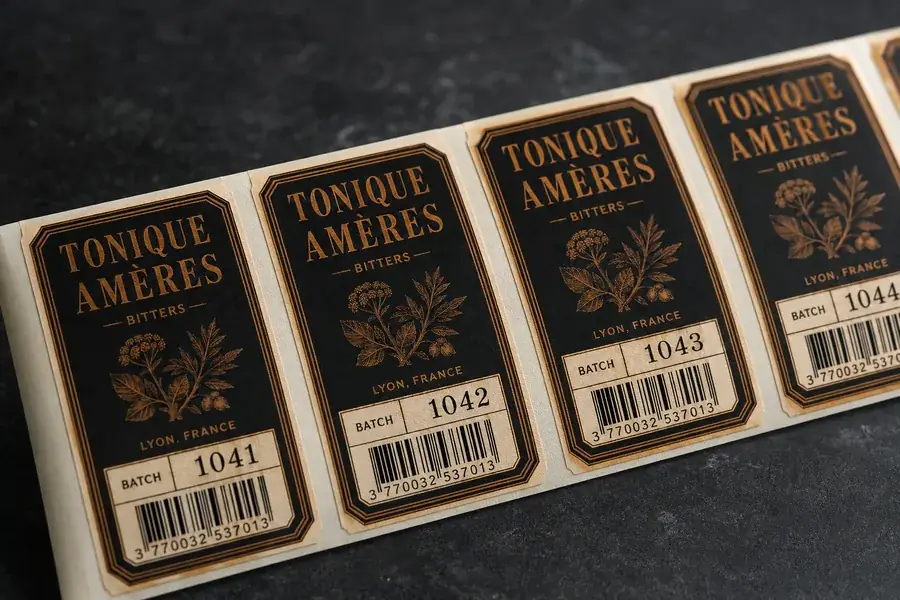
Numbering and barcodes — the label counts. Serial numbers, batch numbers, sequential barcodes, asset references. You give us a starting point and a step; the press does the rest. This is what security seals, asset labels and numbered tickets use.
Unique QR codes and name lists — every label carries a different value that is not a sequence: a one-time authentication code, a personalised name, a URL per product. Here we work from the list you send.
Both are printed in the same pass as the design, which is what keeps them affordable: the press does not stop, it just changes what it prints. It also means the data has to be settled before the run — a numbered run cannot be corrected afterwards, only reprinted.
- Numbering, barcodes
- from + €112
- Unique QR, name lists
- from + €127
- Printed
- in the same pass
- Minimum
- 100 labels
- Settled
- before the run starts
The economics
A supplement per run — so it collapses with volume
| Quantity | Numbering & barcodes | Unique QR & name lists | Per label, numbering |
|---|---|---|---|
| 100 | + €112 | + €127 | €1.12 |
| 500 | + €115 | + €130 | €0.23 |
| 1 000 | + €123 | + €139 | €0.12 |
| 2 000 | + €136 | + €153 | €0.07 |
| 3 000 | + €147 | + €166 | €0.05 |
Read the first column and the last one together: the supplement grows by 31 % while the quantity grows thirtyfold. Numbering a hundred labels is an expensive habit; numbering three thousand is a rounding error. If you are hesitating on quantity for another reason, this is the argument that usually settles it. Above 10 000 labels, quantities are quoted at volume rates — up to millions.
The constraint
Four families accept it. Two do not.
Variable data is available on coated papers, synthetics, industrial and security stocks — thirteen materials in total, which covers every application where a label has to identify one particular object.
It is not available on creative papers or on eco-friendly stocks. Textured, uncoated and fibre-rich surfaces do not give a reliable enough mark for a code that must scan every time, and a barcode that fails on one label in fifty is worse than no barcode.
If you need both — a kraft look and a serial number — there are two honest routes: put the number on a second small label in a coated stock, or use an overprintable roll and print the number yourself. Tell us the case on the request form and we will say which is cheaper for your run.
- Coated papers
- yes
- Synthetics
- yes
- Industrial
- yes
- Security
- yes
- Creative papers
- no
- Eco-friendly
- no
- Blank rolls
- you print it
What we need
A starting number is usually the whole brief
For a sequence
The first number, the step, and how many digits. « From 1 001, one by one, four digits » is a complete instruction. Leading zeros and a prefix are free.
For a list
One value per line, in the order you want them. A spreadsheet is convenient but not required — a starting number or a simple list is enough, we handle the rest.
For codes
The symbology if you know it (Code 128, EAN-13, QR), or simply the values and what they are for. We choose the encoding and check that it scans. What makes a printed code grade well: barcode print quality.
Then leave the space: a number needs about 40 × 12 mm, a Code 128 barcode about 40 × 25 mm, a QR at least 10 × 10 mm with its clear margin. Put them inside the safety area, never across the cut — the rules are in preparing print-ready files.
Being straight about it
Three cases where you should not buy variable data
The data changes every morning. A use-by date, a batch cooked today. Printing it commits you to one production day. Take an overprintable roll: we print the design in colour, you print the date as you pack.
The same code on every unit. An EAN for a product reference, a QR pointing at your website, a wine e-label for one cuvée — that is ordinary printing, included in the price. Only a code that changes is variable data.
You already own a printer. If a thermal transfer printer sits on your packing bench, blank rolls from €44 per 100 plus your own numbering may be the cheaper answer — at the cost of a monochrome label.
- We print it
- + €112 per run
- You overprint it
- rolls from €183
- You print everything
- blank from €44
- Same code for all
- included
FAQ
Variable data — what customers ask us
How much does numbering cost?
It is a supplement on the run, not a price per label: + €112 on 100 labels, + €123 on 1 000 and + €147 on 3 000 for numbering and barcodes. Unique QR codes and name lists are + €127, + €139 and + €166 for the same quantities. Per label that is €1.12 at a hundred and five cents at three thousand.
Do I have to send an Excel file?
No. For a sequence, a starting number, a step and a number of digits are enough — « from 1 001, one by one, four digits » is a complete brief. For a list of names or codes, one value per line in any readable form works. A starting number or a simple list is enough; we handle the rest.
Can I have numbering on kraft or recycled paper?
Not in the online configuration: variable data is available on coated papers, synthetics, industrial and security stocks, but not on creative or eco-friendly ones — those surfaces do not give a mark reliable enough for a code that must scan every time. The workaround is a second small label on a coated stock, or an overprintable roll you print yourself.
Is a QR code on every bottle variable data?
Only if the code changes from bottle to bottle. One code per cuvée or per product reference, printed identically on the whole run, is ordinary printing and costs nothing extra. A different QR on each unit — for authentication or traceability — is variable data, from + €127 a run.
Can you start the numbering at a specific value?
Yes, anywhere you like, with any prefix and any number of digits — « FR-0450 » onwards, or 1 001, or 24-00001. Tell us the first value and the step. If you are continuing a series from a previous order, say so and we carry on from where the last run stopped.
Still unsure?
Ask the person who makes them
The guide covers the general case — your label lives on a real product. Describe it in two lines and a label specialist (not a bot) answers within 2 working hours.
All guides
Everything else we have written down
- Choosing your label material
- Choosing your label adhesive
- Bottle and jar label sizes
- EU food labelling — the INCO rules
- EU wine label rules
- Environmental claims and sorting labels
- Preparing print-ready files
- Variable data, explained — you are here
- Label material comparison chart
- EU vs UK labelling requirements
- What drives the price of a label
- Label glossary
- Direct thermal vs thermal transfer
- GS1 Digital Link and QR codes
- Barcode print quality and ISO 15416 grades
- GHS and CLP chemical labels, BS5609 included
- Printed packing tape vs labels, cost per parcel
One run, three thousand different labels.
From + €112 per run — and five cents a label at 3 000.