
Guides · updated 29 July 2026
The rule that decides your label size is a font size
The short answer: Regulation (EU) 1169/2011 — « INCO » — sets twelve mandatory particulars, fourteen allergens to emphasise, and a minimum text height of 1.2 mm (0.9 mm on very small packs). That last figure is the one that catches producers out: it is not a design preference, it is a legal minimum, and it dictates how much label you have to buy.
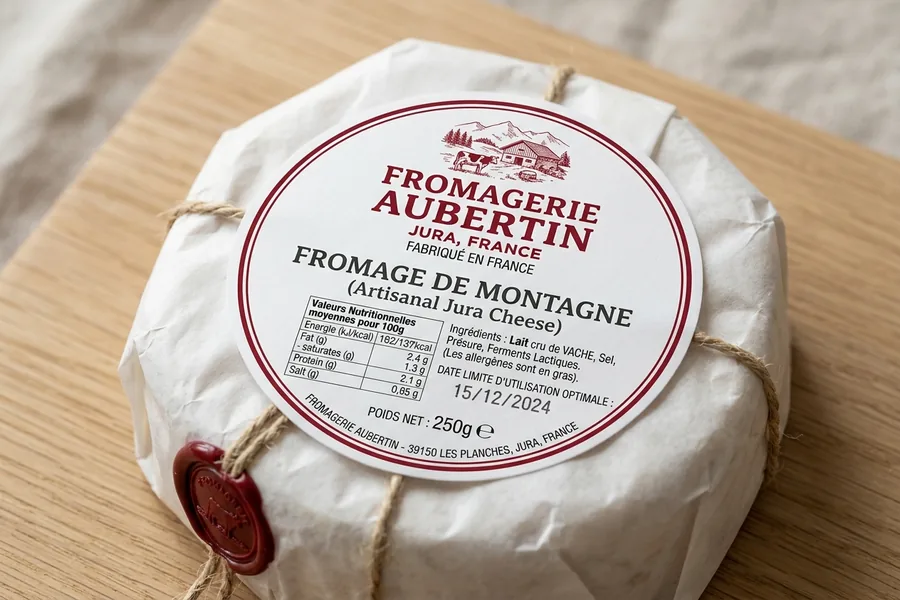
Article 9
Twelve things that must appear on a prepacked food
| # | Particular | What trips producers up |
|---|---|---|
| 1 | Name of the food | The legal or customary name, not your brand name. « Fruit spread » and « jam » are not interchangeable. |
| 2 | List of ingredients | In descending order of weight at the time of manufacture. Additives carry their function and their name or E number. |
| 3 | Allergens, emphasised | Inside the ingredient list, standing out from the rest — bold, capitals, a different type. Colour alone is fragile. |
| 4 | Quantity of certain ingredients (QUID) | If an ingredient is in the name or pictured, its percentage is required. « Strawberry jam » must say how much strawberry. |
| 5 | Net quantity | In the same field of vision as the name and, for drinks over 1.2 % vol, the alcoholic strength. |
| 6 | Date | « Use by » for perishable foods, « best before » for the rest. They are not synonyms and the choice is not yours. |
| 7 | Storage and conditions of use | Including what to do after opening, when that changes the date. |
| 8 | Name and address of the operator | The business under whose name the food is marketed, established in the EU. |
| 9 | Country of origin | Where required by the rules for that product, or where its absence would mislead. |
| 10 | Instructions for use | Where the food cannot reasonably be used without them. |
| 11 | Alcoholic strength | For beverages over 1.2 % vol. |
| 12 | Nutrition declaration | Per 100 g or 100 ml, in the fixed order below. Some products are exempt. |
A thirteenth item is not in Article 9 but is required all the same: the lot number, under Directive 2011/91/EU. It is also the particular most often forgotten on a first proof — and the one a variable-data print can add for you, from + £95 a run.
Annex II
Fourteen allergens, and they must stand out from the list
Cereals containing gluten · crustaceans · eggs · fish · peanuts · soybeans · milk · nuts · celery · mustard · sesame · sulphur dioxide and sulphites above 10 mg/kg · lupin · molluscs.
They are declared inside the list of ingredients, using the name of the substance, and emphasised so they are distinguishable from the surrounding text — typically bold, sometimes capitals or a different typeface.
Two printing consequences worth knowing before you design. First, emphasis by colour alone is a bad idea: it disappears on a one-colour label and on a photocopy of your artwork. Second, bold text at 1.2 mm needs a typeface that survives it — a light condensed sans at that size fills in and becomes unreadable on an uncoated paper.
- Safest
- bold, same size, same font
- Acceptable
- capitals, underline
- Fragile
- colour on its own
- On kraft or textured
- bold, and one point up
- Minimum height
- 1.2 mm x-height
Article 13
1.2 mm — and it is not the font size you type in your software
The regulation sets a minimum x-height of 1.2 mm: the height of a lower-case « x » in your chosen typeface, not the point size. Depending on the font, that lands somewhere around 6 to 8 pt — two typefaces set at the same point size can sit on either side of the line.
On packaging whose largest surface is under 80 cm², the minimum falls to 0.9 mm. That is a small pot or a sample jar; a standard 250 g jar is well over the threshold, so 1.2 mm applies.
Check it on the proof, not on screen: measure the printed « x » with a loupe or a ruler at 100 % scale. We can confirm it on the PDF you send us — ask when you send the file and we will tell you whether the smallest text on the label clears the minimum.
- Standard packs
- x-height ≥ 1.2 mm
- Largest surface < 80 cm²
- x-height ≥ 0.9 mm
- Measured on
- the lower-case x
- Roughly
- 6 to 8 pt, font dependent
- Verified
- on the printed proof
The consequence nobody plans for
Mandatory text is an area, and the area has to be bought
Ingredients, allergens, nutrition table, weight, dates, address, lot: on a simple recipe that block runs to roughly 60 to 90 words plus a seven-line table. Set at the legal minimum with the leading it needs to stay legible, it occupies real estate — and that is before your brand, your logo and the reason someone picks the jar up.
| If your label is | Realistically | What we would do |
|---|---|---|
| Under 40 × 30 mm | The mandatory block does not fit at 1.2 mm. | Split it: a front label and a back label, two labels on one order. |
| 50 × 70 mm | Fits, tightly, with a disciplined ingredient list. | Give the table its own column and keep the brand on the front. |
| 75 × 100 mm | Comfortable for most recipes. | The size most of our food customers land on. |
| Over 100 × 105 mm | Above the ceiling for coated and creative papers. | Move to a synthetic, which runs to 150 × 220 mm. |
| Still not enough | Multilingual ranges, long ingredient lists. | A multi-layer peel label — produced on request rather than configured online. |
💡 The cheapest fix is almost always two labels rather than one big one: a small front label on a creative paper for the brand, and a plain back label on coated paper at £116 per 100 for the legal text. Nobody reads the back label for pleasure.
Annex XV
The nutrition declaration has a fixed order
Energy, then fat, of which saturates, carbohydrate, of which sugars, protein, salt — per 100 g or 100 ml, and in that sequence. Energy is given in both kJ and kcal. A per-portion column may be added, but it never replaces the per-100 one.
Several categories are exempt, among them unprocessed single-ingredient products, herbs and spices, waters, and foods supplied in small quantities directly by the maker to the final consumer or to local retailers. The exemptions are narrower than most small producers hope — if you are counting on one, confirm it before you print two thousand labels.
- 1
- Energy — kJ and kcal
- 2
- Fat
- 3
- of which saturates
- 4
- Carbohydrate
- 5
- of which sugars
- 6
- Protein
- 7
- Salt
From our proofs
Five things we catch before printing — and one we cannot
Text below 1.2 mm
Usually the address line or the nutrition table, shrunk at the last minute to make everything fit. It is the first thing we measure.
No lot number
Forgotten because it is not in the famous list of twelve. If it changes per batch, leave a bare panel and overprint it — or let us number the run.
Allergens in colour only
Fine on screen, invisible on a one-colour print and weak on kraft. Bold survives every material we sell.
Name and quantity separated
The name of the food, the net quantity and the alcoholic strength must share the same field of vision — not front and back.
A date printed as fixed text
A use-by date printed on 3 000 labels commits you to one production day. Leave it to an overprintable panel.
What we cannot check
Whether your ingredient list, your QUID percentage or your claims are correct. We verify legibility and printing, never the substance.
FAQ
Food labelling — what producers ask us
How small can the text on a food label be?
The mandatory particulars need an x-height of at least 1.2 mm — the height of a lower-case « x », not the point size. On packaging whose largest surface is under 80 cm², the minimum is 0.9 mm. Two typefaces set at the same point size can land on either side of that line, so it is measured on the printed proof, not in the design file.
What is the smallest label that can carry all the legal text?
For a simple recipe, around 50 × 70 mm is the practical floor, and 75 × 100 mm is where most of our food customers end up. Below 40 × 30 mm the mandatory block does not fit at the legal size, and the answer is two labels — a front label for the brand and a back label for the text, ordered together.
Do I have to print a nutrition table?
In most cases yes, per 100 g or 100 ml and in the fixed order: energy, fat, saturates, carbohydrate, sugars, protein, salt. Several categories are exempt — unprocessed single-ingredient foods, herbs and spices, waters, and small quantities supplied locally by the maker — but the exemptions are narrower than they look. Confirm yours before you commit a run.
Can I put the date and the lot number on later myself?
Yes, and it is what we recommend as soon as the date changes with each batch. We print the design in full colour and leave a panel bare and unvarnished for your own thermal printer — see overprintable rolls from £155 per 100. Alternatively we print the numbering ourselves as variable data, from + £95 a run.
Does Tagsfab check that my label is compliant?
We check what a printer can check: that the smallest text clears the legal height, that the emphasis on allergens survives the chosen material, that the QR scans, that the artwork prints as intended. We do not verify the substance of your ingredient list, your QUID percentages or your claims — that is your responsibility, and for anything unusual it is worth an adviser.
This guide is a practical summary written by a label printer, not legal advice. National rules add to the European ones — on origin, on language, on health warnings — and the text that binds you is the regulation itself, not this page. Check your product with your national authority or an adviser before printing.
Official texts: Regulation (EU) No 1169/2011 — EUR-Lex
Still unsure?
Ask the person who makes them
The guide covers the general case — your label lives on a real product. Describe it in two lines and a label specialist (not a bot) answers within 2 working hours.
All guides
Everything else we have written down
- Choosing your label material
- Choosing your label adhesive
- Bottle and jar label sizes
- EU food labelling — the INCO rules — you are here
- EU wine label rules
- Environmental claims and sorting labels
- Preparing print-ready files
- Variable data, explained
- Label material comparison chart
- EU vs UK labelling requirements
- What drives the price of a label
- Label glossary
- Direct thermal vs thermal transfer
- GS1 Digital Link and QR codes
- Barcode print quality and ISO 15416 grades
- GHS and CLP chemical labels, BS5609 included
- Printed packing tape vs labels, cost per parcel
Know the rules? Now size the label.
Coated paper from £116 per 100, food-contact polyester from £221.