
Guides · updated 10 July 2026
The container decides the label, not the design
The short answer: a label is limited by the flat area of the container — the part with no curve, no seam and no shoulder. Measure that, subtract a few millimetres, and you have your size. Below are the formats that come up again and again, and the three measurements to take before you draw anything.
Before anything else
Three measurements, one strip of paper
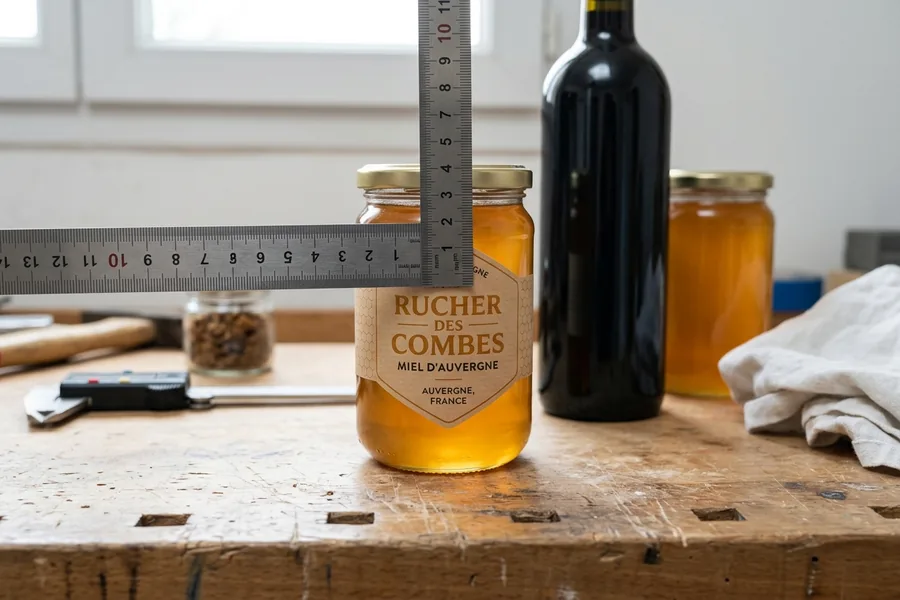
Take a strip of paper, wrap it round the container where the label will sit, and mark it. That gives you the three numbers that matter:
- The usable height — from where the base curve ends to where the shoulder begins. This is almost always the limiting figure, and it is smaller than people expect.
- The usable width — the flat run, avoiding a seam on a can or a mould line on a plastic bottle. A label that crosses a seam lifts along it.
- The diameter, if the label wraps. Below about 30 mm diameter a stiff material will lift at the trailing edge; that is a material question, not a size one.
Then take 3 to 5 mm off each side. A label applied by hand never lands perfectly centred, and one that reaches exactly to the shoulder will crease on the first bottle.
- Measure
- flat height, flat width, diameter
- Subtract
- 3 to 5 mm all round
- Avoid
- seams, mould lines, shoulders
- Under Ø 30 mm
- use a film, not a paper
- Wrap-around
- add 3 mm of overlap
Wine and spirits
The bottle shape sets the label, and Bordeaux is not Burgundy
| Bottle | Front label | Typical size | Notes |
|---|---|---|---|
| Bordelaise (Bordeaux) | Rectangular, portrait or landscape | 100 × 105 mm | The most common; leaves room for a back label |
| Bourguignonne (Burgundy) | Slightly narrower | 75 × 85 mm | Curved shoulder — keep the label below the curve |
| Flûte (Alsace) | Narrow, tall | 55 × 105 mm | Slim bottle, slim label |
| Sparkling | With neck collar | 100 × 70 mm | Add a foil collar and a numbered back label |
| Spirits, miniatures | Any shape | from 35 × 30 mm | Die-cut shapes welcome, at no extra cost |
⚠️ Back labels grew in 2026: ingredients, nutrition, the energy value and often a QR code — see the wine rules. Producers who used 40 × 60 mm are moving to 60 × 90 mm. On creative papers the ceiling is 150 × 105 mm, which is ample; if a multilingual range pushes past it, the synthetics run to 150 × 220 mm.
Beer and cans
A can is a wrap, and a wrap needs overlap
| Container | Label type | Typical size | Watch out for |
|---|---|---|---|
| Bottle 33 cl | Front label | 90 × 70 mm | Keep clear of the shoulder curve |
| Bottle 33 cl | Back label | 70 × 90 mm | Ingredients, allergens, ABV |
| Bottle 75 cl | Front label | 100 × 105 mm | Champagne-style shoulders need a shorter label |
| Can 33 cl | Wrap-around | 200 × 95 mm | Allow 3 mm overlap for the seam |
| Can 44 cl | Wrap-around | 200 × 115 mm | Same overlap; check the rolled edges |
| Keg, growler | Neck or body tag | from 55 × 30 mm | Removable adhesive if the vessel is reused |
A 200 mm wrap is beyond the paper families, which stop at 100 × 105 mm. Wraps are printed on synthetics — which is also the right answer for an ice bucket. For bottles that go back to a washing line, the wash-off paper is what lets the glass be reused.
Jars and preserves
Short jars want square labels, and lids are free
| Jar | Label | Typical size | Note |
|---|---|---|---|
| Honey 250 g | Front | 60 × 50 mm | Leave the shoulder free |
| Honey 500 g | Front | 80 × 60 mm | The most common jar in farm shops |
| Jam 220 g | Front | 55 × 55 mm | Square reads well on a short jar |
| Any jar | Lid label | Ø 45 – 60 mm | Round die, no extra tooling charge |
| Any jar | Neck band | 35 × 30 mm | Batch, date, or a simple seal |
| Terrine, Le Parfait | Front | 75 × 55 mm | Wide flat face, generous format possible |
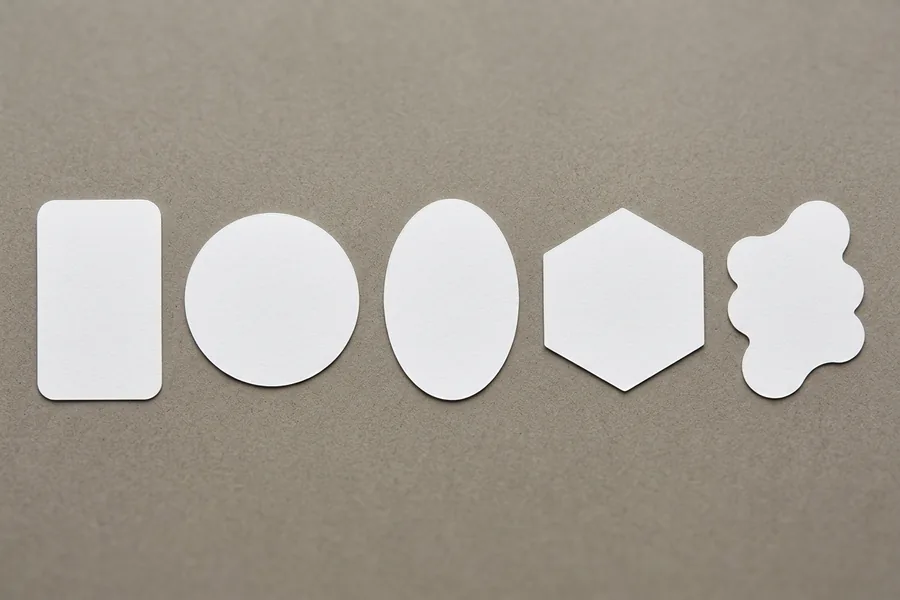
💡 On labels, a round or oval die costs nothing extra — you choose a maximum size, not a shape. (That is the opposite of stickers, where the shape is charged.) So a lid label, a shield or a bottle silhouette costs the same as a rectangle of the same size.
Cosmetics and small containers
Where the mandatory text is bigger than the container
| Container | Label | Typical size | The difficulty |
|---|---|---|---|
| Serum 30 ml | Body wrap | 55 × 40 mm | Fitting the INCI list — consider a peelable layer |
| Cream jar 50 ml | Lid + body | Ø 45 mm + 100 × 25 mm | Two small runs rather than one |
| Shampoo 250 ml | Front + back | 75 × 105 mm | Must bend without creasing on a squeezable bottle |
| Soap bar | Belly band | 150 × 55 mm | Cut to the bar, not to a standard |
| Roll-on 10 ml | Wrap | 70 × 25 mm | Very small type; keep the design sparse |
| Candle 200 g | Body + base | 85 × 60 mm | CLP panel usually goes underneath |
Small containers are where legal text and available surface collide. On food that fight has a legal minimum — 1.2 mm, or 0.9 mm under 80 cm² — and the usual answer is two labels rather than one crowded one.
From our proofs
Five rules that avoid a reprint
Stay below the shoulder
A label that reaches into the curve creases in a fan of small folds along its top edge. Stop 5 mm below where the glass starts to turn.
Never cross a seam
On a can or a moulded bottle the seam is a ridge. The adhesive bridges it instead of touching, and the label lifts along that line first.
Overlap a wrap by 3 mm
A wrap that meets exactly end to end will show a gap on half the run. Three millimetres of overlap absorbs the tolerance of the container and of the hand applying it.
Small diameter, soft material
Below about 30 mm, a rigid paper fights the curve. A soft film follows it — the size was never the problem.
Order the back label at the same time
Two labels on one order share the setup and the delivery. Discovering the back label a week later costs a second run.
Test on the real container
Print your artwork at 100 % on plain paper, cut it out and tape it to the bottle. Two minutes, and it catches most size mistakes before the proof.
FAQ
Label sizes — what customers ask us
What is the most common wine label size?
100 × 105 mm on a Bordeaux bottle — it is the format most of our wine customers order, and it leaves room for a back label. A Burgundy takes about 75 × 85 mm because of its sloping shoulder, and an Alsace flûte around 55 × 105 mm. Measure your own bottle before committing: glass varies from one glassmaker to the next.
Does a round label cost more than a rectangular one?
Not on labels. You choose a maximum size and the shape inside it is free — round, oval, a shield or a bottle silhouette, all at the same price, because we cut a die for your job anyway. On die-cut stickers it is the opposite: those use standing dies and a round one costs more than a square.
How big can a label be?
It depends on the material, and the range is wide: 100 × 105 mm on coated papers, 150 × 105 mm on creative papers, 150 × 220 mm on synthetics, up to 300 × 350 mm on clear films. A 200 mm can wrap therefore has to be a synthetic. The full table is in choosing your material.
What size should the back label be?
On wine, plan for more than you used to: since 2026 the back label carries the energy value, the allergens and usually a QR code, so 60 × 90 mm is a safer starting point than the old 40 × 60 mm. On food, the mandatory text at its legal size decides it — below roughly 50 × 70 mm, a full ingredient and nutrition block will not fit.
Can you cut a label to the shape of my bottle?
Yes — send the outline with your artwork and we cut to it, at no extra charge on labels. The only real limits are very fine spikes and deep narrow notches, which tear on application. If you are unsure, send us the shape before the proof and we will say what survives the machine.
Still unsure?
Ask the person who makes them
The guide covers the general case — your label lives on a real product. Describe it in two lines and a label specialist (not a bot) answers within 2 working hours.
All guides
Everything else we have written down
- Choosing your label material
- Choosing your label adhesive
- Bottle and jar label sizes — you are here
- EU food labelling — the INCO rules
- EU wine label rules
- Environmental claims and sorting labels
- Preparing print-ready files
- Variable data, explained
- Label material comparison chart
- EU vs UK labelling requirements
- What drives the price of a label
- Label glossary
- Direct thermal vs thermal transfer
- GS1 Digital Link and QR codes
- Barcode print quality and ISO 15416 grades
- GHS and CLP chemical labels, BS5609 included
- Printed packing tape vs labels, cost per parcel
Got your three measurements? Price the label.
Any shape within the size you choose — the die is included.