
Guides · updated 9 November 2026
Cosmetics labelling under EU Regulation 1223/2009: what must appear
The short answer: Article 19 of Regulation (EC) No 1223/2009 lists seven mentions for every cosmetic sold in the EU — responsible person and address, nominal content, best-before date or period after opening, precautions, batch number, function and ingredients — in indelible, easily legible and visible lettering, on the container and the packaging. Since 31 July 2026, products placed on the market must also name the fragrance allergens added by Regulation (EU) 2023/1545. And the label has to survive water, oil and fingers until the last dose.
In 30 seconds
The 30-second answer: seven mentions, two places, one standard of legibility
An EU cosmetic label is defined by Article 19 of Regulation (EC) No 1223/2009. Six facts cover most products:
- Seven mentions are mandatory: responsible person and address, nominal content, date of minimum durability or period after opening, precautions, batch number, function and the list of ingredients.
- They go on the container and the packaging. With no outer box, the bottle label carries everything.
- Only the ingredients and precautions may move to an attached leaflet or tag, and only when space makes it impossible.
- The best-before date is required when the product keeps 30 months or less; above that, the period after opening (PAO) replaces it.
- Fragrance allergens: 56 more substances must now be named above 0.001 % in leave-on and 0.01 % in rinse-off products. Older labels could be placed on the market until 31 July 2026.
- Quantity, date, precautions and function follow the language of the country of sale; ingredient names are not translated.
Article 19(1)
What must appear on a cosmetic label in the EU?
Article 19(1) of Regulation 1223/2009 requires seven pieces of information in “indelible, easily legible and visible lettering” on the container and the packaging of every cosmetic product made available in the EU. The regulation sets no minimum type size: legibility is judged on the finished pack, by the authority that inspects it.
| Point | Mention | Where it may go | What printers see go wrong |
|---|---|---|---|
| (a) | Name or registered name and address of the responsible person; country of origin for imported products | Container and packaging | A non-EU address only; several addresses without the one holding the product file highlighted |
| (b) | Nominal content at the time of packaging, by weight or volume | Container and packaging (not required under 5 g or 5 ml, or for single-application packs) | Quantity missing on the bottle because it is on the box |
| (c) | Date of minimum durability, or period after opening when durability exceeds 30 months | Container and packaging | A PAO symbol on a product that keeps less than 30 months |
| (d) | Particular precautions for use, at least those of Annexes III to VI | Container and packaging, or an attached leaflet or label if impossible | Warnings from the safety report left off a small tube |
| (e) | Batch number of manufacture or product reference | Container and packaging; packaging alone if the container is too small | No room left for the coding added at filling |
| (f) | Function of the product, unless clear from its presentation | Container and packaging | A brand name that says nothing about what the product does |
| (g) | List of ingredients, preceded by the word “ingredients” | May be on the packaging alone; attached leaflet or label if impossible | INCI only on the box of a product also sold without it |
“Container” is the bottle, jar or tube in contact with the product; “packaging” is the outer box. Article 19 asks for both: when there is no outer box, the container is the only place left, and the label must hold everything.
Claims fall under Article 20: no text, name or picture may suggest a property the product does not have. Candles and reed diffusers are not cosmetics and follow the chemical labelling rules instead.
Point (g)
How must the ingredients list (INCI) be written?
The list starts with the word “ingredients” and names every ingredient in descending order of weight at the time it is added; ingredients below 1 % may follow in any order. Names are the common ingredient names of the EU glossary (Article 19(6) and Article 33), the INCI names the industry uses — so the list is the same in every language.
- Perfume is written “parfum” or “aroma”, followed by the allergens of the “Other” column of Annex III.
- Nanomaterials are followed by “(nano)”.
- Colorants come last, in any order, with their CI numbers; a make-up range may list every shade’s colorants after “may contain” or “+/-”.
The fragrance allergen update: Regulation (EU) 2023/1545
Until 2023, 24 fragrance allergens had to be named individually. Regulation (EU) 2023/1545 of 26 July 2023 amended Annex III to add the 56 further allergens identified by the Scientific Committee on Consumer Safety, regrouped some entries and fixed the name to use in the list. The trigger is unchanged: the substance is named when its concentration exceeds 0.001 % in a leave-on product or 0.01 % in a rinse-off product.
| Date | What it means for the label |
|---|---|
| 16 August 2023 | Entry into force (twentieth day after publication in the Official Journal of 27 July 2023) |
| Until 31 July 2026 | Products that do not meet the new requirements could still be placed on the EU market |
| Until 31 July 2028 | Products already placed on the market may still be made available — sold through the chain |
| Today, 9 November 2026 | Any product placed on the market now must carry the updated allergen list |
The list to print comes from your perfume supplier’s allergen declaration and your safety assessor. Work from the consolidated text: a corrigendum was published in 2025.
On the label, the update means length: a list that named three allergens may now name eight or ten. Check that reprinted artwork still fits at a legible size. Our page on bottle and jar label sizes gives the usual formats container by container.
A rule still moving: the ingredient names
Proposal COM(2025) 531 (procedure 2025/0531(COD)) would replace the EU glossary of Article 19(6) with the internationally recognised nomenclature. Parliament adopted the agreed text on 22 October 2026; on 9 November 2026 the Council vote and publication were still pending. Check the final text once published.
Points (c) and (e)
Best-before date or PAO, and the batch number
A cosmetic that keeps 30 months or less carries a date of minimum durability; one that keeps longer carries a period after opening instead, unless that concept is not relevant to the product. Both are defined in Article 19(1)(c), with the symbols of Annex VII.
| Situation | What to print | Format | Symbol |
|---|---|---|---|
| Minimum durability of 30 months or less | Date of minimum durability | Month and year, or day, month and year, in that order; storage conditions if needed | Hourglass (Annex VII, point 3) or “best used before the end of” |
| Minimum durability above 30 months | Period after opening | Months and/or years, e.g. 6M, 12M, 24M | Open jar (Annex VII, point 2) followed by the period |
| Durability after opening not relevant (no list in the regulation; single-use and pressurised packs are the usual cases) | No PAO | — | — |
Dates and batch numbers change with each production. Two methods work:
Printed with the artwork
When each batch is a separate run, batch and date are part of the file — the usual choice for runs of 100 to a few thousand labels. Every version gets its own proof.
Coded at filling
When the same labels serve several batches, leave a clear, unvarnished area and tell us which coder prints it: the topcoat decides whether the code holds. Our overprintable polypropylene is made for it. For numbers that change label by label, see numbered and barcode labels.
Points (a), (b) and Article 19(5)
Responsible person, nominal quantity and language
The name and address on the label must be those of the EU responsible person defined in Article 4 — the EU manufacturer, the importer, a person designated by written mandate, or a distributor selling under its own brand. A brand based outside the EU needs an EU address on its labels.
The address may be abbreviated if the person stays identifiable; with several addresses, the one holding the product information file is highlighted. For a British brand, see our EU vs UK labelling guide.
Nominal content and the ℮ mark
Point (b) asks for the content at the time of packaging, by weight or volume. It is not required under 5 g or 5 ml, or for single-application packs. When a pack is filled under the prepackage directive 76/211/EEC and carries the ℮ mark, that directive sets minimum heights for the figures:
| Nominal quantity | Minimum figure height | Typical cosmetic |
|---|---|---|
| Up to 50 g or 50 ml | 2 mm | Serum, lip balm, eye cream |
| Above 50 and below 200 g or ml | 3 mm | Face cream, travel shampoo |
| From 200 g or ml to 1 000 g or ml | 4 mm | Shower gel, body lotion |
| Above 1 000 g or ml | 6 mm | Refill pouch, salon size |
The ℮, when used, is at least 3 mm high and in the same field of vision as the quantity.

Which language?
Article 19(5) leaves the language of points (b), (c), (d) and (f), and of any leaflet, to the country where the product reaches the end user. Spain requires Spanish for them (Real Decreto 85/2018, article 6); France requires French for the presentation of any product (Loi n° 94-665, article 2). INCI names stay the same everywhere, so a multi-country label repeats four short mentions, not the whole label.
Article 19(2) and (3)
What if the mandatory mentions do not fit on the label?
When it is impossible for practical reasons to print the precautions or the ingredients list as required, Article 19(2) allows them on an enclosed or attached leaflet, label, tape, tag or card, referred to on the pack by abbreviated information or the hand-and-book symbol. The other five mentions stay on the container.
For soap and bath balls where even a tag is impossible, the ingredients may sit on a notice next to the display (Article 19(3)).
| Solution | What it solves | Limit |
|---|---|---|
| The whole of the format step | A 55 × 40 mm label is already priced in the “up to 55 × 50 mm” step: using the full 55 × 50 mm costs nothing more | The container’s flat area |
| Outer box carrying the ingredients | Point (g) may be on the packaging alone | Only if the product is never sold without the box |
| Peelable two-layer label | The top layer carries the brand; the layer underneath holds the full list | Quoted through a custom request |
| Attached tag or card, with the hand-and-book symbol | Precautions and ingredients (points d and g) only | Only when impossible for practical reasons |
“Impossible for practical reasons” is a legal test, not a design choice: keep the reasoning in the product file.
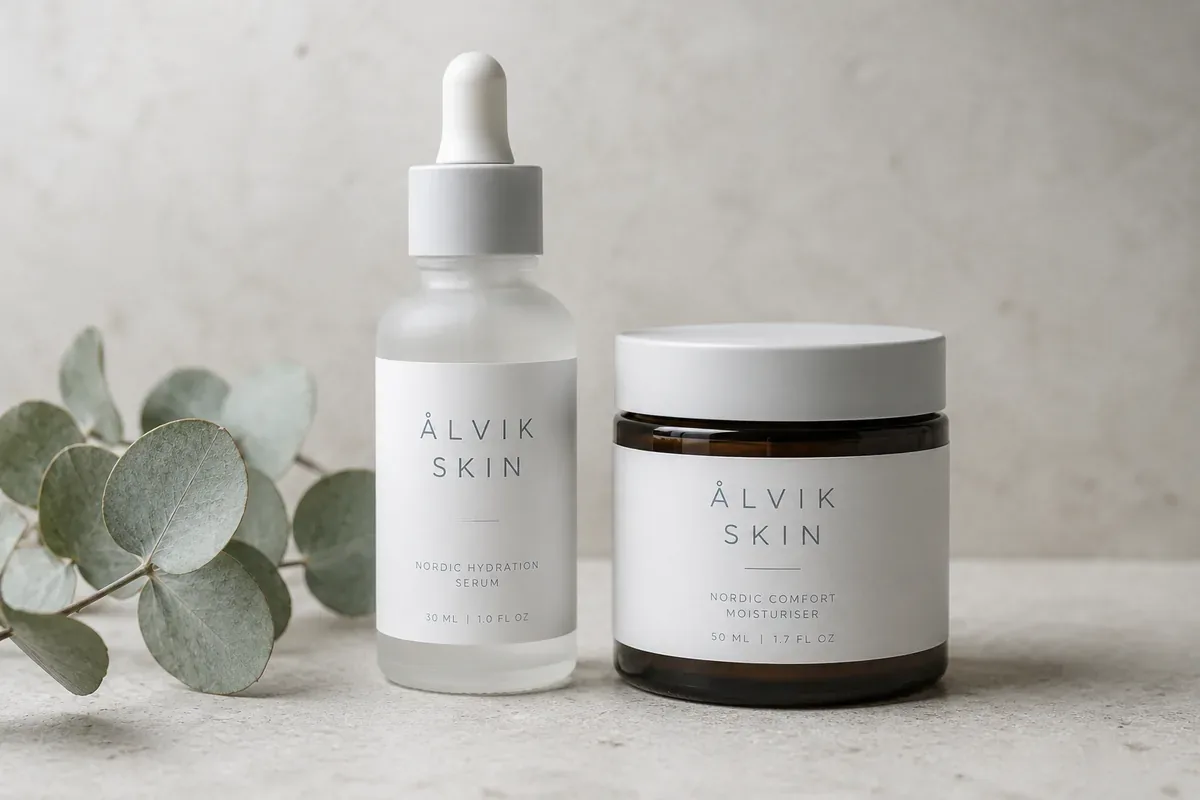
Example: a 30 ml serum without a box
A 30 ml dropper bottle of about 32 mm diameter offers roughly 100 mm of circumference: a 35 × 50 mm front label and a 55 × 50 mm back label fit side by side. If the allergens push the list past the back label, the peelable two-layer label comes before any leaflet.
No legal minimum type size, but a technical one: about 4 pt on coated and synthetic materials. Some brands borrow the 1.2 mm x-height of the EU food labelling rules as a benchmark; it is not a cosmetics requirement.
- Material
- Clear polyester, permanent adhesive
- Format
- Up to 55 × 50 mm, any shape
- Full colour, white underprint where needed
- Protection
- Gloss lamination
- 100 labels
- €266, excluding VAT
- 1 000 labels
- €334, excluding VAT
Configurator prices read on 9 November 2026. Quantities are not capped — we print from a hundred pieces to several million.
Durability
Which label material resists water, oil and alcohol?
“Indelible” in Article 19 means the mentions must still be there at the last dose. Anything that meets water, steam or oil needs a synthetic film with a protection over the ink; paper is for products that stay dry. The film decides where the label can live, the laminate decides how long the ink survives the fingers.
| Product | Material | Why | From |
|---|---|---|---|
| Shower gel, shampoo, rigid bottles | White polypropylene | Waterproof, tear-proof, follows a curved bottle without a wrinkle | €196 |
| Soft tubes and squeezable bottles | Matt white polyethylene | Deforms with the container and springs back without creasing | €195 |
| Serums, glass, frosted bottles | Clear polyester | The “no-label look”; waterproof and oil-resistant | €231 |
| Fragrance and night care, dry storage | Pearlescent paper | A shimmer across the whole surface | €180 |
| Premium boxes and dry jars | Deep black paper with gold or silver hot foil | The strongest contrast for a brand name | €169 |
“From” prices are for the smallest format step, 100 labels. Example on white polypropylene, 75 × 105 mm, gloss lamination, permanent adhesive — a shampoo front label: €273 for 100, €374 for 1 000.
Oils, essential oils and alcohol
Oils creep under the edge of a label and attack adhesive and ink: use a laminated polypropylene or polyester film, never uncoated paper, and mention essential oils or alcohol in your request so that the adhesive and laminate are confirmed before the proof.
Lamination is a film over the print; varnish is a coating. On white polypropylene, 55 × 50 mm, 100 labels cost €204 varnished and €230 laminated (removable grade).

Adhesive: permanent by default, reinforced on damp or textured containers. The whole range, material by material, is on our cosmetic label page.
Clear films and finishes
“No-label look” and premium finishes: keeping the mentions legible
A clear polyester label disappears against glass and leaves only the print visible — but four-colour printing has no white ink, so on a transparent film the white must be printed as a separate layer. Without it, pale colours turn translucent and small black type sits directly over the liquid.

Three rules for clear labels
- Put an opaque white block behind the small mandatory text: it is read against the product inside.
- Check the proof against the filled bottle, not a screen.
- Supply the white as its own layer — see our guide to preparing print-ready files.
Finishes: for the brand, not for the small print
Soft touch lamination gives a velvet surface; gold or silver hot foil reflects light as no ink can; a relief varnish raises a logo you feel under the thumb. They belong to the brand name and the pattern; keep the mandatory mentions in plain dark ink on a plain ground. Hot foil is priced in the configurator where the material allows it; soft touch and relief varnish are quoted per job, from 100 labels — see our options and finishes page.
Before you order
Six cosmetic labelling mistakes — and a checklist
Most non-compliant cosmetic labels are not missing a rule; they are missing space for it, or lose it in the bathroom. The six we see most often:
- Ingredients only on the box, for a product also sold without it — in a gift set, a refill, a hotel range.
- Old artwork reprinted after 31 July 2026 without the allergen update of Regulation 2023/1545.
- A PAO symbol on a product that keeps 30 months or less, which needs a best-before date.
- No room, or a laminated surface, where the batch number is coded at filling.
- Quantity, precautions or function left in English on a product sold in France or Spain.
- Fine gold or pale type for the ingredients on a clear film.
- Seven mentions of Article 19(1) present, on the container and on the packaging if there is one.
- Ingredients list checked against the safety report and the current allergen list.
- Best-before date or PAO with its symbol; batch printed in the run or a clear coding area.
- EU responsible person and address; quantity at the right figure height.
- Quantity, date, precautions and function in the language of each country of sale.
- Material and protection matched to water, oil or alcohol; white underprint on clear films.
- Proof checked on a filled container before production.
Material, size and finish for a whole range are on our cosmetic and soap labels, water- and oil-resistant, from 100 labels page. For a peelable two-layer label, an unusual format or a test against your formula, send a custom request.
FAQ
Cosmetic labels and Regulation 1223/2009 — what brands ask us
What must appear on a cosmetic label in the EU?
Article 19(1) of Regulation (EC) No 1223/2009 lists seven mentions: the name and address of the EU responsible person (and the country of origin for imports), the nominal content, the date of minimum durability or the period after opening, the precautions for use, the batch number, the function unless it is obvious, and the list of ingredients. All must be indelible and easily legible, on the container and the packaging.
Does the INCI list have to be on the bottle itself?
Not always. Article 19(1)(g) allows the ingredients list on the outer packaging alone. If there is no outer packaging, it goes on the container. Only when that is impossible may it move to an attached leaflet or tag, with the hand-and-book symbol on the pack.
PAO or best-before date: which one goes on the label?
A product with a minimum durability of 30 months or less carries a best-before date (month and year, or day, month and year), preceded by the hourglass symbol or the words best used before the end of. Above 30 months, the period after opening replaces it, with the open-jar symbol followed by the number of months or years, unless durability after opening is not relevant.
What changes with the new fragrance allergens of Regulation (EU) 2023/1545?
Regulation 2023/1545 added 56 fragrance allergens to the 24 already named individually. Each is named in the ingredients list above 0.001 % in leave-on and 0.01 % in rinse-off products. Older labels could be placed on the market until 31 July 2026; products already placed may be sold until 31 July 2028.
Which language must a cosmetic label be in?
The language of the nominal content, date, precautions and function is set by the country where the product reaches the end user (Article 19(5)). Spain requires Spanish for these points (Real Decreto 85/2018, article 6); France requires French (Loi n° 94-665, article 2). The ingredients list keeps its INCI names in every country.
Which label material for shower gel, oils or perfume?
A synthetic film with a protection over the print: white polypropylene from €196 per 100 for bottles, matt white polyethylene from €195 for squeezable tubes, clear polyester from €231 for glass and the no-label look. Paper is for products that stay dry; mention essential oils or alcohol in your request.
Is there a minimum font size for the ingredients list?
No. Regulation 1223/2009 requires indelible, easily legible and visible lettering but sets no size. We hold detail down to about 4 pt on coated and synthetic materials; check the proof on the filled container.
This guide is a practical summary written by a label manufacturer, not legal advice. The content of a cosmetic label is the responsibility of the responsible person named on it and of the safety assessor who signs the product safety report. Texts read on EUR-Lex, the BOE and Légifrance on 9 November 2026: check the version in force and confirm with your competent national authority before printing.
Official texts: Regulation (EC) No 1223/2009 on cosmetic products — EUR-Lex · Consolidated text of Regulation (EC) No 1223/2009, 18 May 2026 — EUR-Lex · Regulation (EU) 2023/1545, labelling of fragrance allergens — EUR-Lex · Proposal COM(2025) 531, simplification for chemical products — EUR-Lex · Directive 76/211/EEC on prepackages — EUR-Lex · Real Decreto 85/2018, article 6 (Spain) — BOE · Loi n° 94-665, article 2 (France) — Légifrance
Still unsure?
Ask the person who makes them
The guide covers the general case — your label lives on a real product. Describe it in two lines and a label specialist (not a bot) answers within 2 working hours.
All guides
Everything else we have written down
- Choosing your label material
- Choosing your label adhesive
- Bottle and jar label sizes
- EU food labelling — the INCO rules
- EU wine label rules
- Environmental claims and sorting labels
- Preparing print-ready files
- Variable data, explained
- Label material comparison chart
- EU vs UK labelling requirements
- What drives the price of a label
- Label glossary
- Direct thermal vs thermal transfer
- GS1 Digital Link and QR codes
- Barcode print quality and ISO 15416 grades
- GHS and CLP chemical labels, BS5609 included
- Printed packing tape vs labels, cost per parcel
- EU Battery Regulation labels and QR code
- Cold-chain labelling: freezer, fridge, steam
- Cosmetics labelling — Regulation 1223/2009 — you are here
- Batch numbers, lot codes and expiry dates
- Label unwind direction and roll specs
Price your cosmetic labels
White polypropylene from €196 per 100, clear polyester from €231, a proof before production.