
Guides · updated 18 August 2026
Two European rules that change what you may print
The short answer: from 27 September 2026, Directive (EU) 2024/825 makes vague environmental claims — “eco-friendly”, “green”, “biodegradable” without proof — unlawful across the Union. And the packaging regulation will replace today’s patchwork of national sorting marks with a single European marking towards the end of the decade. Both are label questions before they are legal ones.
Directive (EU) 2024/825
From September 2026, vague green words become unlawful
The « Empowering consumers for the green transition » directive applies from 27 September 2026 across the Union. It targets exactly the vocabulary that has been printed on eco-ranges for a decade: generic claims such as « environmentally friendly », « green », « climate neutral » or « biodegradable » are prohibited unless the claim is substantiated and can be demonstrated.
It also bans self-made sustainability labels — a leaf icon, a green badge, a home-designed « eco » seal — where they do not rest on a recognised certification scheme or a public authority. A logo you drew yourself is now a liability rather than a reassurance.
France applied a stricter version of the same idea years earlier, through its anti-waste law (AGEC), which simply forbids « biodégradable » and « respectueux de l’environnement » on products and packaging. If you already comply with the French rule, you are ahead of the European one.
- Banned unless proven
- eco-friendly, green, climate neutral
- Banned in France today
- biodegradable, environmentally friendly
- Banned outright
- self-made sustainability labels
- Applies from
- 27 September 2026, EU-wide
- Applies to
- products and their packaging
The practical test
Three claims that survive, three that do not
Bio-based is not biodegradable
A bio-based film is made from plants. That is a statement about origin and nothing about end of life. Saying « biodegradable » on it is precisely the claim these rules target.
Compostable is a certification, not an adjective
It survives where a standard backs it — and only if the adhesive composts too. See compostable labels: a compostable film with an ordinary glue is not a compostable label.
Recycled content is measurable
« 100 % recycled paper » is a number someone can check, and our recycled stock comes with its documentation. « Green paper » is not a number at all.
⚠️ This is the most expensive mistake on an eco-range, because it is discovered after the print run: a batch of packaging that can no longer be sold as printed. We flag wording when we see it on a proof — but the claim is yours, not ours.
Sorting information
One market, several markings — for a few more years
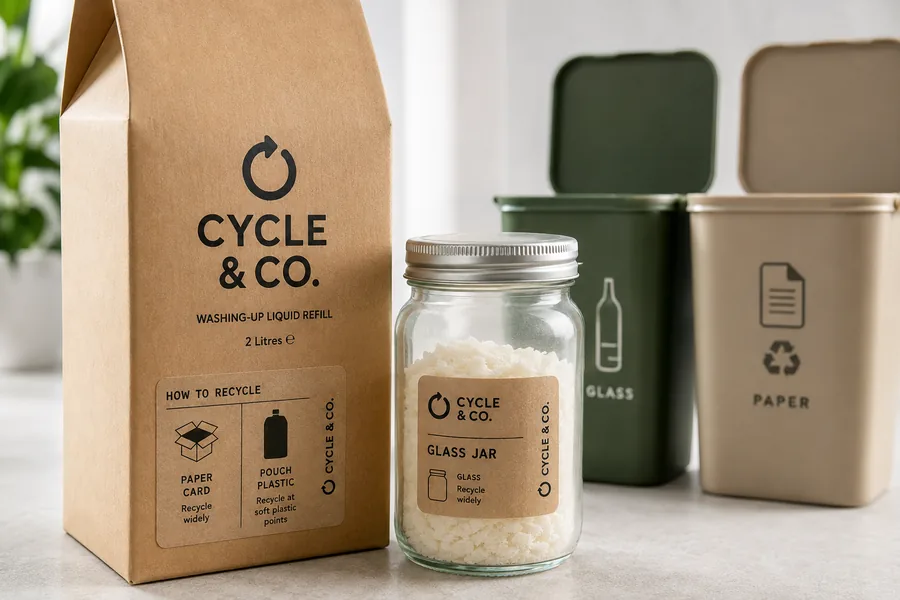
There is no single European sorting mark yet. Several Member States impose their own, and a producer selling into more than one country meets more than one obligation. France is the strictest and the one most exporters hit first: since 1 January 2022 household packaging must carry the Triman together with its Info-tri — the instruction that says which part of the pack goes in which bin.
That last part is what most producers get wrong. A logo alone is not compliance: a jar of jam has glass, a metal lid and a paper label, and the sorting instruction is what separates them. The layout is standardised — you apply the file your eco-organisation provides rather than designing it.
The European packaging regulation replaces this patchwork with a single harmonised marking. Until it applies, the safe approach for a multi-country range is to carry the marking of the strictest market you sell into, or to print a market-specific label per country.
- EU marking
- not in force yet
- France
- Triman + Info-tri, since 2022
- Other markets
- their own schemes
- Layout
- supplied, not designed
- Applies to
- household packaging
- Not to
- pure business-to-business packs
The practical answer
A label costs less than reprinting the packaging
If you hold stock of packaging printed before the rules — or if a claim on it has become unlawful, or a marking has changed — you do not have to scrap it. An adhesive label carrying the correct signage brings the pack into line, and it goes onto what you already have.
It is a small, functional, one-colour label: black on white, typically 25 × 30 to 40 × 50 mm, placed where a buyer will look for it. On coated paper that is €137 per 100 in one or two colours — against the cost of destroying a pallet of printed cartons.
The same reasoning works while a range is still moving: keep the sorting information on its own small label, and merge it into the main artwork at the next reprint, once the European marking is published.
- Content
- sorting mark, instructions
- Colours
- one — black is enough
- Typical size
- 25 × 30 to 40 × 50 mm
- Material
- coated paper
- From
- €137 / 100
- Production
- 4 to 10 working days
Printing it
Four rules so the signage still reads on the shelf
Do not redraw it
Use the file your eco-organisation supplies. Retyping the text or rebuilding the icons breaks a standardised layout whose whole purpose is to look the same on every pack.
Keep the contrast
Black on a pale ground. On kraft or a dark stock the pictograms close up: reserve a white panel behind them, or move the signage to its own label.
Do not shrink it
The pictograms carry the meaning. Reduced too far they become grey squares — and on a textured paper they fill in before they get small.
Put it where it is looked for
Back label, foot of the front label, or its own small label near the barcode. Anywhere the buyer finds it without turning the pack twice.
Planning
Do not print five years of stock
Two European texts land within a few years of each other, and both touch the same square centimetres of your packaging. The claims directive applies from September 2026. The harmonised sorting marking is expected to become obligatory towards 2028, with a sell-through period for packaging printed before then.
Which leads to advice against our own short-term interest: order the quantity you will actually use in the next twelve to eighteen months. At our prices the difference between 1 000 and 3 000 labels is small; the cost of holding an obsolete marking is not. This is one of the rare cases where we tell customers to order less.
- Since 2022
- national sorting marks
- 27 Sept 2026
- EU claims directive applies
- Around 2028
- EU sorting marking obligatory
- Afterwards
- sell-through of printed stock
- Our advice
- short runs until it settles
FAQ
Green claims and sorting marks — what producers ask us
Can I still write “biodegradable” on my packaging?
Not in France, where the word is prohibited on products and packaging along with “environmentally friendly”. And from 27 September 2026, across the Union, a generic environmental claim is unlawful unless it is substantiated and can be demonstrated. “Certified compostable to EN 13432” is a claim; “biodegradable” on its own is not.
Does this apply to me if I do not sell in France?
The claims directive applies across the Union, so yes from September 2026 wherever you sell. Sorting marks are national for now: you meet the obligation of each market you place goods on. A producer selling into several countries either carries the strictest marking or prints a version per market.
Is a green leaf logo on my label a problem?
It can be. Sustainability labels that do not rest on a recognised certification scheme or a public authority are prohibited under the new directive — and a leaf you designed yourself is exactly that. A certification mark you are entitled to use is fine; a decorative eco-badge is not.
I have 5 000 printed cartons with the old wording. Must I scrap them?
Usually not. A small adhesive label carrying the correct signage brings the pack into line and goes onto the stock you already hold — one colour, black on white, typically 25 × 30 to 40 × 50 mm, from €137 per 100 on coated paper. It is almost always cheaper than reprinting packaging.
Should I wait for the European sorting marking before printing?
No — today’s national obligations apply now. But do not print years of stock either: the harmonised marking is expected around 2028, with a sell-through period afterwards. Order what you will use in the next twelve to eighteen months; the price difference is small, the risk of obsolete stock is not.
This guide is a practical summary written by a label printer, not legal advice. Directives are transposed country by country, national sorting schemes still differ, and the European texts are being amended as they are implemented. Confirm your own case with your eco-organisation or an adviser before printing.
Official texts: Directive (EU) 2024/825 — EUR-Lex · Regulation (EU) 2025/40 (PPWR) — EUR-Lex
Still unsure?
Ask the person who makes them
The guide covers the general case — your label lives on a real product. Describe it in two lines and a label specialist (not a bot) answers within 2 working hours.
All guides
Everything else we have written down
- Choosing your label material
- Choosing your label adhesive
- Bottle and jar label sizes
- EU food labelling — the INCO rules
- EU wine label rules
- Environmental claims and sorting labels — you are here
- Preparing print-ready files
- Variable data, explained
- Label material comparison chart
- EU vs UK labelling requirements
- What drives the price of a label
- Label glossary
- Direct thermal vs thermal transfer
- GS1 Digital Link and QR codes
- Barcode print quality and ISO 15416 grades
- GHS and CLP chemical labels, BS5609 included
- Printed packing tape vs labels, cost per parcel
A compliance label, printed this week.
One colour on coated paper, from €137 per 100 — and it goes on the stock you already have.