
Guides · updated 12 August 2026
Wine became a food with a label to match
The short answer: since December 2023 a European wine must declare its ingredients and its nutrition, and since 18 March 2026 the rules are tighter about what has to be physically printed: the energy value and the allergens go on the bottle, the rest may sit behind a QR code. In printing terms, the back label just grew.
The base
What was already mandatory, and still is
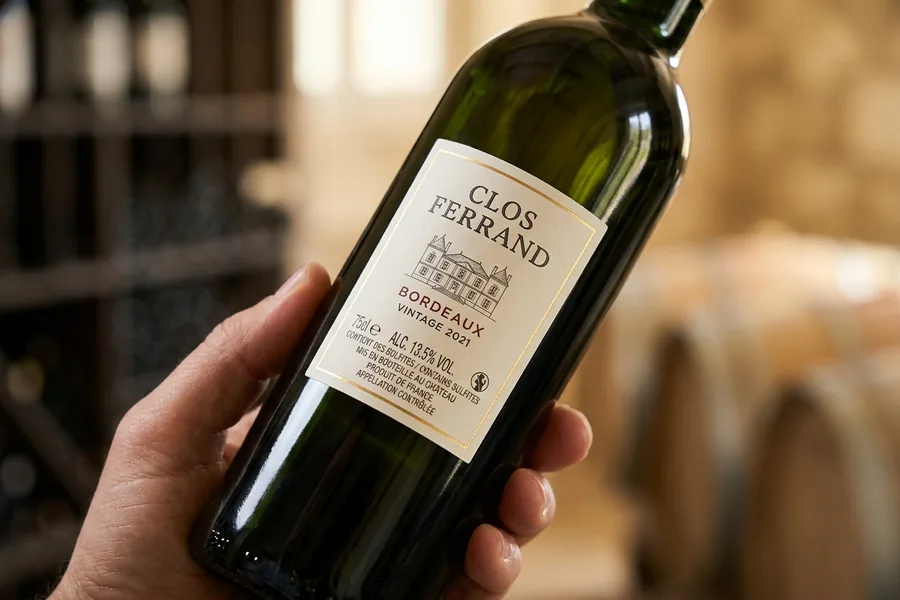
None of this went away in 2026. A European wine label carries the category (wine, sparkling wine, liqueur wine…), the protected designation and its name where it applies, the actual alcoholic strength in % vol, the provenance, the bottler — producer, vendor or importer as the case may be — the nominal volume, the lot number, and the declaration of allergens, which for almost every wine means sulphites.
Three of those must sit in the same field of vision: the designation, the nominal volume and the alcoholic strength. In practice that means they cannot be split between a front and a back label — a rule that quietly decides your front label size.
National rules add to this. France requires the pregnancy pictogram; other Member States have their own health messages and their own language requirements. Check the market you sell into, not just the one you bottle in.
- 1
- Designation / category
- 2
- Nominal volume
- 3
- Alcoholic strength, % vol
- Meaning
- readable without turning the bottle
- Consequence
- they share one label
2023, then 2026
Ingredients and nutrition — and where each part has to live
Regulation (EU) 2021/2117 brought wine into the food-information fold: from 8 December 2023, every wine produced in the EU declares its ingredients and its nutrition. Operators were given a choice — print it, or provide it by electronic means. Regulation (EU) 2026/471, applicable since 18 March 2026, drew the line more firmly between the two.
| Information | Where it must be | Printing consequence |
|---|---|---|
| Energy value | On the physical label, with the « E » symbol, per 100 ml | A new line of text on every back label. |
| Allergens | On the physical label — sulphites, and egg or milk derivatives where used | Already there for most producers. |
| Full nutrition declaration | Label or e-label: fat, saturates, carbohydrate, sugars, protein, salt | Seven lines saved if you use a QR. |
| Ingredients list | Label or e-label, headed « Ingredients », grapes first | The longest block — additives, acidity regulators, stabilisers. |
| Sugar content — sparkling | On the physical label | Brut, extra dry, and the rest of the scale. |
| Durability date — dealcoholised | On the physical label | Only for dealcoholised and partially dealcoholised wines. |
In short: you can move the long lists to a QR code, but not the calories and not the allergens. Those two are printed, on every bottle, whatever you decide about the e-label.
The e-label
A QR code with conditions attached
The electronic label is not a marketing page with the ingredients at the bottom. The European rules are explicit about what it may and may not do: it leads directly to the product information, it carries no advertising, and it must not track the person who scans it or collect their data. A QR that lands on your shop, or that passes through an analytics redirect, is not compliant.
On the printing side, three practical rules. Print the code at at least 10 mm square — smaller works on a phone in a shop but fails under cellar light, and a wine label is often read in the dark. Keep a clear quiet zone of a few millimetres around it, free of rules, decoration and text. And print it in solid dark ink on a pale ground: a QR reversed out in white, printed in gold, or laid over a photograph, is the single most common cause of a code that will not scan.
⚠️ Textured papers deserve a test. On a heavy laid or a grooved stock, the relief breaks the small modules of a dense code — we print a sample and scan it before running three thousand bottles.
- Minimum size
- 10 × 10 mm
- Quiet zone
- 3 to 4 mm all round
- Contrast
- dark on pale, never reversed
- Avoid
- gold, metallic, photographs
- Texture
- test before the run
- Content
- no tracking, no advertising
The part that concerns us
Three consequences for the label you order
The back label grew
Energy value, allergens, the QR and its explanation. Producers who used a 40 × 60 mm back label are moving to 60 × 90 mm or larger — on coated paper that costs a few euros per hundred, not a redesign.
One QR per cuvée is free
A single code printed identically on every bottle is ordinary printing. A code that changes per lot or per bottle is variable data, from + €112 a run — worth knowing before you promise batch-level traceability.
The front label is unchanged
Nothing new lands on the front, so your creative paper, your foil and your embossing are untouched. The new text goes where nobody looks until they turn the bottle.
💡 The cheapest way through all of this is two different materials: a textured or laid paper on the front for the shelf, and a plain coated paper on the back for the legal text at €137 per 100. They ship on the same order.
Materials
What survives an ice bucket, and what fits the text
A wine label has two enemies: condensation and the ice bucket. A standard creative paper handles a cellar and a dinner table; it does not handle twenty minutes in water. If your wine is served chilled, the honest answer is a wet-strength paper at €184 per 100, which keeps the look of a paper and survives the bucket.
For the rest, the creative range is where wine lives: laid and kraft at €205, Tintoretto at €205, pearlescent at €180, and deep black with gold foil at €169 — cheaper than four-colour printing on the same stock, because there the foil replaces the ink.
One constraint to keep in mind: creative papers stop at 150 × 105 mm. That is ample for a back label, but if a multilingual range pushes you beyond it, the synthetics run to 150 × 220 mm.
- Back label, coated
- €137
- Deep black + gold foil
- €169
- Pearlescent
- €180
- Wet-strength paper
- €184
- Laid, kraft, Tintoretto
- €205
- Creative ceiling
- 150 × 105 mm
FAQ
Wine labelling — what producers ask us
What exactly has to be printed on the bottle since March 2026?
The energy value, shown with the « E » symbol per 100 ml, and the allergens — sulphites for almost every wine, plus egg or milk derivatives where they are used. Sparkling wines add the sugar content, and dealcoholised wines a minimum durability date. The full nutrition declaration and the ingredients list may be printed too, or provided through an e-label reached by a QR code.
Can I put the ingredients behind a QR code?
Yes — that is exactly what the e-label is for. The conditions are that the code leads directly to the product information, carries no advertising, and does not track or collect data from the person scanning it. A QR pointing at your online shop, or passing through an analytics redirect, does not meet those conditions.
How big does the QR code need to be printed?
At least 10 × 10 mm, with 3 to 4 mm of clear space around it, printed dark on a pale ground. Avoid reversing it out in white, printing it in gold or metallic ink, or laying it over a photograph. On a heavily textured paper, ask us for a test print and scan it yourself before committing the run.
Does a QR code cost extra to print?
Not if it is the same code on every bottle — that is ordinary printing, included in the price. It costs extra when the code changes: a different QR per lot or per bottle is variable data, from + €112 per run. Most producers use one code per cuvée, which costs nothing and is enough for the regulation.
Do I need a bigger label now?
Usually a bigger back label, not a bigger front one. Nothing new lands on the front, so your paper, your foil and your embossing are untouched. Producers who used a 40 × 60 mm back label often move to 60 × 90 mm — on coated paper that is a few euros per hundred, and it is far cheaper than shrinking the text below what anyone can read.
This guide is a practical summary written by a label printer, not legal advice. Wine labelling combines European rules with national and appellation ones — health pictograms, language, traditional terms — and the binding text is the regulation, not this page. Confirm your label with your trade body or an adviser before printing.
Official texts: Regulation (EU) 2026/471 — EUR-Lex · Regulation (EU) No 1308/2013 (CMO) — EUR-Lex
Still unsure?
Ask the person who makes them
The guide covers the general case — your label lives on a real product. Describe it in two lines and a label specialist (not a bot) answers within 2 working hours.
All guides
Everything else we have written down
- Choosing your label material
- Choosing your label adhesive
- Bottle and jar label sizes
- EU food labelling — the INCO rules
- EU wine label rules — you are here
- Environmental claims and sorting labels
- Preparing print-ready files
- Variable data, explained
- Label material comparison chart
- EU vs UK labelling requirements
- What drives the price of a label
- Label glossary
- Direct thermal vs thermal transfer
- GS1 Digital Link and QR codes
- Barcode print quality and ISO 15416 grades
- GHS and CLP chemical labels, BS5609 included
- Printed packing tape vs labels, cost per parcel
A back label that holds the new text.
Coated paper from €137 per 100, wet-strength from €184 — priced in a minute.