
Guides · updated 9 November 2026
Freezer, fridge, steam: labelling through the cold chain
The short answer: a cold-chain label fails at its coldest or wettest moment, and that moment is usually the one when it is applied, not the one when it is stored. Read two temperatures on any specification: the lowest at which the label can be applied, and the range it survives once bonded. Our freezer labels with a deep-freeze adhesive apply from about −20 °C and hold in service down to −40 °C; a standard permanent adhesive needs a warm, dry surface. Where condensation or frost is part of the journey, a polyethylene or polypropylene film replaces paper. Heat — steam, cooking, an oven — is a separate requirement, specified on its own.
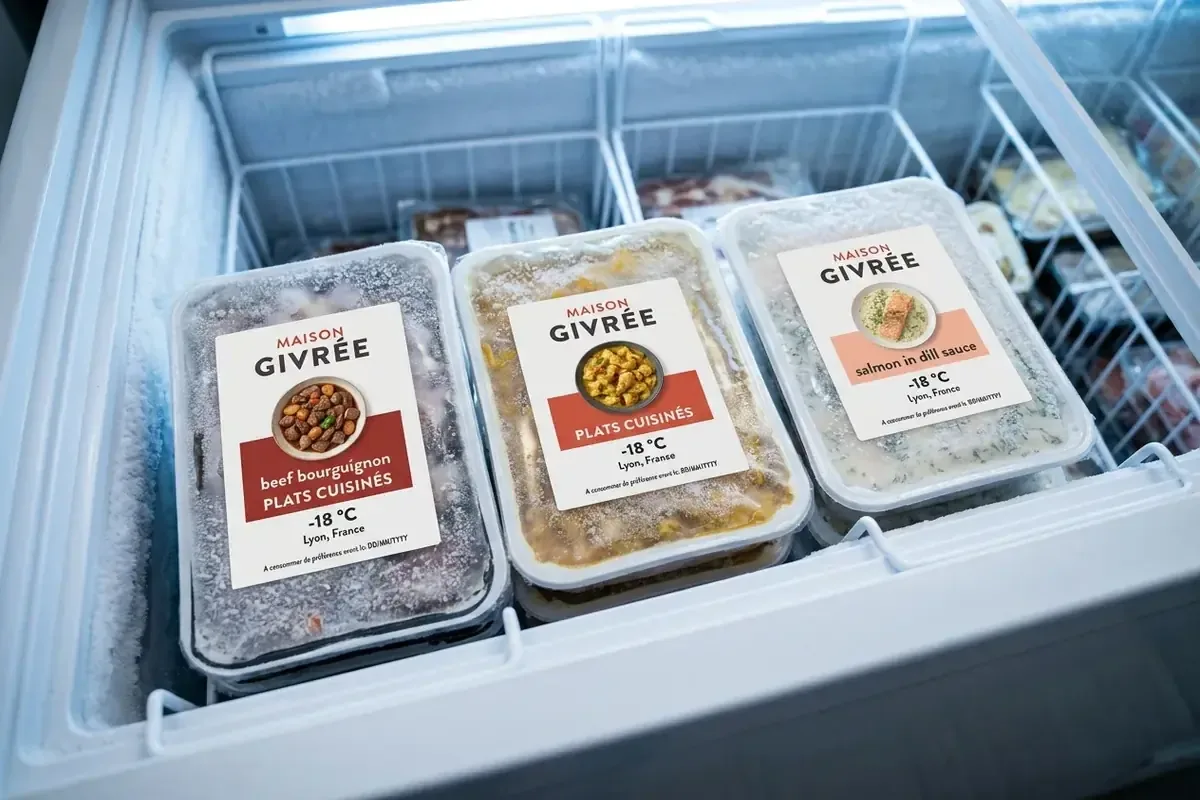
In 30 seconds
The 30-second answer: specify the coldest, wettest moment
A label survives the cold chain when its adhesive was chosen for the moment it is applied and its face material for the water it will meet. Six facts settle most cases:
- Two temperatures, not one. The minimum application temperature is the coldest surface the adhesive can still wet; the service temperature is what the bonded label then survives. A label rated to −40 °C in service can still fall off a pack labelled at +2 °C.
- Our freezer adhesives apply from about −20 °C and hold down to −40 °C. A standard permanent adhesive wants a dry surface at room temperature — it never really grabs a pack at 2 °C.
- Condensation is the hidden enemy. A pack taken out at −18 °C into a room at 20 °C and 60 % humidity stays wet until its surface passes about 12 °C, the dew point of that air.
- Water decides paper or film. Freezer coated paper suits dry, stable freezing; frost, blast freezing and packs that go in and out need a polyethylene or polypropylene film.
- The film is not a premium. A full-colour 75 × 50 mm freezer label costs £210 for 1 000 on freezer paper and £203 on freezer polyethylene film, excluding VAT.
- Heat is another specification. Steam, pasteurisation, regeneration and the oven are quoted on a custom request, with the temperature, the duration and whether the pack is wet or dry.
Two numbers on every specification
Application temperature or service temperature: which one matters?
Both, but the application temperature fails first. The application temperature is the lowest surface temperature at which the adhesive can still flow onto the pack and form a bond; the service temperature is the range a label that has already bonded will tolerate afterwards. A data sheet that gives only “−40 °C” almost always means service.
The reason is physical. A pressure-sensitive adhesive is a very thick liquid that must flow into the microscopic roughness of the pack. Cold stiffens it: below its application limit it touches without wetting, and the label lifts at a corner days later, usually in the display cabinet. Once bonded at the right temperature, the same adhesive tolerates far colder storage.
So the first question is not “how cold does it get?” but “how cold and how wet is the pack when the label touches it?”. Adhesives for every other use are compared in our guide to choosing a label adhesive.
Adhesives
Which adhesive for chilled, frozen and deep-freeze products?
Use a standard permanent adhesive for chilled products labelled warm and dry, a freezer adhesive as soon as the pack is cold or damp when labelled or stored frozen, and a cryogenic stock only for laboratory storage at −80 °C or in liquid nitrogen.
| Adhesive | Apply on | Holds in service | Typical use | Printed from, per 100 |
|---|---|---|---|---|
| Standard permanent | Dry surface, room temperature | Chilled, +2 to +8 °C | Dairy, fresh meals, drinks labelled before chilling | £164 on white PP |
| Freezer (deep-freeze) | Cold or slightly damp surface, from about −20 °C | Down to −40 °C | Frozen meals, ice cream, butcher and fish packs, blast freezing | £147 on PE film · £152 on paper |
| Cryogenic permanent | Room temperature, before immersion | Down to −196 °C | Vials, cryoboxes, sample libraries | £54 blank |
Prices read in our configurator on 9 November 2026, excluding VAT, smallest size step (up to 35 × 30 mm), full colour. The cryogenic stock is a blank roll for your printer; a printed run is quoted on request.
Why the freezer adhesive also suits chilled lines
Chilled is not always dry. A tray sealed hot and chilled in a tunnel, or a bottle filled cold in a humid hall, arrives at the labeller wet. The freezer adhesive, made to grab a cold, slightly damp surface, solves that case even if the product never sees −18 °C — the deep-freeze adhesive labels on polyethylene film start at £147 per 100, below most of the standard films.
- Material
- Freezer polyethylene film, white
- Finish
- Gloss varnish
- Adhesive
- Freezer, applies from about −20 °C
- Size
- Up to 75 × 50 mm
- Full colour
- Quantity
- 1 000 — £203 excl. VAT
An example, priced in the configurator. Quantities are not capped — we print from a hundred pieces to several million.
Water
Why do labels lift with condensation, and how do you stop it?
Condensation forms whenever the surface of a pack is colder than the dew point of the surrounding air: water then settles between the adhesive and the pack, and paper absorbs it. The cure is to label before the pack is cold, or to use a film with an adhesive made to bond on a damp surface.
Values calculated with the Magnus formula: a pack taken out of a freezer first frosts, then sweats until its surface passes the dew point of the room.
| Room | Air temperature | Relative humidity | Dew point |
|---|---|---|---|
| Chilled cutting room | 4 °C | 90 % | 2.5 °C |
| Cool packing hall | 12 °C | 80 % | 8.7 °C |
| Heated packing room | 20 °C | 60 % | 12.0 °C |
| Summer dock | 25 °C | 70 % | 19.1 °C |
| Hot, humid kitchen | 30 °C | 70 % | 23.9 °C |
Magnus formula, coefficients 17.625 and 243.04 °C. A bottle at 4 °C sweats in a hall at 20 °C and 60 %, not in a cutting room at 4 °C and 90 %.
Three ways out
Label warm, then chill or freeze. The adhesive wets a dry surface and has a few minutes to set before the cold arrives. It is the most reliable route and works with every adhesive.
Use a film, not paper. A polyethylene or polypropylene face does not absorb water; a paper face swells, wrinkles and lets the edge go. On drinks that sweat, the white polypropylene labels (from £164 per 100) are the usual answer; for a paper look, aquaproof (from £154) survives an ice bucket.
Use a freezer adhesive where the pack is already cold. It is formulated to grab through a light film of moisture — not through standing water or a layer of frost, which must be wiped off first.

The other end of the thermometer
Can a cold-chain label go through steam or into the oven?
Not by default: a freezer adhesive is chosen for cold, and steam, pasteurisation, regeneration or an oven are a separate heat requirement. When a pack sees both, the label is specified for both at once, on a custom request giving the temperature, the duration and whether the heat is wet or dry.
Cook-chill trays regenerated in a steam oven, vacuum bags cooked then frozen, jars pasteurised then chilled: steam brings heat and water together, which softens adhesives and soaks paper; dry oven heat attacks the film itself. Three practical rules:
- Label after the hot step whenever the line allows it — once the pack is cooled and wiped dry, before it goes into the chiller. The label then only has to survive the cold.
- Keep direct thermal paper away from heat. Its coating darkens with heat: that is how it prints, and it does not stop. A date printed on direct thermal paper turns grey or black in a steam oven.
- Separate washing from cooking. Our dishwasher-safe labels (white polypropylene, from £165 per 100) go through repeated washes and the microwave, not the oven. Returnable crates that must lose their label in the wash need the opposite: a wash-off label, from £185 per 100 for the caustic wash at 80 °C.
Anything that goes into an oven, a retort or an autoclave is quoted: describe the cycle in a custom request and we specify the film, the adhesive and the print together. Avoid metallised films and foil on anything that may go into a microwave.
Face materials
Paper, polypropylene, polyethylene or polyester in the cold?
Choose freezer coated paper for dry, stable freezing, polyethylene film where frost, moisture or a soft pack is involved, polypropylene for chilled bottles and tubs that sweat, and polyester for rigid crates and laboratory labels printed by thermal transfer. The cold rarely damages the face material itself; water and flexing do.
| Material | Strength in the cold | Watch out for | 75 × 50 mm, 100 | 1 000 | 10 000 |
|---|---|---|---|---|---|
| Freezer coated paper, freezer adhesive | Bright print, stable frozen storage | Absorbs melting frost and condensation | £183 | £210 | £505 |
| Freezer polyethylene film, gloss varnish | Softest film, follows bags and uneven packs, water-resistant | Less rigid on a flat dispenser edge | £174 | £203 | £512 |
| White polypropylene, gloss varnish | Waterproof, wraps a bottle, condensation | Standard adhesive: label it warm and dry | £177 | £204 | £507 |
| White polyester, overprintable | Rigid and stable, best surface for resin ribbons | Too stiff for tight curves and soft packs | £159 | £199 | £615 |
Polypropylene shown with the reinforced adhesive; polyester shown as the overprintable stock with a reinforced adhesive and no protection, so the date panel takes your printer.
At 1 000 labels the freezer polyethylene film costs less than the freezer paper, so moisture is never a reason to stay on paper; paper keeps its place on dry boxes going straight into a stable −18 °C store. The soft film also holds on bags and moulded trays that a rigid film would peel off.
Print and data
Inks, thermal transfer and the date panel in the cold
We print the fixed design in full colour and protect it with a varnish or a lamination; the data that changes every day — date, lot, weight — is added on your line, either on protected direct thermal paper or by thermal transfer with a resin or wax-resin ribbon on a film.
Direct thermal or thermal transfer?
Direct thermal needs no ribbon: the head darkens a coated paper. The protected grade handles the damp of a cold room and suits labels read within weeks — it is the paper of our direct thermal labels, blank from £53 per 100. It fears heat and long storage.
Thermal transfer melts ink from a ribbon. Wax-resin on paper or polypropylene resists scuffing and moderate moisture; resin on polypropylene or polyester resists alcohol wipes, −80 °C and condensation on thawing. A wax ribbon on a film smears under a thumb. The full comparison is in our guide direct thermal vs thermal transfer.
Blank or overprintable rolls?
Blank freezer rolls (freezer coated paper from £54 per 100, freezer polypropylene from £55) let your printer do the whole label. Overprintable rolls carry your brand in full colour with a panel left free for the date and the lot, from £153 per 100 on protected thermal paper.

What a frozen-food label has to carry
The daily data is not optional on frozen food. In the EU, Directive 89/108/EEC asks quick-frozen foods for the consumer to carry the words “quick-frozen”, the storage period and temperature or equipment, a batch reference and a message such as “do not refreeze after defrosting”; it also sets the product temperature at −18 °C or lower, with brief rises of no more than 3 °C in transport. Regulation (EU) No 1169/2011 adds a “Frozen on …” date for frozen meat, meat preparations and unprocessed fishery products (Annex III, point 6, and Annex X), and the word “defrosted” for food frozen before sale and sold thawed (Annex VI). Plan the panel for those mentions before the artwork is fixed; the wider rules are in our guide to EU food labelling and the INCO rules.
Decision table
Which label for which cold-chain environment?
Find the line that matches the coldest and wettest moment of your pack, not its average day. The right-hand column is the configurator’s starting price for 100 labels, full colour unless stated, excluding VAT.
| Environment | Main risk | Face material | Adhesive | Date and lot | From / 100 |
|---|---|---|---|---|---|
| Chilled +2 to +8 °C, labelled warm and dry | Light condensation in the cabinet | White polypropylene or coated paper | Standard permanent | Protected direct thermal | £164 (PP) |
| Chilled bottles and tubs that sweat | Water film, ice bucket | White polypropylene or aquaproof | Standard permanent, applied dry | Thermal transfer, wax-resin | £154 |
| Frozen −18 °C, labelled before freezing | Dry cold, long storage | Freezer coated paper | Freezer | Overprintable panel | £152 |
| Blast freezing, labelled cold or damp | Frost, moisture, door openings | Freezer polyethylene film | Freezer, from about −20 °C | Thermal transfer, resin or wax-resin | £147 |
| Deep-freeze storage −40 °C | Brittle adhesive, thaw cycles | Freezer polyethylene film | Freezer | Thermal transfer, resin | £147 |
| Laboratory −80 °C and liquid nitrogen −196 °C | Extreme cold, alcohol, condensation on thawing | Cryogenic polypropylene, blank | Cryogenic permanent | Thermal transfer, resin | £54 blank |
| Cooked, steamed or regenerated, then chilled | Heat and water together | Specified for the whole cycle on a custom request | quoted | ||
| Frozen, then washed (returnable crates) | Label must leave in the wash | Wash-off coated paper | Removable or wash-off, applied at room temperature | Direct thermal or thermal transfer | £185 |


Production takes 4 to 10 working days once the proof is approved; delivery is free in France and calculated by country elsewhere.
Before you order
Seven cold-chain labelling mistakes — and a checklist
Most cold-chain failures come from a specification written for the storage temperature instead of the labelling moment, and from a date printed with a method that does not suit the film. The seven we see most often:
- Reading only the service temperature on a data sheet, and applying the label to a pack that is colder than the adhesive’s application limit.
- Labelling a pack straight out of a chiller or a blast tunnel with a standard permanent adhesive.
- Keeping paper on packs that frost and thaw, because the film was assumed to cost more.
- Freezing the pack seconds after labelling, before the adhesive has had a few minutes to set.
- Printing dates with a wax ribbon on a film, or with direct thermal on a pack that goes into a steam oven.
- Varnishing over the date panel, so the overprint smears or does not take.
- Ordering a −196 °C stock for a −18 °C freezer: it is a blank roll for laboratory printers, not a full-colour product label.
- Product temperature at the moment of labelling, and whether the surface is dry, damp or frosted.
- Coldest storage temperature and number of freeze–thaw or door-opening cycles.
- Room temperature and humidity at the labeller — dew point checked.
- Any heat step: steam, pasteurisation, regeneration, oven, microwave, wash — with temperature and duration.
- Pack surface: film, carton, tray, glass, bag; flat or curved.
- Face material chosen for the water, adhesive chosen for the application temperature.
- Date, lot, “Frozen on …” and storage mentions planned in an unvarnished panel.
- Printing method and ribbon matched to the face material.
- A test pack labelled on the real line and stored through a full cycle before the long run.
FAQ
Cold-chain labels — what producers ask us
What is the difference between application temperature and service temperature?
The application temperature is the lowest surface temperature at which the adhesive can still wet the pack and form a bond. The service temperature is the range a bonded label then tolerates. Our freezer adhesives apply from about −20 °C and hold in service down to −40 °C, where a standard permanent adhesive needs a dry surface at room temperature.
Why do my labels fall off in the freezer?
Usually because they were applied to a pack that was already cold or wet. The adhesive froze before it could flow onto the surface, or a film of condensation sat between them. Label before freezing and let the label set for a few minutes, or use a freezer adhesive on polyethylene film, made to grab a cold, slightly damp surface.
Is paper or film better for frozen food labels?
Freezer coated paper works on dry packs stored at a stable −18 °C. Where there is frost, blast freezing, condensation or packs going in and out, a polyethylene film does not absorb the water and stays flat. At 1 000 labels of 75 × 50 mm, the film costs £203 and the freezer paper £210, excluding VAT.
Can freezer labels go in a steam oven or a microwave?
Not by default: freezer adhesives are chosen for cold. Our dishwasher-safe polypropylene labels go in the microwave but not the oven. For steam, pasteurisation, regeneration or the oven, send a custom request with the temperature, duration and whether the heat is wet or dry, and we specify the label for the whole cycle.
How do I print dates on freezer labels?
Order overprintable rolls, with your brand printed in full colour and a panel left free, or blank freezer rolls. Add the date and lot with protected direct thermal paper for short-life chilled products, or by thermal transfer — resin or wax-resin ribbon — on films and for frozen storage. Keep direct thermal away from heat.
What temperature must frozen food be kept at in the EU?
Directive 89/108/EEC requires quick-frozen foods to be kept at −18 °C or lower at all points in the product, with brief upward fluctuations of no more than 3 °C during transport and limited tolerances in local distribution and retail cabinets. The label must also carry a batch reference and a message such as “do not refreeze after defrosting”.
This guide is a practical summary written by a label manufacturer, not legal advice. Food labelling duties depend on your product and your market; check them with your food authority or your trade body.
Official texts: Council Directive 89/108/EEC on quick-frozen foodstuffs, Articles 5 and 8 — EUR-Lex · Regulation (EU) No 1169/2011 on food information to consumers, Annex III point 6, Annex VI and Annex X — EUR-Lex
Still unsure?
Ask the person who makes them
The guide covers the general case — your label lives on a real product. Describe it in two lines and a label specialist (not a bot) answers within 2 working hours.
All guides
Everything else we have written down
- Choosing your label material
- Choosing your label adhesive
- Bottle and jar label sizes
- EU food labelling — the INCO rules
- EU wine label rules
- Environmental claims and sorting labels
- Preparing print-ready files
- Variable data, explained
- Label material comparison chart
- EU vs UK labelling requirements
- What drives the price of a label
- Label glossary
- Direct thermal vs thermal transfer
- GS1 Digital Link and QR codes
- Barcode print quality and ISO 15416 grades
- GHS and CLP chemical labels, BS5609 included
- Printed packing tape vs labels, cost per parcel
- EU Battery Regulation labels and QR code
- Cold-chain labelling: freezer, fridge, steam — you are here
- Cosmetics labelling — Regulation 1223/2009
- Batch numbers, lot codes and expiry dates
- Label unwind direction and roll specs
Price your freezer labels
Freezer polyethylene film from £147 per 100, freezer coated paper from £152, a proof before production.