
Guides · updated 25 September 2026
GHS and CLP chemical labels: what the rules require, from pictograms to BS5609
The short answer: GHS is the UN model; it becomes law in the EU through the CLP Regulation — Regulation (EC) No 1272/2008 — and in Great Britain through GB CLP. A hazard label carries a fixed set of elements: product identifier, supplier, pictograms, signal word, hazard and precautionary statements, plus the nominal quantity when the product is sold to the public. Its minimum size follows the container, from 52 × 74 mm up to 3 litres to 148 × 210 mm above 500 litres, and from 1 January 2028 the EU adds minimum font sizes. BS 5609 is a different question: the marine standard for packages shipped by sea.
In 30 seconds
The 30-second answer: GHS is the model, CLP is the law, BS 5609 is the sea
A compliant chemical label answers three separate questions — which rulebook applies, what must be printed and at what size, and whether the label has to survive transport by sea. Six facts cover most cases:
- GHS is not a law. The UN model — 11th revised edition, 2025 — binds nobody until a legal text adopts it: CLP in the EU and Northern Ireland, GB CLP in England, Scotland and Wales.
- The content is fixed. Product identifier, supplier details, pictograms, signal word, hazard (H) and precautionary (P) statements, plus the nominal quantity for products sold to the general public.
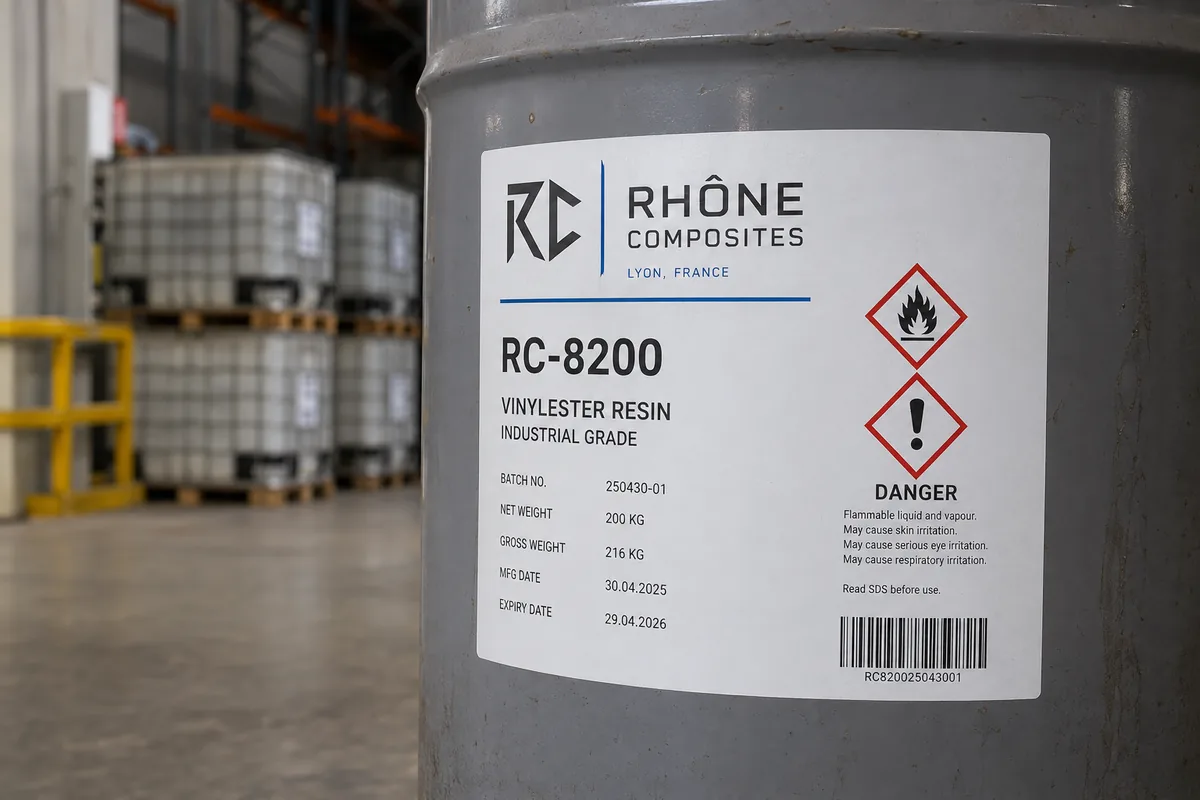
- The container sets the size. At least 52 × 74 mm up to 3 litres where possible, 74 × 105 mm up to 50 litres, 105 × 148 mm up to 500 litres, 148 × 210 mm above; each pictogram at least a fifteenth of that area and never under 1 cm².
- Formatting rules arrive in 2028. Minimum x-height from 1.2 to 2.0 mm, line spacing of at least 120 %, black text on white — postponed to 1 January 2028, and possibly relaxed for business-to-business supplies.
- Fold-out labels are a regular format since 1 July 2026, with a set layout for the front, inner and back pages.
- BS 5609 belongs to transport, not to CLP. The IMDG Code requires labels still identifiable after three months in the sea; BS 5609 is the British Standard used to test labels against that requirement.
Which rulebook
GHS, EU CLP or GB CLP: the market decides which rulebook applies
The rulebook depends on where the product is placed on the market: the EU and Northern Ireland apply EU CLP, Great Britain applies GB CLP, and both implement the same UN GHS model. The Globally Harmonized System is published by UNECE; its 11th revised edition appeared in 2025. As HSE puts it, GHS is a voluntary agreement that only becomes binding through a legal mechanism — the EU adds each GHS revision to CLP by delegated act, so the edition applied in a market can lag behind the latest UN text.
| Market | Legal text | Authority | What to watch |
|---|---|---|---|
| European Union (and EEA) | Regulation (EC) No 1272/2008 (CLP), amended by Regulation (EU) 2024/2865 | ECHA and national authorities | Formatting rules from 1 January 2028; label in the official language(s) of each country of sale |
| Northern Ireland | EU CLP, under the Windsor Framework | HSE Northern Ireland | Same label as for the EU |
| Great Britain | GB CLP — Regulation 1272/2008 as assimilated and amended for Great Britain | HSE | GB mandatory classifications (GB MCL list); EU amendments are not copied automatically |
| Transport by road, sea, air | Dangerous goods rules (at sea: the IMDG Code) | Transport authorities | CLP does not apply to transport (Article 1(6)), except the outer-packaging rules of Article 33 |
Out of scope too, under Article 1(5): medicinal products, cosmetic products and food in the finished state, intended for the final user. A finished cosmetic follows cosmetics law; the concentrated raw material delivered to its manufacturer is CLP-labelled.
CLP label requirements
The mandatory elements of a CLP label, block by block
Article 17 of CLP lists what a hazard label must carry, and your safety data sheet supplies the exact wording: a printer places the elements, it never decides them. The pictograms, signal word, hazard statements and precautionary statements must be located together (Article 32), so the hazard block is one zone of the label, not scattered around it.
| Element | Rule | Source of the wording |
|---|---|---|
| Product identifier | The same name as on the safety data sheet; for a mixture, the trade name plus the substances driving its health classification — four names as a rule (Article 18) | SDS, sections 1 and 3 |
| Supplier | Name, address and telephone number (Article 17(1)(a)) | Your company, or the importer |
| Nominal quantity | Only for products made available to the general public, unless shown elsewhere on the pack | The pack |
| Hazard pictograms | Black symbol on white, red frame, square set on a point; nine exist, GHS01 to GHS09; precedence removes duplicates — GHS06 excludes GHS07, for example (Article 26) | SDS, section 2 |
| Signal word | « Danger » or « Warning » — where Danger appears, Warning may not (Article 20) | SDS, section 2 |
| Hazard statements (H) | Every relevant statement, grouped by language | SDS, section 2 |
| Precautionary statements (P) | No more than six, unless the nature and severity of the hazards require more (Article 28) | SDS, section 2 |
| Supplemental information | EUH statements and elements required by other EU acts; the UFI poison-centre code where it applies | SDS and Annex VIII |
Language is what makes labels grow. The label must be written in the official language or languages of every country where the product is sold (Article 17(2)); more languages are allowed provided the same details appear in each. A mixture sold across six markets can carry six versions of its H and P statements — which is usually when a label outgrows its minimum size or becomes a fold-out.
What we do with it: we print exactly what is in your artwork, red-framed diamonds included, and place the pictograms on the proof for you to check. The classification and the statements stay yours. For the ready-made route, see our GHS and CLP chemical labels on solvent-resistant film.
CLP label size
CLP label and pictogram sizes by container volume
The minimum area for the hazard information is set by the capacity of the package, and each pictogram must cover at least one fifteenth of that area, never less than 1 cm² (Annex I, section 1.2.1). The revision keeps the label and pictogram dimensions and adds a minimum font size, applicable from 1 January 2028.
| Capacity of the package | Label area for the Article 17 information | Each pictogram | Minimum x-height from 1 Jan 2028 | Typical pack |
|---|---|---|---|---|
| Up to 0.5 litre | if possible 52 × 74 mm | not under 10 × 10 mm, if possible 16 × 16 mm | 1.2 mm | Vials, trigger sprays |
| 0.5 to 3 litres | if possible 52 × 74 mm | not under 10 × 10 mm, if possible 16 × 16 mm | 1.4 mm | 1 L bottles, 2.5 L cans |
| 3 to 50 litres | at least 74 × 105 mm | at least 23 × 23 mm | 1.8 mm | Jerricans, 20 to 25 L drums |
| 50 to 500 litres | at least 105 × 148 mm | at least 32 × 32 mm | 2.0 mm | 200 L drums |
| Above 500 litres | at least 148 × 210 mm | at least 46 × 46 mm | 2.0 mm | IBCs, tanks |
These are minimums for the zone carrying the hazard information, not for the whole pack. On inner packs of 10 ml or less, the font may be smaller where it is needed to fit the most critical statement, provided the outer packaging carries the full label.
What the numbers mean on a real label
The pictogram sizes are the one-fifteenth rule worked out: 74 × 105 mm is 7 770 mm², a fifteenth is 518 mm², a square of about 23 mm. The consequence is spatial. Three pictograms side by side take 69 mm of a 105 mm label before a single word is printed, and at a 1.8 mm x-height the type is around 10 points in a typical sans serif — so a 20-litre jerrican with two languages and eight statements rarely fits the minimum. Work out the text first, then pick the label size; the reverse order is how redesigns happen after the proof.
CLP revision
What Regulation (EU) 2024/2865 changes on the label — and when
The CLP revision entered into force on 10 December 2024, but its label formatting rules only become mandatory on 1 January 2028: Regulation (EU) 2025/2439 of 26 November 2025 postponed them, together with the new relabelling deadlines. Fold-out and digital labels kept their date of 1 July 2026.
| Change | What the text says | Applies from |
|---|---|---|
| Fold-out labels | Allowed as a regular format. Front page: supplier, nominal quantity (public), product identifier and signal words in every language used, pictograms, UFI where applicable, a pointer to the inside and the language codes. Inner pages: all Article 17 elements, grouped by language. Back page: repeats the front. | 1 July 2026 |
| Digital labels | Allowed in addition to the physical label, through a data carrier printed on the label or next to it; a limited list of elements, set out in Annex I section 1.6, may be given on the digital label only | 1 July 2026 |
| Minimum font size | x-height of 1.2 to 2.0 mm according to capacity (table above) | 1 January 2028 |
| Text formatting | Black on a white background; line spacing at least 120 % of the font size; a single, easily legible sans-serif font; letter spacing suited to that font | 1 January 2028 |
| Relabelling deadlines | 6 months after a new or more severe hazard is known, 18 months for other changes | 1 January 2028 |
Until 31 December 2027, labels may still follow the formatting rules as they stood on 9 December 2024 — and may apply the new ones early.
The June 2026 political deal
On 16 June 2026 the Parliament and the Council reached a provisional agreement on the Commission’s chemicals simplification package. According to the European Commission, it will eliminate obligatory font sizes on business-to-business shipments and strengthen legibility requirements for consumer products. It still has to be formally adopted and published in the Official Journal, which the Commission expects by the end of the year. Until then, the 2028 table is the law as written.
Our reading for a label printed now and still in use in 2028: design the hazard block to the table anyway. A product sold to consumers will keep the font rules in any version of the deal, and a white panel with black sans-serif text at 120 % spacing is simply more legible — a coloured band behind the H and P statements, common today, does not meet the black-on-white rule as written.
Great Britain
GB CLP after Brexit: the same structure, a separate rulebook
Since 1 January 2021, chemicals placed on the market in England, Scotland and Wales follow GB CLP — the EU regulation as assimilated and amended for Great Britain — with HSE as the agency; Northern Ireland stays under EU CLP. HSE describes GB CLP as Great Britain continuing to adopt GHS independently of the European Union, which has four practical consequences for a label:
- EU amendments are not copied across. The 2024/2865 formatting, fold-out and digital rules are EU law; they apply in Great Britain only if Great Britain legislates its own version.
- Classifications can drift. The harmonised EU classifications in force on 31 December 2020 became the GB mandatory classification and labelling list; new entries on either side are not mirrored automatically, so the same substance can end up with different statements.
- The supplier changes. A business in Great Britain that buys from the EU or EEA and places the product on the GB market is an importer under GB CLP, with the supplier duties that go with it.
- Less paperwork, same label. Since 21 May 2026, substances placed on the GB market no longer have to be notified to HSE — the labelling duties themselves are unchanged.
A single label for both markets is possible when the classification is identical under both lists and both suppliers appear on it. The wider picture — food, CE and UKCA, wine, green claims — is in our guide to EU vs UK labelling requirements.
BS5609 certified labels
BS 5609 and the IMDG Code: labels that have to survive the sea
For packages shipped by sea, the IMDG Code requires marks and labels that are still identifiable after at least three months’ immersion in the sea; BS 5609 is the British Standard that tests pressure-sensitive labels against that scenario. The Code states the result, not the method — which is why BS 5609 has become the usual evidence.
What the IMDG Code asks
Chapter 5.2 of the Code requires package marks and labels to remain identifiable on packages that survive at least three months’ immersion in the sea, taking into account the packaging material and its surface. Transport labels are diamonds of at least 100 × 100 mm, except on packages too small to bear them. Amendment 42-24 has been mandatory since 1 January 2026.
On a drum that carries both, CLP gives way where hazards overlap: on a single package bearing transport labels, a CLP pictogram for the same hazard need not appear (Article 33(3)); on combination packaging, the inner packs carry the CLP label and the outer box the transport marks.

What BS 5609 tests
BS 5609:1986 — listed by BSI as current and under review — covers printed pressure-sensitive labels for marine use in two parts: requirements for the adhesive-coated label base material, and requirements for the finished printed label. Across the two, it describes methods for resistance to marine immersion, weathering, temperature cycling and abrasion, for legibility and print key, and a recommended method for adhesion to specific substrates.
| Level | What is assessed | What to ask your supplier |
|---|---|---|
| Section 2 — base material | The face film with its adhesive, as a combination | The certificate for that exact film and adhesive, not for the film family |
| Section 3 — printed label | The printing — inks or thermal-transfer ribbon — applied on a Section 2 material | Evidence covering the print process actually used on your labels |
| Your drum | Adhesion depends on the substrate: steel, HDPE, lacquered or textured surfaces behave differently | A trial on your container, filled with your product |
A BS 5609 claim is only as good as its weakest link. A Section 2 film printed with an untested ink is not a Section 3 label, and a waterproof film is not a marine film: wet is not the same as three months in seawater. Where we stand: our catalogue films are chosen for solvents, water and handling, and we do not sell BS 5609 as a catalogue option. A marine requirement is a custom request — tell us the product, the container material, the route and the level of evidence you need, and we come back with a specification or with the reason we cannot meet it.
Materials
Choosing the film, adhesive and print for a chemical label
A hazard label needs a synthetic film — polypropylene, polyethylene or polyester — under a protective lamination or with a resin print; paper fails at the first run of solvent down the container. The choice then follows the container size and surface.
| Container | Stock | Sizes | From |
|---|---|---|---|
| Bottles, sprays and cans up to 3 L | White polypropylene, laminated | Standard sizes up to 100 × 105 mm | €196 |
| Squeezable bottles, jerricans | Protected white polyethylene, reinforced adhesive | Up to 100 × 105 mm | €199 |
| Drums, textured or low-energy plastics | Heavy-duty polyethylene, reinforced adhesive | Up to 100 × 105 mm | €249 |
| 200 L drums and IBCs — 105 × 148 and 148 × 210 mm | White polyester, from our synthetic films | Cut up to 150 × 220 mm | €173 |
| Pre-printed hazard block, batch data added in-house | Overprintable white polyester, bare panel | 23 sizes, 35 × 30 to 150 × 220 mm | €173 |
| Labels generated by your own system | Blank matt white polyester on rolls | Up to 100 × 70 mm | €68 |
Prices as shown on each product page on 25 September 2026; the configurator gives the exact figure for your size and quantity. Batch numbers and barcodes printed in the run add from €112 per run of 100 on the stocks that offer them — see numbered and barcode labels.
Three decisions that make or break it
Colour first. A CLP pictogram is a black symbol inside a red frame, so it needs at least two colours: a one-colour print cannot carry a compliant pictogram on its own.
Then adhesion. Drums, HDPE jerricans and powder-coated steel call for a reinforced adhesive; a squeezable bottle needs a film that flexes with it. Our adhesive guide explains the trade-offs.
Then protection. The lamination is what resists solvent and abrasion, and our configurator adds it automatically on synthetic films. The exception is the overprintable panel, which must stay bare: print it with a resin ribbon, the thermal-transfer print that stands up to solvents.
- Material
- Overprintable white polyester
- Size
- 148 × 210 mm
- Full colour, two languages
- Panel
- Bare, for batch and date
- Adhesive
- Reinforced
- Quantity
- 1 000 labels
A typical order, shown as an example. Quantities are not capped — we print from a hundred pieces to several million.


Production takes 4 to 10 working days after proof approval; delivery is quoted with the order. Fold-out and multi-layer labels are quoted on request — see the options and finishes.
Before the proof
Seven mistakes that make a hazard label non-compliant — and a checklist
Most non-compliant hazard labels fail on layout rather than content: a size chosen for the design instead of the container, a pictogram shrunk to fit, a hazard block split up or drowned in marketing. The seven we see most often:
- Sizing the label to the front panel of the design, not to the capacity of the container.
- Shrinking pictograms below a fifteenth of the minimum area — 16 mm diamonds on a 20-litre jerrican, where 23 mm is the floor.
- Printing pictograms in black only: under CLP the frame is red.
- Showing Danger and Warning together, or a GHS07 exclamation mark next to a GHS06 skull.
- Splitting the hazard block — pictograms on the front, statements on the back — on a label that is not a fold-out.
- Putting an unlaminated or paper label on a solvent container: the hazard information is the part that disappears first.
- Assuming a waterproof film is BS 5609 compliant. Water resistance and three months of marine immersion are two different tests.
- Container capacity confirmed, and with it the minimum label area.
- Each pictogram at least a fifteenth of that area, black symbol, red frame.
- One signal word; pictogram precedence rules applied.
- H and P statements match the current revision of the safety data sheet; six P statements at most unless justified.
- Every language of every destination market, with the same details in each.
- The supplier named is the right one for the market: EU-based for the EU, the GB supplier for Great Britain.
- If the label will still be in use in 2028: black text on white, one sans-serif font, line spacing of 120 % or more, x-height to the table.
- Film, adhesive and print tried on your container with your product.
- Sea freight: the BS 5609 level stated in the request, not assumed.
FAQ
GHS and CLP labels — what formulators ask us
Is a GHS label the same as a CLP label?
In the EU, yes in substance: CLP is the legal text that implements the UN GHS, so a CLP label is a GHS label with EU-specific rules on top — minimum sizes by container, languages, EUH statements, and from 2028 minimum font sizes. GHS itself is a model with no force of law; a label is checked against CLP in the EU and against GB CLP in Great Britain.
What size must a CLP label be on a 20-litre drum?
For a container of 3 to 50 litres, the area carrying the hazard information must be at least 74 × 105 mm and each pictogram at least 23 × 23 mm. From 1 January 2028 the text also needs an x-height of at least 1.8 mm. With several languages, the label usually has to be larger than this minimum.
When do the new CLP font size rules apply?
From 1 January 2028. Regulation (EU) 2024/2865 originally set 1 January 2027, and Regulation (EU) 2025/2439 moved it. A political agreement of June 2026 would remove mandatory font sizes for business-to-business shipments while keeping them for consumer products; it applies only once formally adopted and published in the Official Journal.
Do labels for Great Britain have to follow the 2024 EU changes?
Not automatically. Great Britain applies GB CLP, administered by HSE, and adopts GHS independently of the EU; EU amendments such as Regulation 2024/2865 become GB rules only if Great Britain legislates its own version. Northern Ireland follows EU CLP.
Are your labels BS 5609 certified?
BS 5609 is not a catalogue option. The standard covers the film with its adhesive and the printed label as a system, so we treat it as a custom request: send the product, the container, the route and the level of evidence you need, and we answer with a specification — or with the reason we cannot meet it.
Can each label carry its own batch number?
Yes. Batch numbers, filling dates and barcodes can be printed label by label in the same run, from €112 per run of 100 on the stocks that offer it. Alternatively, an overprintable polyester label keeps a bare panel so that you add the batch data on site with a thermal-transfer printer and a resin ribbon.
Can I use a fold-out label for several languages?
Yes: since 1 July 2026, CLP allows fold-out labels as a regular format, with a set layout — supplier, pictograms, product identifier and signal words on the front, all label elements by language inside, the front repeated on the back. Multi-layer labels are quoted on request.
This guide is a practical summary written by a label manufacturer, not legal advice. The classification and the wording of every statement come from your safety data sheet; check the current texts and your national authority before printing.
Official texts: Regulation (EC) No 1272/2008 (CLP) — EUR-Lex · Regulation (EU) 2024/2865 amending CLP — EUR-Lex · Regulation (EU) 2025/2439 (dates of application) — EUR-Lex · Political agreement on the chemicals simplification package, 16 June 2026 — European Commission · CLP in Great Britain or Northern Ireland — HSE · The GB CLP Regulation — HSE · GHS, 11th revised edition (2025) — UNECE · BS 5609:1986 — BSI · IMDG Code — International Maritime Organization
Still unsure?
Ask the person who makes them
The guide covers the general case — your label lives on a real product. Describe it in two lines and a label specialist (not a bot) answers within 2 working hours.
All guides
Everything else we have written down
- Choosing your label material
- Choosing your label adhesive
- Bottle and jar label sizes
- EU food labelling — the INCO rules
- EU wine label rules
- Environmental claims and sorting labels
- Preparing print-ready files
- Variable data, explained
- Label material comparison chart
- EU vs UK labelling requirements
- What drives the price of a label
- Label glossary
- Direct thermal vs thermal transfer
- GS1 Digital Link and QR codes
- Barcode print quality and ISO 15416 grades
- GHS and CLP chemical labels, BS5609 included — you are here
Hazard labels sized to the container
Synthetic films from €173 per 100, batch numbers in the same run, a proof before production.