
Guides · updated 15 July 2026
Five questions, and the material chooses itself
The short answer: almost every label decision comes down to five questions — does it meet water, does it meet cold, does it touch food, does it have to sell the product, and who prints it. Answer them in that order and the nine families we hold reduce to one or two. Prices below are our real starting prices for 100 printed labels.
Question 1
Does it meet water — and how?
This one question eliminates half the catalogue, so it comes first. But « waterproof » is three different problems and the answers are not interchangeable:
- Condensation — a bottle out of a fridge, a jar in a cellar. A coated paper survives it if it is laminated; an uncoated creative paper does not.
- Splashing and wiping — a bathroom, a kitchen, a workshop bench. Here you change material: white polypropylene from £166, or polyethylene for a pack that flexes.
- Immersion or wash-down — an ice bucket, a returnable bottle, a hosed floor. Polypropylene or polyester, and an adhesive chosen for wet application. A wet-strength paper at £156 keeps a paper look through an ice bucket, which is why wine and beer use it.
⚠️ The trap: a lamination does not waterproof a label. It protects the printed face; the edges and the paper behind still drink. If the label is genuinely wet, change the material, not the finish.
- Condensation
- laminated coated paper £163
- Ice bucket
- wet-strength paper £156
- Splash, wiping
- white polypropylene £166
- Squeezed packs
- matt polyethylene £165
- Wash-down
- white polyester £147
- Per 100 labels
- excluding VAT
Question 2
Does it meet cold — and is it cold when you apply it?
Cold rarely damages the material. It stops the adhesive working, and it does so at the moment of application: an adhesive that grabs at 20 °C may never grab at 2 °C, and then the label lifts three days later in the customer's freezer.
Chilled, applied warm
Nothing special is needed. Label the pack before it goes into the cold room and any standard permanent adhesive holds.
Applied cold or damp
A deep-freeze adhesive, which is designed to bond onto a surface already at temperature — freezer film from £149.
Below −40 °C
Laboratory territory: a cryogenic polypropylene rated to −196 °C, supplied blank at £55 per 100 for your own printer.
Full detail on freezer and deep-freeze labels, including the storage-condition table.
Question 3
Does the label touch the food itself?
Not « is it a food product » — does the adhesive side touch what will be eaten. The two cases are priced very differently and confusing them is the most expensive mistake on this page.
On the packaging — a jar, a pot, a wrapped bar, a carton. Any material works and you start at £116 per 100 on coated paper. This is the vast majority of food labels.
On the food — a label stuck to a cheese rind, a fruit, an unwrapped bakery item. That needs a certified food-contact stock supplied with its documentation: food-contact white polyester at £221 per 100. It is the only range we sell that comes with paperwork.
In between sits the greaseproof family — greaseproof Tintoretto at £169 — for anything oily enough to bleed through an ordinary paper, from cheese to soap.
- On the packaging
- coated paper £116
- Oily products
- greaseproof £169
- Frozen packs
- freezer paper £154
- Direct contact
- certified polyester £221
- Documentation
- with the certified range only
Question 4
Does the label have to sell the product, or only identify it?
If a customer picks the product up and decides, the material is doing part of the selling — and this is the only place where paying more is obviously worth it. If the label is read by a scanner, a warehouse or an inspector, spend nothing here.
| You want | Material | From / 100 |
|---|---|---|
| Natural, artisanal | Natural kraft, laid paper | £174 |
| Texture under the finger | Tintoretto, grooved | £174 |
| A soft shimmer | Pearlescent | £153 |
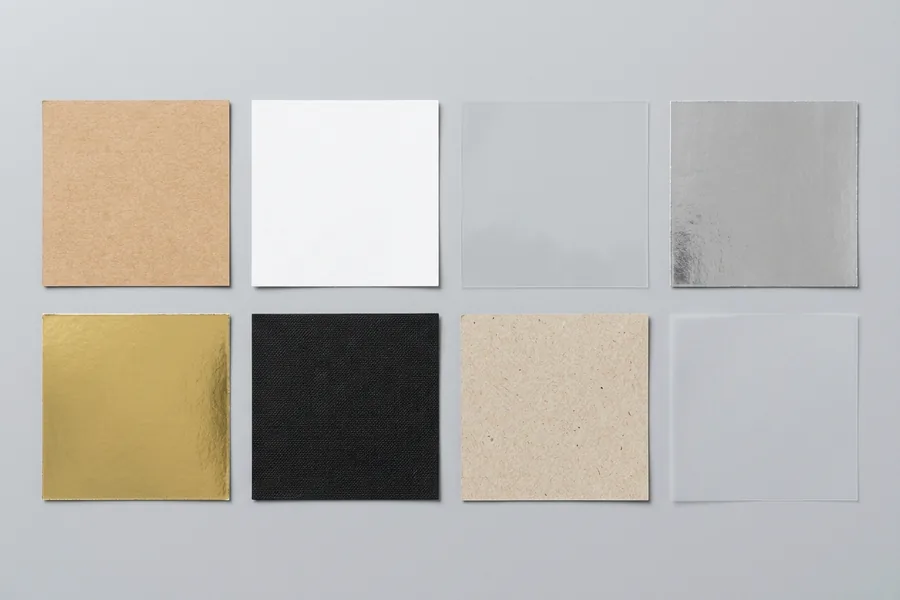
| Depth and contrast | Deep black, gold foil included | £143 |
| Metal that shines through the ink | Foil-effect paper | £182 |
| No visible label at all | Clear polyester | £196 |
| Only to be scanned | Coated paper | £116 |
💡 Counter-intuitive but true: gold foil on deep black paper costs less than four-colour printing — £143 against £157 — because there the foil replaces the printing instead of being added to it.
Question 5
Who prints it — us, you, or both?
The answer changes the price by a factor of four, and most people never ask it.
We print everything — from £116 per 100. The label leaves finished, data included if you send us a list.
You print everything — blank rolls from £37 per 100, every stock, from ordinary coated paper to cryogenic and VOID films. The comparison chart lines all of them up in one table. Right when the content changes constantly and nobody needs colour. Your printer becomes the limit: a film needs a ribbon, a thermal paper needs none.
Both — overprintable rolls from £155: we print the design in full colour and leave a panel bare for the date and the lot you add as you pack. The middle road for anyone whose in-house printer is monochrome.
- You print all
- £37 — blank roll
- We print all
- £116 — finished label
- Split
- £155 — overprintable
- Numbering by us
- from + £95 per run
The map
Nine families, and what each one is really for
| Family | Take it when | From / 100 |
|---|---|---|
| Coated paper | The label is read, not admired. The default, and the cheapest printed route. | £116 |
| Creative papers | The customer touches the product before buying. Texture, kraft, pearlescent, deep black. | £143 |
| Eco-friendly | You can substantiate the claim. Sugarcane, recycled, stone, grass, compostable films. | £144 |
| Synthetic & waterproof | Water, tearing or a flexible pack. Polypropylene, polyethylene, polyester. | £147 |
| Metallic | You want metal, not a metallic-looking ink. Silver and gold stocks, metallised films. | £119 |
| Functional | The label has a job: freezer, greaseproof, thermal, washable, double-sided, blockout. | £144 |
| Industrial & security | It must last twenty years — or destroy itself when someone lifts it. | £137 |
| Blank rolls | You print it — no printing from us at all. | £37 |
| Overprintable rolls | We print the brand, you print the date. | £155 |
Every figure is the real minimum for 100 labels in that family, excluding VAT and variable data. The configurator prices your exact size and quantity in a few clicks.
The constraint people discover last
The maximum size depends on the material — from 95 mm to 350 mm
There is no single « maximum label size » on this site, and assuming one is how artwork gets redrawn. Each family has its own ceiling, and they differ by a factor of three:
- Security films stop at 95 × 105 mm — the smallest ceiling we have.
- Coated papers, eco, metallic and industrial stop at 100 × 105 mm. An A6 label at 105 × 148 mm does not exist in paper.
- Creative papers reach 150 × 105 mm.
- Synthetics reach 150 × 220 mm — which is where A5 becomes possible.
- Clear polyester and PVC reach 300 × 350 mm, the largest die we cut.
- Blank rolls stop at 100 × 70 mm, whatever the stock.
The smallest is 15 × 10 mm, on the 3D doming range, and 15 × 20 mm on the industrial films. If your design is bigger than your family allows, the honest options are to change material or to go to stickers, which run to A3 — or, for a shop window, to window graphics, sold by the piece and produced well beyond any of these figures.
- Security
- 95 × 105 mm
- Paper, eco, metallic
- 100 × 105 mm
- Creative
- 150 × 105 mm
- Synthetic
- 150 × 220 mm
- Clear films
- 300 × 350 mm
- Blank rolls
- 100 × 70 mm
- Smallest of all
- 15 × 10 mm
FAQ
Choosing a material — what customers ask us
If I only remember one thing, what should it be?
That a lamination does not make a label waterproof. It protects the printed face; the edges and the paper behind still absorb water. If the label is genuinely wet — an ice bucket, a fridge, a bathroom — you change the material, not the finish. That single confusion causes more failed labels than every other mistake put together.
What is the cheapest material?
Printed, coated paper at £116 per 100 — and one or two colours rather than four is what makes it that price. Unprinted, a blank satin coated roll at £37 per 100. If a run is genuinely tight, the saving is almost never in the material: it is in the number of colours, the finish, and whether you print it yourself.
How do I know which material suits my product?
Tell us the product and the conditions on the custom request form and we will tell you which two or three stocks are candidates, with their prices. For anything unusual — a curved pack, a cold application, a solvent — describe the surface: it decides more than the material does.
Which material should I take if I really cannot choose?
For a product on a shelf, coated paper with a gloss lamination at £163 per 100 fails in almost no situation. For anything damp, white polypropylene at £166. Those two cover most of what leaves this factory, and both are priced in the configurator in under a minute.
Does the material change the printing quality?
Yes, and predictably. A coated paper and a white film give the sharpest colour. A textured or uncoated paper softens everything printed on it — kraft turns every colour browner, which is either the effect you want or the one that ruins your logo. On a transparent film, white has to be printed as a colour or it disappears.
Still unsure?
Ask the person who makes them
The guide covers the general case — your label lives on a real product. Describe it in two lines and a label specialist (not a bot) answers within 2 working hours.
All guides
Everything else we have written down
- Choosing your label material — you are here
- Choosing your label adhesive
- Bottle and jar label sizes
- EU food labelling — the INCO rules
- EU wine label rules
- Environmental claims and sorting labels
- Preparing print-ready files
- Variable data, explained
- Label material comparison chart
- EU vs UK labelling requirements
- What drives the price of a label
- Label glossary
- Direct thermal vs thermal transfer
- GS1 Digital Link and QR codes
- Barcode print quality and ISO 15416 grades
- GHS and CLP chemical labels, BS5609 included
- Printed packing tape vs labels, cost per parcel
Five questions answered? Price it.
Every stock in the configurator, real prices, no account needed.